

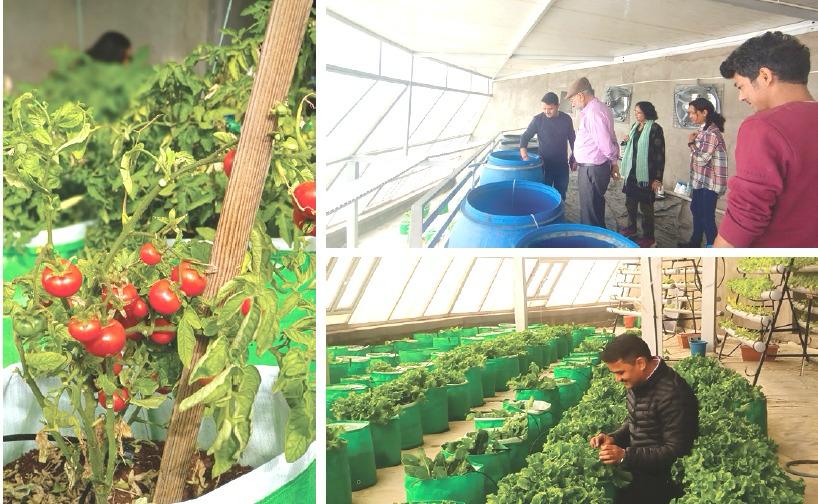
LEH: In a landmark step towards sustainable agriculture and circular resource management in the cold-arid Trans-Himalayan region, scientists in Ladakh have successfully demonstrated a Faecal Sludge Treatment Model integrated with solar-powered hydroponic farming, offering a climate-resilient solution to the region’s growing water scarcity and food security challenges.
Ladakh faces severe limitations of water availability due to its harsh, dry climate, coupled with increasing urbanisation and tourism that have significantly raised wastewater generation and groundwater extraction.
To address these challenges, a pioneering pilot project was launched by the G.B. Pant National Institute of Himalayan Environment (GBP-NIHE), Ladakh Regional Centre, in collaboration with the Municipal Committee Leh (MCL) and the Ladakh Ecological Development Group (LEDeG).
Under this initiative, treated wastewater from a Faecal Sludge Treatment Plant (FSTP) was reused through a solar-powered hydroponic system set up inside a polycarbonate greenhouse. The innovative system reused nearly 15,000 litres of treated wastewater every month for growing vegetables such as tomatoes and cucumbers, marking a major breakthrough in sustainable cultivation practices in the Trans-Himalayan region.
The project, led by scientists Lalit Giri and Sandipan Mukherjee of GBP-NIHE, signals a transformative pathway towards sustainable, water-efficient and climate-resilient agriculture in one of India’s most ecologically sensitive regions.
Scientific evaluation of the pilot revealed remarkable results. Tomatoes grown using treated wastewater significantly outperformed those grown in conventional soil in terms of biomass, chlorophyll and beta-carotene content. Nutritional analysis also showed higher levels of carbohydrates, proteins, fats, ash content and total energy value in hydroponically grown produce. Importantly, heavy metal testing confirmed that the harvested vegetables contained no harmful residues of lead, cadmium, chromium or copper, validating their safety for human consumption.
The system proved highly viable under Ladakh’s extreme cold-arid conditions and demonstrated strong potential for enabling year-round vegetable production in the region. In recognition of its novelty, the innovation has been granted a patent titled “A System for Hydroponic Cultivation Using Treated Wastewater from FSTPs.”
The project aligns closely with national priorities such as doubling farmers’ income, promoting climate-resilient agriculture, strengthening urban–rural sustainability linkages and advancing wastewater reuse as envisioned under the Jal Shakti Abhiyan, GOBARdhan Scheme and Namami Gange Mission. Experts believe the model offers a replicable framework for other Indian Himalayan Region (IHR) states.
Looking ahead, researchers have recommended establishing long-term monitoring systems and safety standards for treated wastewater reuse in high-altitude farming. Plans are also being explored to scale up solar-powered community hydroponic clusters integrated with livelihood and horticulture missions, and to promote public–private partnerships for decentralised wastewater reuse and circular resource management across Ladakh and the Trans-Himalayan belt.
