

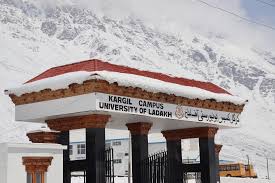
Kargil, Apr 14: In a reflective gathering that blended historical recall with contemporary relevance, the Kargil Campus of the University of Ladakh, in collaboration with Yuva Bharat, hosted a special lecture and documentary screening to commemorate the 107th Remembrance Day of the Jallianwala Bagh Massacre and the 135th birth anniversary of B. R. Ambedkar on Monday.
The programme unfolded as a measured tribute to history’s enduring voices while also echoing a deeper, unspoken commitment — to honour those who chronicled such moments and to extend solidarity to the families of journalists who are no longer alive, whose contributions often fade quietly into the margins of public memory.
The opening session revisited the tragic events of April 1919, with Dr. Gupta presenting a detailed account of the circumstances that culminated in the massacre. His narration traced the sequence of political unrest and colonial repression, offering the audience a stark reminder of the cost at which civil liberties were forged. A short documentary clip further reinforced the gravity of the episode, drawing the audience into a moment of collective silence.
Adding a literary dimension to the remembrance, Ms. Farzana Batool, a student of Political Science, recited a translated version of a poem originally penned by Nanak Singh. The verses, layered with grief and resistance, served as a bridge between lived history and its artistic interpretation.
The second session turned its focus to the intellectual and social legacy of Dr. Ambedkar. Dr. Ghulam Murtaza, Coordinator and Assistant Professor, Department of Political Science, delivered a lecture that examined Ambedkar’s enduring relevance in shaping a more equitable society. He underscored the architect of the Constitution’s emphasis on social mobility, equality, and institutional reform, positioning his ideas as both historical and urgently contemporary.
The event was attended by Dr. Mehboob Ali, In-charge Administration of the Kargil Campus, who reflected on the lasting imprint of the Jallianwala Bagh tragedy on India’s freedom movement. He also highlighted Ambedkar’s role in uplifting marginalised communities through a vision rooted in justice and dignity.
Proceedings were moderated by Dr. Vinit Vishal of the Department of Mass Communication and Journalism and Dr. Punam Kumari of Sociology, ensuring a seamless transition between sessions. The programme concluded with a formal vote of thanks by Dr. Shriprakash Pal.
Beyond its academic contours, the event carried a quiet resonance — a reminder that history is not merely preserved in textbooks or lectures, but also in the work of journalists who document truth, often at personal cost. As institutions continue to revisit defining chapters of the past, there remains a shared responsibility to honour those voices and to stand by the families they leave behind.
