

Jammu’s contributions can’t be overlooked anymore
Words spoken by those in power corridors carry weight and impact. When Jammu and Kashmir Deputy Chief Minister Surinder Choudhary recently said that statehood was a “gift” from former Chief Minister Sheikh Mohammad Abdullah, the statement drew attention not because of political rivalry, but because of what it overlooked.
Dy CM must understand that history is not shaped by slogans, and statehood is not something that can be gifted by one leader to an entire region.
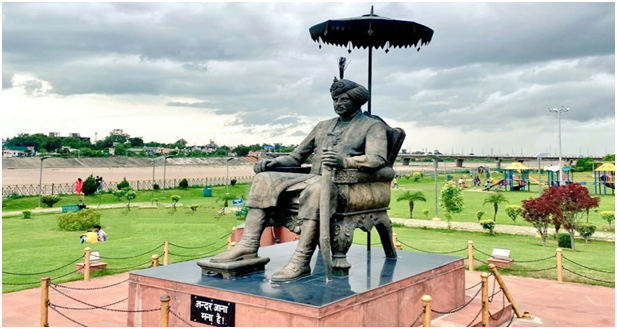
There is not an iota of doubt that the princely state of Jammu and Kashmir existed long before modern political leadership came into being. It was formally established in 1846 by Maharaja Gulab Singh under the Treaty of Amritsar. The state had clearly defined borders and a functioning administration that stretched from Jammu to Kashmir, from Ladakh to Baltistan, and up to the Tibetan frontier. This historical fact is well documented and widely accepted beyond doubt.
For more than a century, the Dogra rulers governed the princely state. Maharaja Ranbir Singh strengthened institutions, Maharaja Pratap Singh introduced administrative reforms, and Maharaja Hari Singh ruled during the most critical period in the state’s history. It was Maharaja Hari Singh who signed the ‘Instrument of Accession’ with the Union of India in 1947, legally integrating Jammu and Kashmir with India. Without this decision, the present political status of the region would not exist.
There is no doubt that the National Conference’s founder Sheikh Mohammad Abdullah played an important role in the political history of Jammu and Kashmir, particularly in the Kashmir Valley. He led mass movements, raised issues of governance, and contributed to the evolution of democratic politics. His contribution deserves recognition. However, acknowledging his role does not require rewriting history. The state did not come into existence because of Sheikh Abdullah; rather, his political career developed within an already established princely state.
Calling statehood a ‘gift’ creates confusion and distorts history. It suggests that centuries of governance, territorial consolidation, and political struggle can be reduced to the actions of a single leader. Such a narrative overlooks the contributions of Jammu, which gave the region its founding rulers, and Ladakh and frontier areas, which were integral to the state’s strategic and cultural identity.
This kind of statement also reinforces a long-standing problem in the region’s politics—a tendency to view history only through the lens of the Kashmir Valley. Jammu, Kathua, Doda, Kishtwar, Mirpur, Gilgit, and Baltistan were not passive spectators in history. They were active parts of the princely state and deserve equal acknowledgment in any honest historical discussion.
Criticism of the Dogra rulers, like criticism of any monarchy, is valid and necessary in a democratic society. But denying their role in creating and governing the state crosses the line from critique into distortion. History allows for debate, but it does not allow erasure.
For Deputy Chief Minister representing Jammu, such statements are particularly sensitive. Jammu’s people do not seek political validation through historical exaggeration. They seek recognition of
facts. The history of Jammu and Kashmir is complex, layered, and shared across regions. Reducing it to a single narrative does injustice to that complexity.
Statehood was not a gift handed over by any one individual. It was the result of treaties, administration, political decisions, and historical circumstances that unfolded over decades. Respecting that history is not about political positioning—it is about honesty.
As Jammu and Kashmir moves forward, its leaders would do well to speak with care and responsibility.
A truthful understanding of the past is essential for building trust in the present and unity in the future. History, after all, belongs to everyone and not just to those who speak the loudest.
Statehood is not a gift: Remembering the real history of Jammu & Kashmir
Previous ArticleGlobal Media and Leaders Hail India–EU FTA
