

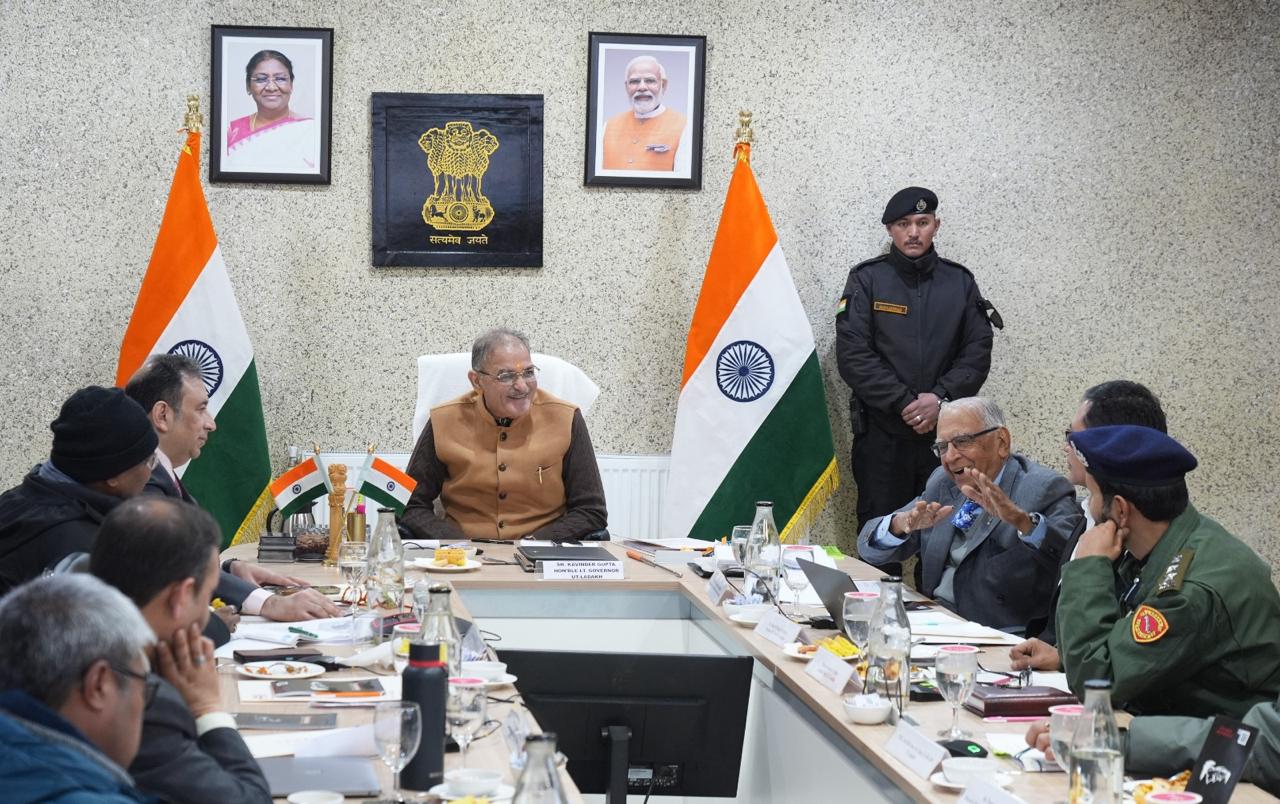
Leh, Jan 30 : Amid growing concerns over overlapping jurisdictions, operational constraints, and ecological priorities, the proposed rationalisation of boundaries of the Karakoram (Nubra–Shayok) Wildlife Sanctuary and the High Altitude Cold Desert (Changthang) Wildlife Sanctuary came under detailed scrutiny at the 15th meeting of the State Board for Wildlife chaired by the Hon’ble Lieutenant Governor of Ladakh, Kavinder Gupta, on Thursday.
Presiding over the meeting at the Lieutenant Governor’s Secretariat in Leh, the Lt Governor made it clear that national security considerations would prevail in the final decision-making process related to sanctuary boundary revisions. He called for a pragmatic and evidence-based approach that balances defence requirements, conservation imperatives, and the socio-economic needs of local communities.
The meeting deliberated extensively on proposals presented by Wildlife Warden Mandeep Mittal, who outlined inconsistencies in the original 1987 notifications governing the boundaries of the Karakoram and Changthang wildlife sanctuaries, as well as Hemis National Park. The Board was informed that these discrepancies have led to ambiguity on the ground, affecting administration, development planning, and wildlife management.
Additional Principal Chief Conservator of Forests, S. Rajesh, briefed the Board on the mandate of the department and ongoing conservation measures. His presentation covered wildlife rescue and rehabilitation operations conducted between April and December 2025, steps taken to mitigate human-wildlife conflict, field-based studies, issuance of protection advisories, and participation in meetings of the Standing Committee of the National Board for Wildlife for project approvals.
Officials apprised the Lt Governor that, following the creation of the Union Territory, a systematic review of sanctuary boundaries was initiated, with technical assessments carried out by the Wildlife Institute of India. The assessments flagged that existing proposals, if implemented without revision, could bring a substantial portion of Ladakh’s landmass under protected areas, posing challenges for infrastructure development, governance, and security operations.
During the discussions, concerns raised by the Army, paramilitary forces, Ladakh Police, and local communities were examined in detail. The Lt Governor acknowledged the Army’s continued commitment to wildlife conservation but stressed that strategic and operational zones, particularly along sensitive border regions, cannot be included within protected areas. Issues related to development initiatives and administrative restructuring were also taken on record.
Wildlife expert Dr M.K. Ranjitsinh emphasised Ladakh’s ecological value and called for the identification of well-defined core conservation zones supported by seasonal wildlife corridors. He underscored the importance of excluding areas essential for national security and community livelihoods, a view echoed by other experts and senior officials who advocated for a scientific and rational boundary realignment.
Concluding the meeting, the Lt Governor stated that national security would be the overriding factor in finalising sanctuary boundaries. He directed the immediate formation of a committee, under the supervision of the Chief Secretary and with representation from local communities, to delineate core wildlife areas while excluding Army settlements and essential habitations. The committee has been asked to submit its report within four months.
He further instructed the Wildlife Department and the Army to conduct joint sensitisation programmes aimed at strengthening conservation efforts for endangered species and ensuring coordinated action on the ground.
Senior officers, wildlife experts, and representatives from research institutions attended the meeting both physically and through virtual mode.
