

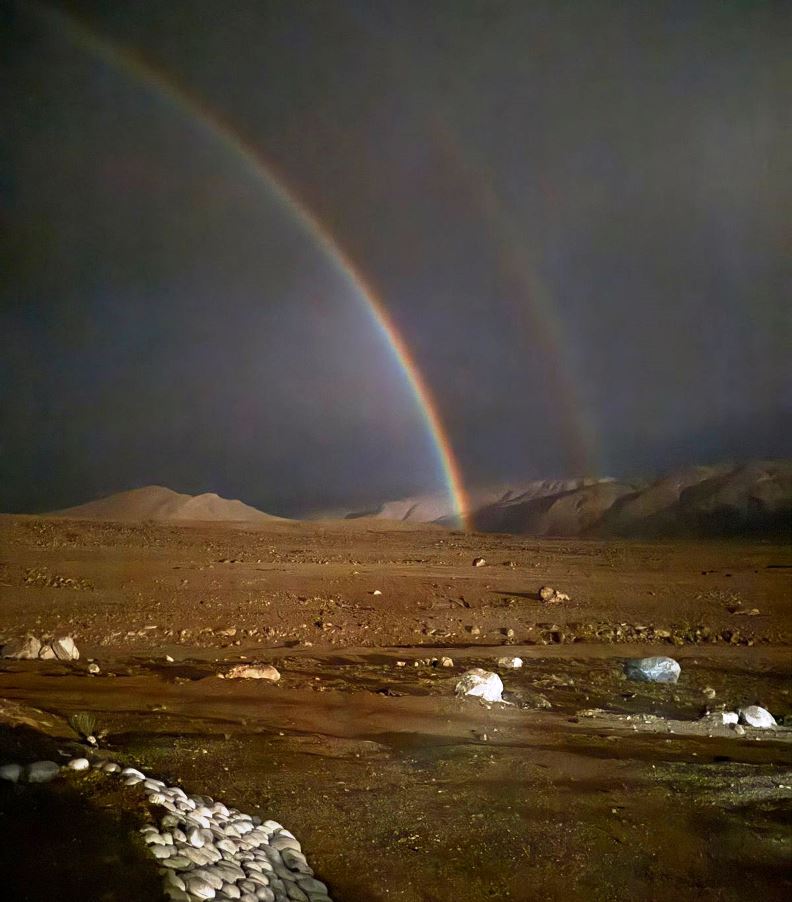
Leh, Aug 01: India’s space program soared to new heights as Indian Space Research Organisation (ISRO) launched its first analogue mission, the Himalayan Outpost for Planetary Exploration (Hope), in Ladakh’s rugged Tso Kar at 14,000 feet.
Simulating lunar conditions, the mission tests tech and human resilience for future space exploration. Featuring Hab-1, an inflatable habitat with hydroponics, sanitation, and a self-sustaining kitchen, it houses two analogue astronauts—a planetary science graduate and a PhD researcher—for ten days of isolation.
Selected from 135 applicants, they face the psychological and physical challenges of a Moon mission. India aims to send astronauts to space by 2027 and to the Moon by 2040, marking a bold step toward its cosmic ambitions.
These analogue astronauts a planetary science graduate and a PhD researcher, were chosen to simulate the psychological and physiological stresses of a real Moon mission.
Ladakh was selected due to its extreme isolation, high-altitude terrain, and lunar-like geology, providing an environment where oxygen levels are just 40% of those found at sea level.
Ladakh has unique geological characteristics that closely resemble Martian and lunar landscapes. Its cold, arid conditions and high altitude provide an ideal environment for testing technologies and strategies necessary for long-duration space missions.
These conditions allow for detailed examination of how life support systems, habitats, and protocols perform under the intense pressures of space-like isolation and scarcity.
Analogue missions are a globally recognised method for field-testing everything from astronaut health monitoring and emergency drills to robotics and communications in challenging conditions.
The Ladakh mission, part of Isro’s preparations for its upcoming Gaganyaan human spaceflight as well as longer lunar ambitions, involves diverse partners, including IIT Bombay, the University of Ladakh, and private collaborators such as Protoplanet.
The data collected will help researchers optimise crew health, adapt technologies for the lunar surface, and better understand how human teams operate cut off from the world for extended periods. It also demonstrates India’s growing capability and scientific leadership as the nation pursues its goal of establishing a permanent human presence on the Moon and, eventually, other planets.
