

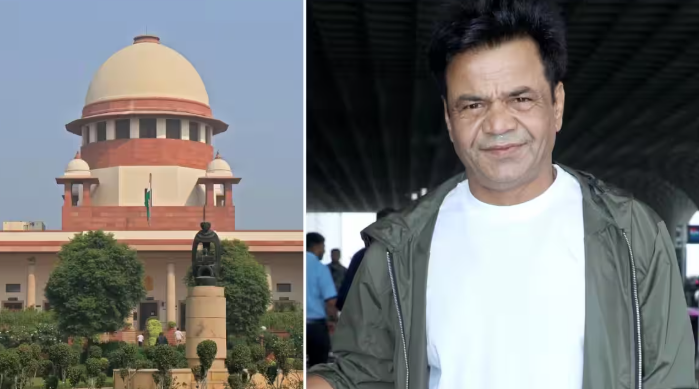
NEW DELHI, Oct 7: The Supreme Court on Tuesday advised actor Rajpal Yadav to make a good film and return to entertaining audiences as a way of rebuilding his public image, while taking note of his payment of Rs 1.15 crore in a long-running series of cheque-bounce cases.
A bench comprising Chief Justice Surya Kant and Justices Joymalya Bagchi and V Mohana noted that Yadav had deposited Rs 1.15 crore in compliance with the court’s previous order.
The court was also informed by Yadav’s counsel that a prospective buyer had been found for one of his properties and was willing to deposit Rs 85 lakh through a demand draft with the Supreme Court Registry by October 12.
During the hearing, the bench said it was not satisfied with Yadav’s conduct but was giving him some additional time to comply with the proceedings.
Yadav, who appeared personally before the court, attributed his financial difficulties to losses incurred from his directorial film Ata Pata Laapata.
“Over the last 13 years, I have also incurred losses amounting to Rs 200-250 crore. I suffered a loss with Ata Pata Laapata. Rs 17 crore went down the drain,” Yadav told the court.
He also said the film, which was expected to release in around 1,200 theatres, ultimately could not be released in even a single theatre.
Responding to the actor, Chief Justice Surya Kant asked whether he had any new film coming up and suggested that he return to filmmaking and entertainment.
The CJI said, “Make a good movie and entertain people again; that will help rebuild your image. We have some lawyers here who are also good actors—why not make a movie featuring them?”
The matter has been listed for hearing next week.
Dispute Over Film Financing
The legal dispute relates to a 2010 financial agreement under which Rajpal Yadav received Rs 5 crore from Murli Projects Pvt Ltd to finance his directorial debut Ata Pata Laapata.
According to the complainant, Yadav issued seven cheques of Rs 1.05 crore each in 2013 towards settlement of the financial assistance, but the cheques were dishonoured.
The complainant further claimed that an agreement signed in 2012 required Yadav, his wife and their company to repay around Rs 11 crore, including interest.
The Supreme Court had earlier granted Yadav temporary relief from surrendering in the case. On September 8, the court issued notice on his plea and said that, subject to a deposit of Rs 5 crore with the Registry, he could be exempted from surrendering.
Delhi High Court Conviction
On July 10, the Delhi High Court upheld Yadav’s conviction in multiple cheque-bounce cases and sentenced him to three months in prison.
The High Court also directed him to pay more than Rs 1 crore to the complainant in each of the seven cases. It noted an extraordinary delay of 1,894 days, or more than five years, in filing petitions challenging the conviction.
However, the court allowed around Rs 2 crore already paid by Yadav to be adjusted against the amount due and kept his sentence in abeyance for two months to enable him to approach the appellate court.
Yadav’s wife, Radha Rajpal Yadav, was also directed to pay around Rs 5.5 lakh as a fine to the complainant in each case, with a three-month simple imprisonment term in case of default.
The High Court’s order came on revision petitions filed by Yadav and his wife against a 2019 sessions court decision that had upheld their conviction by a magistrate in April 2018.
The magistrate had initially sentenced Yadav to six months’ imprisonment, which was later reduced to three months.
