

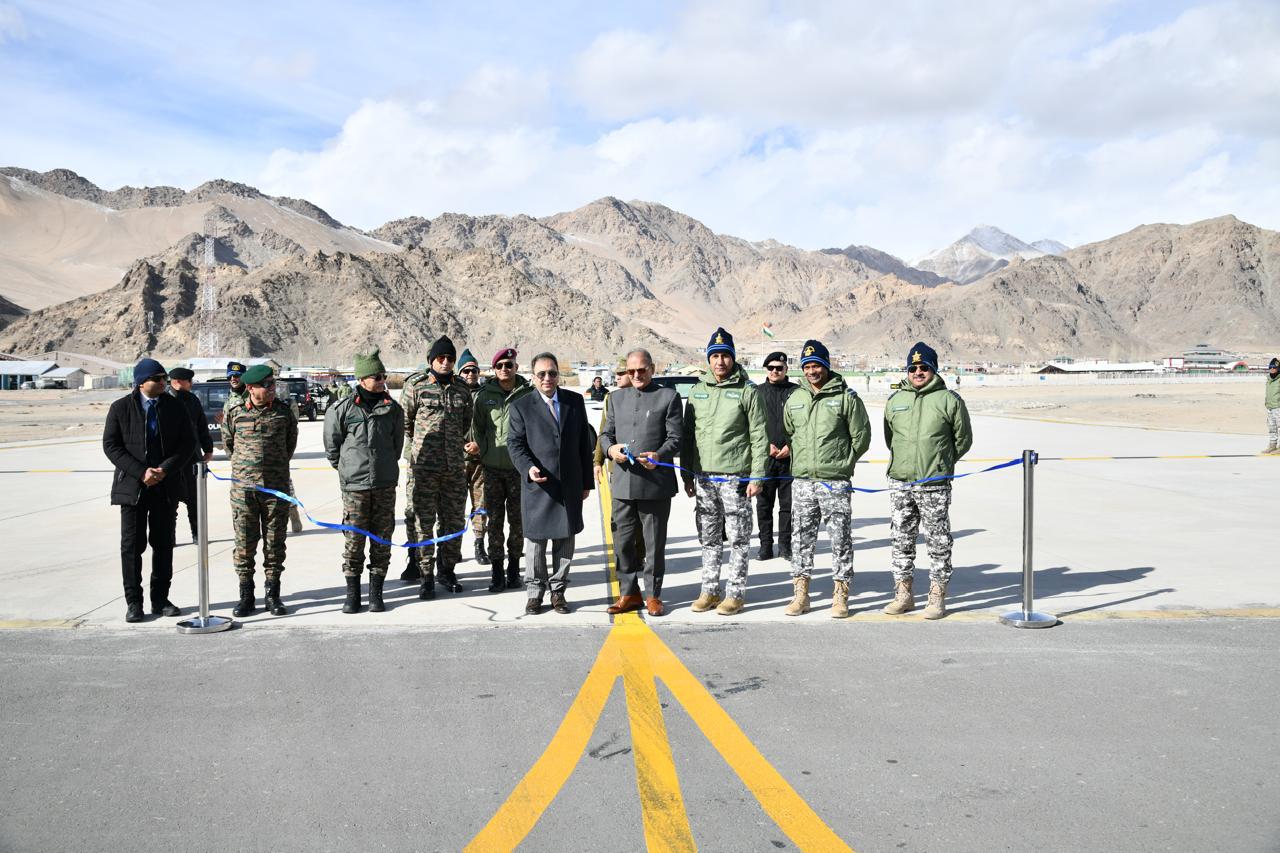
Leh, Jan 28: Air operations at Leh Airport were expanded on Wednesday with the formal commissioning of a newly constructed runway, marked by the smooth landing of an Indian Air Force (IAF) Hercules transport aircraft at exactly 2:43 pm.
The precise touchdown officially brought the new facility into operation, highlighting its enhanced load-bearing capacity and improved operational flexibility at one of India’s most critical high-altitude airfields. The landing was carried out under close technical supervision, confirming the runway’s readiness for sustained military and civil aviation use.
The new runway was inaugurated by Lieutenant Governor of Ladakh, Kavinder Gupta, who described the development as a significant step towards strengthening aviation infrastructure in the region. The facility is part of the Parallel Taxi Track (PTT) project at Leh Airport, aimed at supporting heavy aircraft operations and improving aircraft movement efficiency on the ground.
The project to upgrade civil aviation infrastructure at Air Force Station Leh was inaugurated in the presence of Air Marshal Jasvir Singh Mann, Senior Air Staff Officer, Western Air Command.
Officials said the infrastructure was completed in record time despite challenging high-altitude terrain, harsh weather conditions and a limited working season. The upgraded facilities are expected to ensure smoother aircraft ground movement, quicker civil departures, reduced turnaround time and improved passenger convenience.
Improved air connectivity is also expected to boost tourism in the Leh sector, generating economic opportunities and supporting local livelihoods. Officials added that the enhanced infrastructure will strengthen the region’s ability to respond swiftly to humanitarian assistance and disaster relief operations.
The successful Hercules landing demonstrated the airfield’s capability to handle large military transport aircraft in demanding terrain and weather conditions. The new facility will also provide operational redundancy during maintenance or resurfacing of the existing main runway.
Given Leh’s strategic location and its reliance on air connectivity during prolonged winter closures of the Srinagar–Leh and Manali–Leh highways, the new runway is expected to play a vital role in ensuring uninterrupted access for defence, emergency and civilian operations.
The Parallel Taxi Track project, initiated in 2023 and completed at a cost of around ₹452 crore, has the potential to function as a main runway. It is expected to significantly improve air connectivity, ease traffic flow and support increased tourist movement.
Addressing the gathering, the Lieutenant Governor said the Leh Airfield holds immense strategic importance for national security along the northern borders and serves as a vital lifeline for the people of Ladakh during winter months. He said the project includes a full-length parallel taxi track, two large aircraft dispersal areas and five taxi links, all designed to support heavy aircraft operations.
He added that while military aircraft operations on the new taxi track have already commenced with certain restrictions, the UT Ladakh Administration will take necessary steps to remove obstacles near Glory Hill to make it fully operational for civilian air traffic. The parallel taxi track, he said, will be particularly useful during future resurfacing of the main runway.
Highlighting the role of air connectivity in Ladakh’s tourism-driven economy, the Lieutenant Governor said year-round civil air operations ensure a steady flow of visitors and directly benefit local residents. He also acknowledged the Indian Air Force’s continued support during medical emergencies by airlifting critically ill patients to hospitals in Delhi and Chandigarh.
The Lieutenant Governor praised the Air Force’s humanitarian efforts under Operation Sadbhavana, including winter air connectivity, medical camps and community outreach programmes, and said the coordination between Air Force Station Leh and the UT Administration reflected exemplary civil-military cooperation.
Senior officers of the Indian Air Force and officials from the UT Administration were present at the inauguration, underlining the operational importance of the facility for national security and regional connectivity.
