

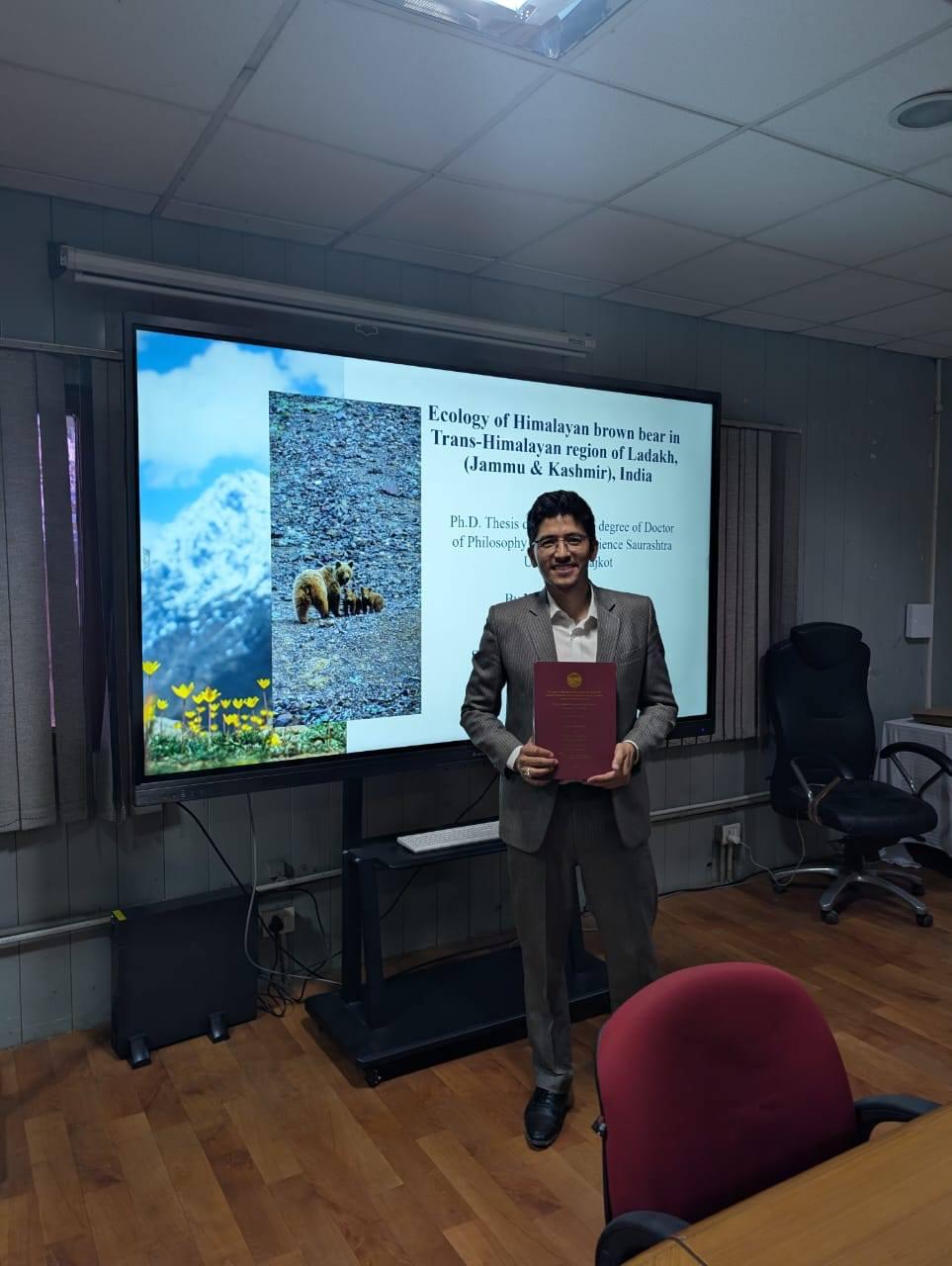
Kargil, Apr 28 : A fresh body of scientific evidence on the Himalayan brown bear has emerged from Ladakh’s high-altitude terrain, with Dr. Niazul H. Khan successfully defending his doctoral research at the Wildlife Institute of India, offering what experts describe as the first landscape-scale baseline assessment of the species in the Trans-Himalayan region.
The study, conducted across parts of Ladakh, documents population distribution, habitat utilisation, and behavioural patterns of the elusive bear, providing a rare scientific window into one of the world’s most demanding ecosystems. Researchers say the findings arrive at a time when the region is witnessing rising human-wildlife interactions alongside ecological stress linked to climate variability and infrastructure expansion.
According to wildlife specialists familiar with the work, the research fills a long-standing gap in baseline data required for policy formulation and field-level conservation. The absence of such large-scale, evidence-backed studies has often limited the ability of authorities to design targeted conservation measures in the cold desert landscape.
Officials in the wildlife sector note that the findings could inform management strategies aimed at reducing conflict between local communities and wildlife, while ensuring habitat protection. The study underscores the need for sustained monitoring systems and adaptive habitat management, particularly in ecologically sensitive zones where seasonal changes directly influence species movement.
The research is also expected to support forest and wildlife departments, as well as conservation agencies, in aligning development planning with ecological safeguards. Experts believe that such data-driven approaches are increasingly necessary in Ladakh, where biodiversity conservation must operate alongside evolving socio-economic priorities.
Beyond its immediate regional relevance, the study is being seen as a reference point for future scientific inquiry in the Trans-Himalayan belt. It reinforces the growing role of Ladakh in contributing to national-level wildlife research and highlights the importance of long-term ecological datasets in fragile mountain ecosystems.
