

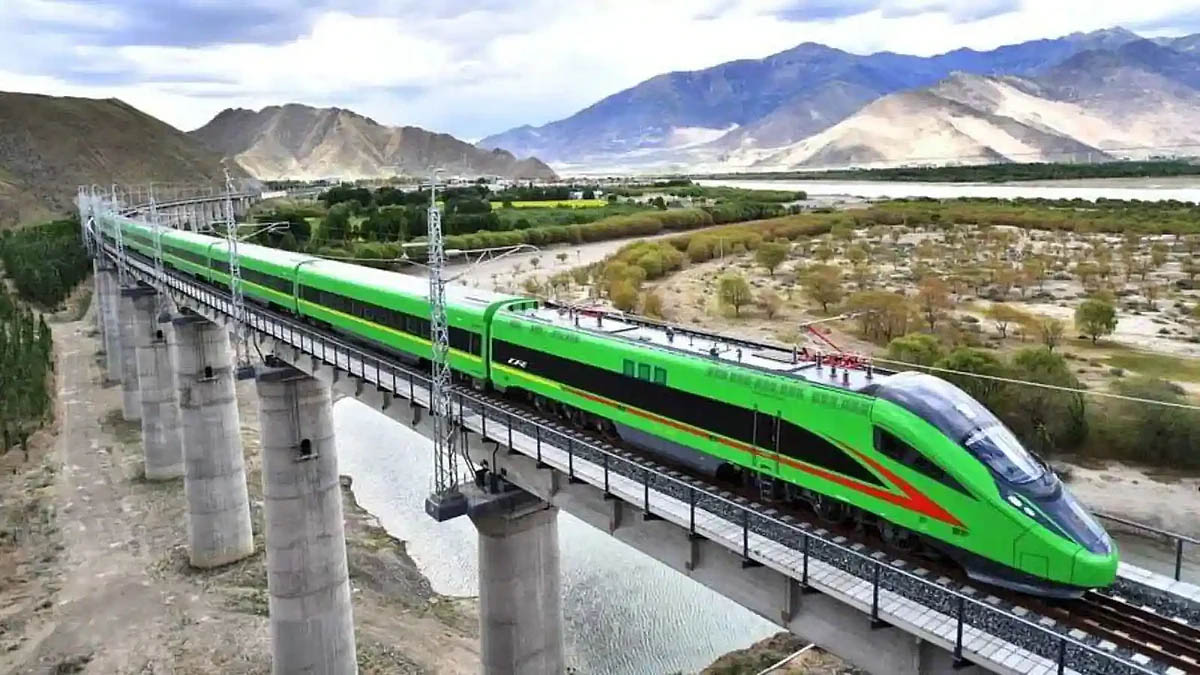
Beijing, Aug 11: China is set to launch a major rail project connecting Xinjiang’s Hotan to Tibet’s Lhasa, with parts of the route near the Line of Actual Control (LAC) with India, according to the South China Morning Post.
The state-owned Xinjiang-Tibet Railway Company (XTRC), registered with 95 billion yuan (USD 13.2 billion) in capital, will oversee the construction, which aims to form a 5,000 km plateau rail network by 2035.
The project, with strategic defensive significance due to its proximity to the contested border, follows the Xinjiang-Tibet highway through the disputed Aksai Chin area, a flashpoint in the 1962 India-China war.
India maintains Aksai Chin as part of its territory based on historical claims and treaties. Construction is expected to begin this year.
“This ambitious project aims to establish a 5,000 km plateau rail framework centred on Lhasa by 2035,” Hubei-based Huayuan Securities said in a research note last Friday. India asserts Aksai Chin as an integral part of its territory based on historical claims and past treaties.
The Xinjiang-Tibet Railway is one of four lines planned to connect Tibet with the rest of the country, with the other services linking the western region to Qinghai, Sichuan and Yunnan provinces, the report said.
The Qinghai-Tibet line is up and running while construction continues on the other two, it said.
The Tibet region in China is well connected by air, road and rail networks. Its high-speed rail network from Lhasa stretches close to the Arunachal Pradesh border.
Significantly, China’s plans for the new Xinjiang-Tibet rail link come just after Beijing and New Delhi began a normalisation of relations after over four years of a freeze in ties due to the military standoff in the sprawling Eastern Ladakh. Aksai Chin is part of the region.
The relations began looking up after last year’s meeting in Russia between Prime Minister Narendra Modi and Chinese President Xi Jinping on the sidelines of the BRICS summit.
Modi is expected to attend the two-day Shanghai Cooperation Organisation (SCO) summit beginning August 31.
Tibet continues to be the focus of China’s mega constructions. China recently started the construction of the world’s biggest dam over the Brahmaputra River in ecologically fragile Tibet, close to Arunachal Pradesh.
The mega dam raised concerns in the lower riparian countries – India and Bangladesh. Costing about USD 170 billion, the dam is stated to be the world’s biggest infrastructure project.
China defended the dam project, saying it would not have any negative impact on the downstream countries.
According to the details provided in the registration of XTRC, its business scope also includes diversified operations such as real estate development, tourism, catering, accommodation and international project contracting.
Under the plan, the train route will join the existing Lhasa-Shigatse line with a new one from Hotan to Shigatse, forming a roughly 2,000km strategic artery linking northwestern and southwestern China, the Post reported.
The route will have an average elevation of over 4,500 metres, and pass through the Kunlun, Karakoram, Kailash and Himalayan mountain ranges, going through glaciers, frozen rivers and permafrost.
The project posed many challenges as the winter temperatures on the Tibetan Plateau can plunge to -40 degrees Celsius, with oxygen levels at just 44 per cent of inland regions.
Along with the engineering challenges, the project team will have to cope with accelerated machinery wear, soaring logistics costs, and environmental conservation needs, the report said.
Planning for the Xinjiang-Tibet line dates back to 2008, when it was included in the revised “Medium and Long-Term Railway Network Plan” approved by the National Development and Reform Commission, the country’s top economic planner.
Key milestones include the May 2022 launch of survey and design tenders for the Hotan-Shigatse section.
Ministry of Transport officials confirmed in April that construction was expected to get underway this year, the Post report said.
