

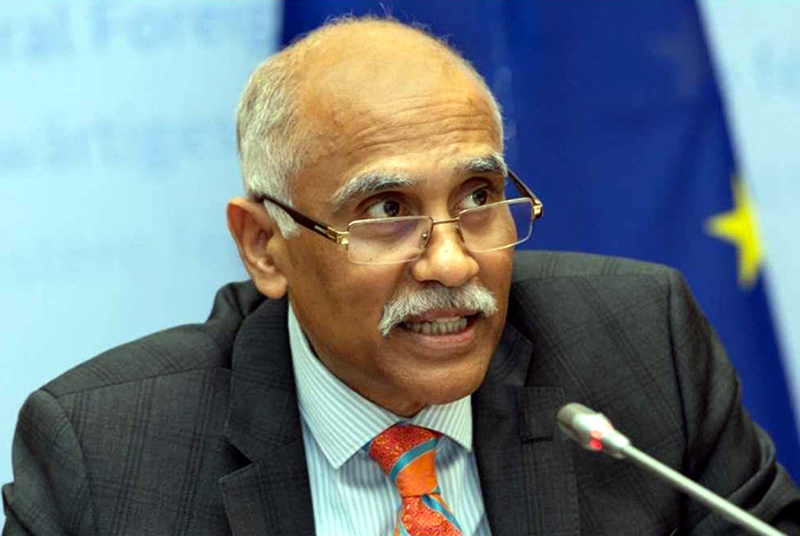
United Nations, Jul 23: In a strongly-worded statement at the UN Security Council, India condemned Pakistan for fostering cross-border terrorism and labelled it a “serial borrower” immersed in fanaticism. Addressing a high-level open debate chaired by Pakistan, India’s Permanent Representative to the UN, Ambassador Parvathaneni Harish, emphasized the need for zero tolerance towards terrorism and insisted that nations encouraging such acts must pay a “serious cost.” Join The Earth News Whatsapp Channel
The debate, titled “Promoting International Peace and Security through Multilateralism and Peaceful Settlement of Disputes,” was presided over by Pakistan’s Deputy Prime Minister and Foreign Minister Ishaq Dar. UN Secretary-General Antonio Guterres also addressed the session. Dar reignited discussions on Jammu and Kashmir and the Indus Waters Treaty during his remarks.
Responding firmly, Harish underscored the stark contrast between India’s pluralistic democracy and Pakistan’s growing extremism and economic dependence on institutions like the IMF. He cited Pakistan’s recent IMF bailout of $1 billion as yet another sign of its financial instability.
Harish also referenced the recent terror attack in Pahalgam, Jammu and Kashmir, in which 26 tourists lost their lives. The attack was claimed by The Resistance Front, believed to be linked to Pakistan-based Lashkar-e-Taiba. India’s response, termed “Operation Sindoor,” was launched against terror camps in Pakistan and Pakistan-occupied Jammu and Kashmir. He confirmed the military action was “focused, measured, and non-escalatory,” and ceased at Pakistan’s request once objectives were achieved.
Citing the UN Security Council’s April 25 statement condemning the Pahalgam attack, Harish reiterated the need to hold perpetrators, sponsors, and financiers accountable. He criticized Pakistan’s duplicity in offering diplomatic rhetoric while harboring terrorist elements.
Acting US Representative Ambassador Dorothy Shea acknowledged America’s role in de-escalating recent tensions globally, including between India and Pakistan. Meanwhile, Harish elaborated on the evolving nature of global conflicts, noting the rise of non-state actors supported by state entities through funding, arms, and ideological radicalization amplified by digital technologies.
On peaceful dispute resolution, Harish reinforced that per the UN Charter, the primary responsibility lies with the involved parties. He cautioned against one-size-fits-all approaches and emphasized the need for adaptability in resolving modern conflicts.
Addressing broader concerns about global governance, Harish pointed out the growing distrust in the UN system and called for urgent reforms, particularly in the Security Council’s representativeness. He highlighted India’s role in facilitating the African Union’s inclusion in the G-20 during its presidency as an example of inclusive diplomacy.
Pakistan currently holds a non-permanent seat on the UN Security Council for the 2025–26 term.
