

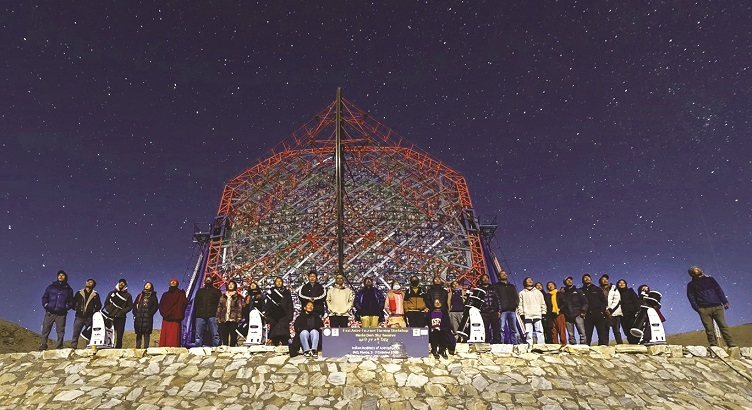
Hanle: In the remote heights of Hanle, Ladakh, a new generation of villagers is rewriting the story of life in the high Himalayas. At 4,500 metres above sea level, 25 locally trained astronomy ambassadors—18 of them women—are guiding visitors through some of the clearest night skies on Earth. By day, they run homestays and host tourists; by night, they unveil the cosmos, pointing out planets, constellations, and the Milky Way. Through their efforts, these ambassadors are generating livelihoods, preserving centuries-old celestial knowledge, and safeguarding the pristine conditions essential for India’s Himalayan Chandra Telescope and the Indian Astronomical Observatory.
Zipped into warm jackets, visitors gather around Tsering Dolkar, 28, as she adjusts her telescope beneath a cloudless sky. “That is Venus,” she points out, while murmurs of awe ripple through the group as the Milky Way unfurls overhead. It is a scene repeated nightly in Hanle, India’s first dark sky reserve, designated in 2022.
“They are the interlocutors between the sky and the tourists,” said Niruj Mohan Ramanujam, outreach head at the Indian Institute of Astrophysics, Bengaluru, the observatory’s main research partner.
Since the installation of the 2-metre Himalayan Chandra Telescope in 2000, three more instruments have been added atop Digpa-ratsa Ri and its foothills, turning Hanle into a world-class astronomy hub and providing a reason for formerly nomadic communities to settle permanently.
The village’s designation as a dark sky reserve sparked a project to involve locals directly in its management. Ambassadors receive a week-long training and access to telescopes, guiding visitors for roughly £1.70 per person while hosting them in homestays. Homestay numbers have surged from a handful to 70, revitalising the local economy and attracting residents who had left for urban jobs.
Dolkar converted her five-bedroom house into a homestay, charging around £17 per night with home-cooked meals. “During the day, I cook and clean; at night, I guide visitors through deep-sky exploration,” she said, often hosting more than 50 tourists on peak nights.
The programme has opened new opportunities, particularly for women. Padma Chamchot, 25, a college graduate, earns more in a week than she could in a month working in a city job. “This is a dream role: I learn about the stars daily, support my family, and promote our culture, all while staying rooted in Hanle,” she said.
Astro-tourism is also reconnecting villagers with their cultural heritage. Elders once relied on stars for navigation and agricultural cycles, knowledge that had faded over generations. “This initiative has restored our link to science and tradition,” said Kesang Dorjey, a former observatory labourer now serving as an ambassador. Students of astronomy and village elders alike are finding parallels between celestial patterns and local folklore.
Even Hanle’s 17th-century monastery has joined the movement. Acting head monk Nawang Tsoundu, 30, guides visitors by night while continuing his monastic duties by day. “Astronomy has always been part of Buddhist practice. Reviving this knowledge connects our past to the present,” he said.
Each year, the observatory hosts a star party in collaboration with local authorities, drawing enthusiasts from across India. For participants such as 24-year-old engineer Hashika Raj from Chennai, the experience is unparalleled. “I’ve never seen skies this clear,” she said.
Yet, challenges remain. Hanle’s “Bortle 1” skies—the darkest classification possible—face threats from light pollution, including military installations responding to border tensions with China and tourists ignoring reserve guidelines. Dorjey has worked with military officials to reduce nighttime lighting, though frequent rotations complicate enforcement.
“I sleep uneasy,” he said. “These skies, which define our identity and livelihoods, must be preserved.”
Despite these concerns, Hanle’s night skies illuminate a broader story: of a village harnessing its natural wonder, empowering women, preserving heritage, and placing itself firmly on the global astro-tourism map.
As Asia’s first officially notified Dark Sky Reserve, Hanle has become a haven for both amateur and professional astronomers. A key feature of this initiative is the training of 25 astronomy ambassadors—two-thirds of them women—drawn from local communities. These ambassadors serve as guides, storytellers, and homestay hosts, offering visitors an immersive night-sky experience while promoting sustainable livelihoods in the high-altitude Changthang region.
Officials from the Department of Science & Technology described the model as “an innovative blend of scientific research, tourism, and community development that showcases how local engagement can protect natural resources while creating economic opportunities.”
To protect the region’s pristine skies, a Light Management Plan restricts artificial lighting in and around the reserve, ensuring minimal light pollution and crystal-clear views of celestial wonders.
From stargazing and astrophotography to public outreach and scientific education, the Hanle Dark Sky Reserve is gaining global attention. The Tso Moriri–Hanle corridor, known for its stark landscapes and high passes, now draws travellers eager not just for the mountains but to witness the Milky Way in its full glory.
Officials at the Indian Institute of Astrophysics highlighted that “Hanle has become a shining example of how astronomical research and tourism can work together, inviting visitors to connect with the cosmos while respecting local traditions and the environment.” As global demand for astro-tourism rises, Hanle offers India a shining example of how science-led tourism can preserve nature, empower communities, and open new frontiers for exploration.
