

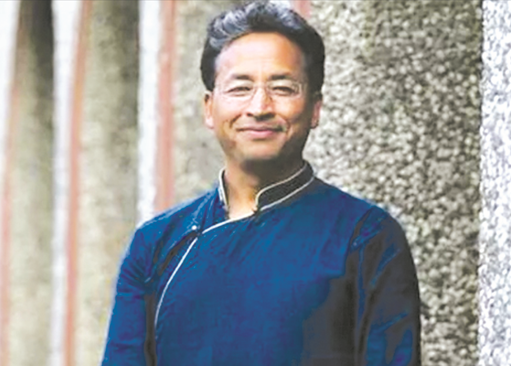
Leh, Mar 29: Sonam Wangchuk on Sunday termed his six-month detention under the National Security Act (NSA) as a “most unjust ordeal”, while urging stakeholders to prioritise dialogue and reconciliation in addressing Ladakh’s constitutional and governance concerns.
In his first post on X after being released from detention in Jodhpur Jail, Wangchuk acknowledged the support extended by people across the country, including those who stood in solidarity with him, fellow activist Gitanjali Angmo, and the people of Ladakh during the period of his incarceration.
Wangchuk struck a conciliatory note, emphasising the need to move beyond personal grievance and prioritise engagement with the Union Government.
“Julay & greetings. I don’t have words to thank you all for your solidarity with me, Gitanjali Angmo and Ladakh,” Wangchuk said in a post on X, acknowledging the support extended to him and fellow activist Gitanjali Angmo during his incarceration.
Indicating that he is yet to fully resume normal life, Wangchuk noted that some of his belongings, including his phone, remain in official custody. “Please bear with me as I slowly limp back to normal life,” he said.
Reflecting on his detention, Wangchuk observed that anger would not advance the cause he has been advocating. “While the past six months have been a most unjust ordeal, I do not know if anger and bitterness will help the cause I was fighting for,” he said, adding that the government’s release order — which referred to building “mutual trust for constructive meaningful dialogue” — should be viewed as an opening for reconciliation.
He said the moment should be treated as “an acceptance of mistakes and an intention to correct them”, calling for a positive approach as stakeholders prepare for further engagement.
Wangchuk, however, maintained that he had more to say about his detention but chose restraint in view of the ongoing process. “I have a lot to say about the ordeal but at the moment I do not want to derail this meaningful dialogue, as Wangchuk cannot win if his cause loses,” he said.
Reiterating the core objectives of his campaign, Wangchuk said his struggle was not personal but centred on ensuring that the government honours its commitments to Ladakh. He underscored the demand for constitutional safeguards under the Sixth Schedule and the restoration of democratic processes in the region.
“My struggle was not for me; it was to make the government fulfil its pledge to Ladakh to safeguard it under the Sixth Schedule and to restore democracy,” he said.
Expressing cautious optimism, Wangchuk said the forthcoming rounds of talks between Ladakhi representatives and the Centre would be crucial in determining the region’s future trajectory. “We await the next round of talks to see if Ladakh sees a new dawn,” he said, while urging continued public support for the cause.
The activist’s remarks signal a calibrated shift towards dialogue-driven engagement, even as demands for constitutional protection and institutional representation in Ladakh remain unresolved.
