

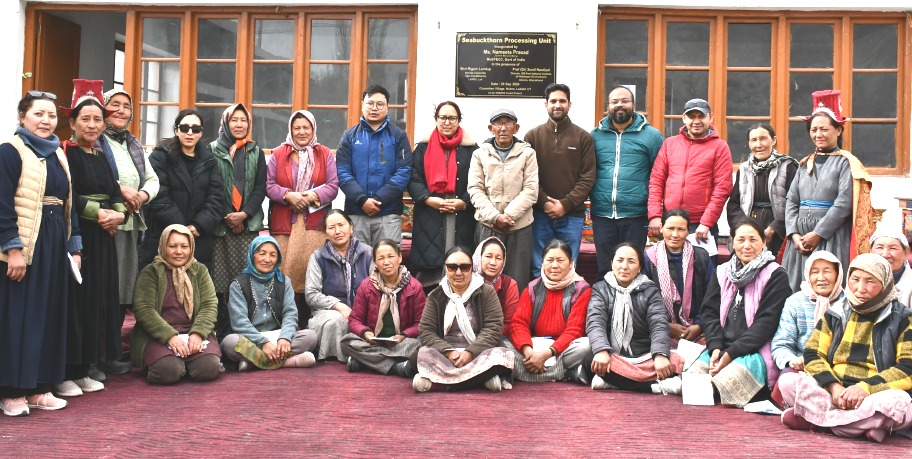
Leh, Mar 13: A two-day capacity-building programme on seabuckthorn processing and value addition was organised for members of the Chamsen Women Self-Help Group (SHG) from Zamo-40 village in Nubra, aiming to strengthen community-based livelihoods through improved utilisation of local resources.
The programme was held at the Seabuckthorn Processing Unit in Chamsen under a NABARD-supported initiative titled “Strengthening Ladakh’s Livelihoods: Empowering Self-Help Groups through Harvesting and Primary Processing of Seabuckthorn.” It focused on equipping women with practical knowledge on harvesting, handling, and developing value-added products from seabuckthorn (Hippophae rhamnoides), a plant widely found in Ladakh and known for its nutritional and medicinal properties.
The training was inaugurated by Dr. Sandipan Mukherjee, Scientist-E and Head of the Ladakh Regional Centre of the G. B. Pant National Institute of Himalayan Environment (GBPNIHE), Leh. Among those present were Dr. Sarla Shashni, Scientist-E from GBPNIHE, Kullu; LEDeG Director Eashay Tundup; NABARD District Development Manager Tundup Wangyal; Dr. Dalbeer Singh (TA-II, GBPNIHE, Leh); Vinod Kumar, founder of Tribal Organic Sustainable Himalayan Harvest (TOSHH) Natural Products, Himachal Pradesh; and Project Coordinator Sonam Chorol from GBPNIHE, Leh.
Around 27 participants attended the programme, where sessions focused on the nutritional benefits of seabuckthorn and sustainable harvesting practices. The training also covered post-harvest handling techniques and methods for small-scale processing.
Participants were given practical demonstrations on preparing a range of value-added products such as seabuckthorn leaf tea, herbal blends, pickles, papads, natural scrubs, soaps, lip balms, and candies. Trainers also guided the participants on packaging, labeling, quality standards, and potential marketing channels.
Officials from NABARD and LEDeG encouraged the SHG members to explore collective initiatives, including the formation of a Farmer Producer Organization (FPO), to strengthen market access and expand livelihood opportunities.
Participants expressed interest in expanding seabuckthorn processing activities in their village and noted the usefulness of the hands-on training sessions. The programme concluded with discussions on follow-up support, including guidance on product development, marketing strategies, and institutional linkages aimed at promoting sustainable utilisation of seabuckthorn resources in the region.
