


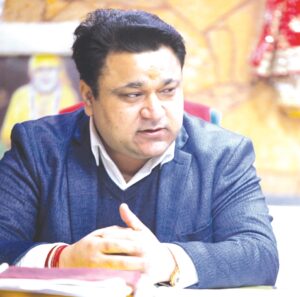
Shivang Satya Gupta
By Shivang Satya Gupta
In the ever-evolving political landscape of Jammu and Kashmir, the call for unity and responsible governance is growing louder. Amid growing mistrust and political speculation, one fact remains clear that people of both Jammu and Kashmir divisions desire peace, stability, social security, development and effective governance rather than endless political posturing.
The growing divide between the two regions, if left unchecked, could have long-term implications for the future of the J&K Union Territory.
We at The Earth News believe that frequent attempts to politicize every issue and create narratives targeting or ignoring one region over the other have started widening the emotional and administrative gap between Jammu and Kashmir. We must caution that this divide could harm the unity and progress of the Union Territory.
Instead, leaders from all parties then it may be National Conference (NC), BJP, Congress, PDP and others must recognise that the essence of leadership lies in inclusivity — ensuring that development and decision-making are not region-centric but people-centric.
Recently, speculation arose that Chief Minister Omar Abdullah might consider resigning over the delay in the restoration of Statehood to Jammu and Kashmir. Such conjectures, however, do little to serve the public interest. The Centre has already made a clear commitment on the floor of the Parliament that Statehood to J&K will be restored at an appropriate time. Therefore, political theatrics or manoeuvring at this stage only creates instability and confusion. What required is political maturity, patience, and a collective focus on governance rather than optics.
The political temperature rose further after the Rajya Sabha elections in Jammu and Kashmir on October 24. The Bharatiya Janata Party (BJP), through the hidden support of a few independent MLAs and cross-voting, managed to secure one seat out of four, while the NC retained three. Following the results, speculation began about instability within the Omar Abdullah-led government. Political whispers suggested that the BJP might attempt to form the government by attracting independents or discontented legislators from other parties.
However, political observers argue that such power-driven manoeuvres only fuel uncertainty. At a time when Jammu and Kashmir is striving to rebuild its democratic institutions and regain the trust of the people, unnecessary political theatrics and statements can be detrimental. Stability and continuity in governance are crucial to ensure that the transition towards full statehood and holistic development continues smoothly.
Adding to the political noise, NC MP Aga Ruhullah has recently drawn criticism for statements seen as inciting youth sentiments by raising the issue of individuals detained under serious charges. His stance, viewed by many as sympathetic to separatist narratives, risks undoing the progress made toward peace and reconciliation. Instead of fanning emotions, leaders like Ruhullah must work to bridge the divide between the two regions and reinforce public confidence in the democratic process.
If Aga Ruhullah is genuinely concerned about the plight of detainees, he can take a constructive approach by facilitating ‘legal aid’ and encouraging lawful redress instead of adopting a confrontational or provocative tone. Political maturity demands responsibility in words and actions, especially in a region like Jammu and Kashmir, where sentiments can easily be exploited.
Ruhullah must also recognise that the vacuum created after the demise of hard-line separatist leaders like Syed Ali Shah Geelani does not need to be filled with divisive rhetoric. The Central Government has made it clear that it will not tolerate separatist appeasement or coercive tactics. Unlike the past, the present leadership in New Delhi has adopted a firm stance against cross-border terrorism, responding to provocations not with dialogue alone but with decisive measures, including the use of advanced military technology such as drones and precision strikes.
Rather than rekindling separatist sentiment, Ruhullah and other political leaders should focus on real issues affecting the people of Jammu and Kashmir — unemployment, irregularities in the regularization of daily wagers, and the urgent need for improved healthcare and education facilities. These are the concerns that truly matter to the common citizen, and these should be at the core of political discourse.
At the same time, the J&K BJP, which holds significant representation from the Jammu region with 28 MLAs, must also ensure that the rights and aspirations of the people of Jammu are not side-lined. The party carries a responsibility to balance regional representation with inclusive development across the Union Territory.
There is no denying that if the NC-led government collapses, the BJP, as the second-largest party, would be the natural contender to form the government in J&K. However, the party must resist the temptation to exploit instability for short-term gains. What the people truly need is not another round of political realignment but continuity, governance, and credible policies that address their day-to-day needs.
Political observers say that the public mood across both regions has shifted significantly since 2019. Citizens today are more concerned about social welfare schemes, employment opportunities, infrastructure, and safety than about symbolic politics or power struggles. This makes it imperative for all political stakeholders to reorient their priorities.
Instead of indulging in speculative politics and backroom deals, leaders should work to strengthen institutions, improve service delivery, and address the grievances of ordinary people. Accountability must become the cornerstone of governance. Every political leader whether in power or in opposition must evaluate their performance against the promises made to the electorate.
Jammu and Kashmir has already witnessed the consequences of political instability and policy paralysis in the past. Any repetition of such missteps could derail the progress achieved since the reorganization of the erstwhile State into a Union Territory. Politicians must therefore remember that public trust is fragile — it cannot be restored through rhetoric alone but through sustained and transparent action.
Meanwhile, the public too has a vital role to play. Citizens must rise above rumour-driven politics and focus on holding their representatives accountable. They must demand progress on promises made from better roads and schools to healthcare, jobs, and social security. It is only when the electorate prioritizes performance over populism that real democracy thrives.
Today, Jammu and Kashmir stands at a crossroads. On one side lies the path of reconciliation, inclusivity, and progressive governance; on the other, a return to divisive politics that has historically kept the region unstable. The choice, as analysts point out, lies not only with the political class but also with the people who elect them.
The message is clear that Jammu and Kashmir needs unity, not polarization. It needs visionary leadership that can heal old wounds, bridge regional gaps, and deliver on the aspirations of its people. Political parties must learn to rise above immediate gains and act with statesmanship.
In conclusion, politicians in Jammu and Kashmir must remember that the era of emotional manipulation and divisive politics is ending. The new generation of voters is pragmatic, aware, and driven by aspirations of stability and growth. The public wants good governance, accountability, and social security and not the empty promises or political brinkmanship. If the leaders of Jammu and Kashmir can rise above factionalism and work collectively for the welfare of both regions, they can restore the people’s faith in democracy and pave the way for a peaceful, prosperous, and united future for the Union Territory. The call is loud and clear — bridge the gap, deliver governance, and let people, not politics, define the destiny of Jammu and Kashmir.
