

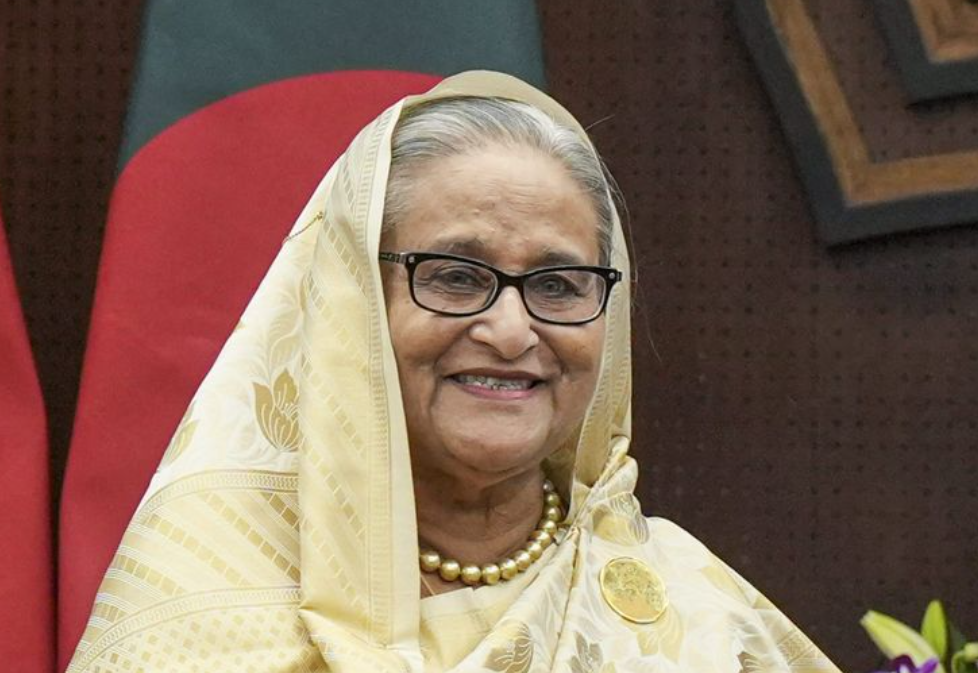
New Delhi, Oct 14: Former Bangladesh Prime Minister Sheikh Hasina has criticised Prime Minister Tarique Rahman for skipping the BRICS summit held in New Delhi, describing the decision as “immature” and contrary to Bangladesh’s national interests.
In an interview with news agency IANS, Hasina said Bangladesh’s participation in the summit could have created opportunities for economic growth, investment, infrastructure development and international cooperation.
She argued that foreign policy should be guided by national interests rather than personal differences or short-term political considerations.
“It was deeply unfortunate that Bangladesh chose not to participate. In my view, it was an immature decision and one that did not serve Bangladesh’s national interest,” Hasina said.
India had invited Rahman to attend the summit in his capacity as the current chair of the Bay of Bengal Initiative for Multi-Sectoral Technical and Economic Cooperation (BIMSTEC). However, he declined the invitation to the gathering held in New Delhi on September 12 and 13.
Hasina suggested that her presence in India may have influenced Rahman’s decision, questioning why personal and political considerations should affect relations between neighbouring countries.
She recalled that former Bangladesh president Ziaur Rahman had visited New Delhi in 1979 while she was living in India. She also referred to his visit to London in 1980, when she was present there, arguing that her presence had not prevented him from travelling.
“Relations between two countries cannot be determined by personal considerations or political sensitivities involving one individual,” she said.
Calls for balanced foreign policy
The Awami League leader defended her government’s approach to international relations, saying Bangladesh had maintained strong ties with India while expanding cooperation with China, Russia, Japan, the United States, Europe and other partners.
She stressed that closer relations with one country should not come at the expense of another and called for an independent, balanced foreign policy guided by national interests.
Referring to Bangladesh’s founding leader, Sheikh Mujibur Rahman, she reiterated the principle of “friendship to all, malice to none”.
Hasina also criticised what she described as anti-India rhetoric being encouraged for domestic political purposes, warning that using relations with one country against another could undermine Bangladesh’s diplomatic interests.
India-Bangladesh ties face renewed strain
Relations between New Delhi and Dhaka have faced renewed tensions following Hasina’s virtual media interaction in New Delhi on August 5.
After the event, Dhaka reiterated its demand for her extradition and sought to link the issue with Rahman’s planned visit to India. New Delhi, however, distanced itself from the interaction, stating that it had neither played a role in the event nor endorsed Hasina’s remarks.
Hasina, who has been living in Delhi since leaving Bangladesh in August 2024 following the collapse of her government amid mass protests, also accused the current administration of undermining democratic institutions.
She alleged restrictions on media freedom, political persecution, weakening law and order, insecurity among minorities and economic difficulties. She further claimed that the exclusion of a major political force from the democratic process would make it difficult for Bangladesh to achieve lasting stability.
Hasina says return to Bangladesh is aimed at restoring democracy
Without providing specific details about when she might return, Hasina said her intention was to stand alongside the people of Bangladesh and work towards restoring democracy, voting rights and the rule of law.
She called for free, fair and inclusive elections, arguing that the country’s future should be decided by its people.
Hasina acknowledged that returning to Bangladesh could pose serious risks, noting that a Bangladeshi court had sentenced her to death. However, she maintained that she was not afraid and questioned the fairness of what she described as a politically motivated judicial process.
“The greater concern today is not personal safety. It is the destruction of justice in Bangladesh,” she said.
She added that restoring democratic institutions and ensuring the rights of citizens remained central to her political objectives.
