

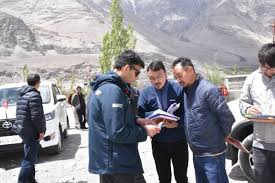
Nubra, May 13 : Administrative Secretary for Agriculture and Horticulture, Bhupesh Choudhary (IAS), on Tuesday inspected the proposed District Industrial Area in Nubra and reviewed infrastructure requirements for the project, amid ongoing efforts by the administration to strengthen industrial and economic development in the region.
Accompanied by Deputy Commissioner Nubra Mukul Beniwal (IAS), the Administrative Secretary carried out an on-site assessment of the proposed industrial zone and examined the present status of infrastructure necessary for future development.
Officials reviewed the condition of internal road connectivity within the proposed site and discussed the requirement of essential utilities, including power supply, bore well facilities and sewage infrastructure, for the planned industrial area.
The visit also focused on evaluating the developmental scope of the project and identifying infrastructure gaps that need to be addressed before industrial activities can be operationalised in the district.
During the inspection, Choudhary sought updates from district officials regarding ongoing developmental works in Nubra and emphasised the need for integrated infrastructure planning to support long-term economic growth in the region.
He also briefed officials on the Bharat Audyogik Vikas Yojna (BHAVYA), a Central Sector scheme aimed at developing integrated industrial infrastructure and promoting manufacturing-based economic activity across emerging regions.
Officials said the proposed industrial area is expected to play an important role in expanding local economic opportunities and creating infrastructure for future industrial and entrepreneurial initiatives in Nubra district.
The inspection was attended by SDM Nubra Jigmet Raftan (JKAS), Executive Engineer PWD and other district officials associated with infrastructure and development planning.
The visit assumes significance as the administration in Ladakh continues to explore region-specific industrial development models aimed at improving economic infrastructure while addressing the logistical and geographical challenges of high-altitude districts.
