

JUIAK flags local issues, seeks rotational HQ in Kargil
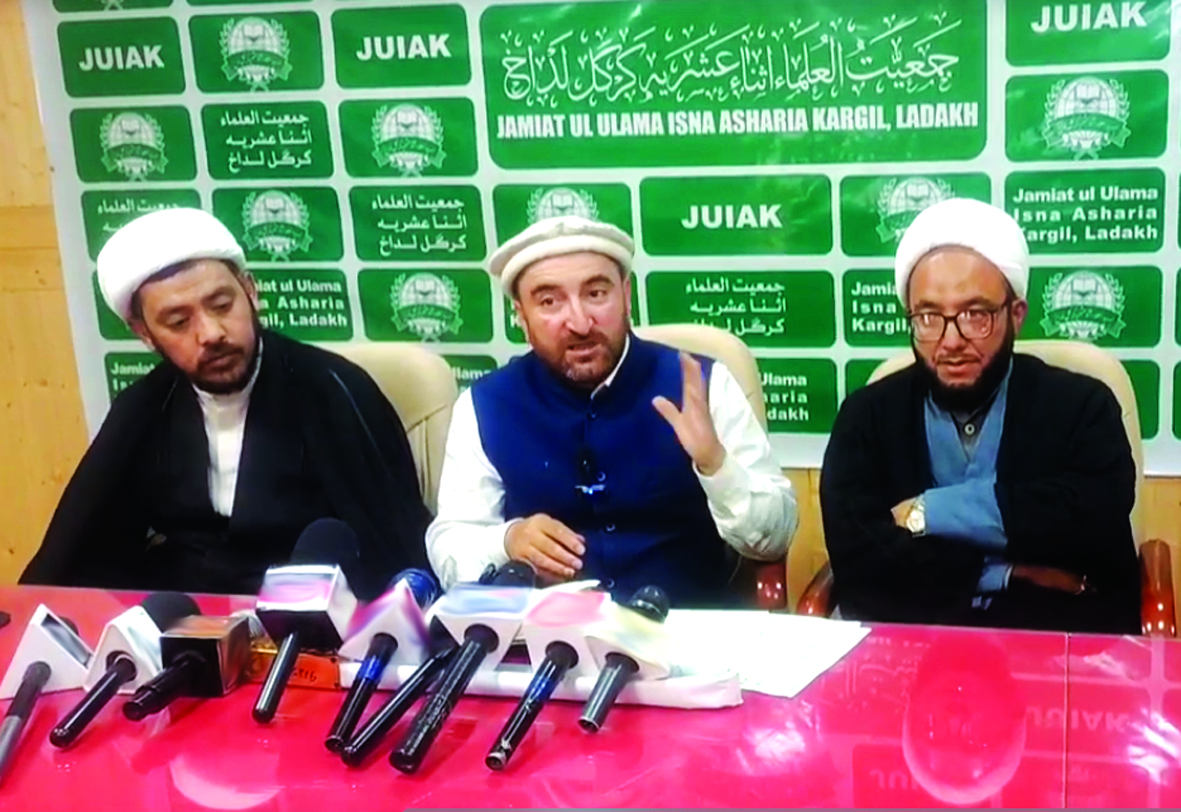
Kargil, Jul 29: Social and political activist Sajjad Kargili on Tuesday voiced deep concern over critical public matters including employment, healthcare, human rights, and administrative fairness in Ladakh. Addressing a press conference at the Jamiat Ul Ulama Isna Asharia Kargil (JUIAK), he urged the Union Territory administration to act promptly on long-pending projects, structural gaps, and regional disparities.
Flanked by senior JUIAK leaders Sheikh Ghulam Ali Mufidi, Sheikh Ibrahim Khalili, and Sheikh Asgar Zakiri, Kargili began by appreciating the Dalai Lama’s enduring efforts to promote peace. He recalled His Holiness’s earlier visits to JUIAK and acknowledged Sheikh Nazir’s role in the Peace Conference during the recent Yarchos festival in Zanskar.
Kargili reaffirmed the organisation’s dedication to international human rights causes, particularly the Palestinian struggle. He highlighted JUIAK’s participation in a conference in Delhi attended by the Ambassador of Palestine and mentioned that he, along with other civil society members under the India Palestine Solidarity Forum, had written to Indian parliamentarians to raise the matter on the national stage.
Bringing focus back to Ladakh, Kargili called for the immediate establishment of a Human Rights Commission in the Union Territory. He said the absence of such a body limits accountability and weakens channels through which citizens can raise complaints. This, he argued, is especially pressing following the UT’s creation.
He then addressed electoral concerns, stating that while the recent redrawing of the Lower Leh Constituency is a positive step, similar efforts must follow in areas like Chuchot, Turtuk, and Bhinbhat. He confirmed that JUIAK has formally submitted this demand to the Lieutenant Governor.
Moving to employment issues, Kargili criticized the KSSRB for advertising only 473 posts despite receiving a higher number of referrals. He also raised objections to the shifting of district cadre posts to Leh, urging the Chief Secretary to take corrective measures and ensure regional balance.
Kargili welcomed the LG’s visit to Hozia Ilmiya but expressed disappointment over the current healthcare setup. He reminded the media that a promised 200-bed hospital in Kargil is still operating with only 73 functional beds. He further criticized the reliance on outsourced medical staff, calling the system irregular and poorly managed. He demanded permanent hiring and the implementation of a fair transfer policy, especially in departments where politically unaffiliated employees face neglect.
In the education sector, Kargili questioned whether recent lecturer promotions were made against sanctioned posts. He also flagged the lack of timely promotions in the IRP 25 Battalion, calling for immediate administrative attention.
He revisited the issue of incomplete infrastructure, particularly the Kargil Jail Project, and called for it to be made operational without further delay. He objected to the UT headquarters being permanently located 250 kilometers away from Kargil and proposed that a Camp Office of the General Administration Department be established locally until a rotational model is introduced.
Kargili also expressed concern over the delay in the MRI machine project, despite over ₹25 crore being allocated. He pointed to poor air connectivity in the region and revealed that a detailed proposal had already been submitted to the LG by Pilot Haji Hussain to address this gap.
As the briefing progressed, Kargili pushed for the revival of High-Powered Committee meetings, stating that many unresolved issues remain in limbo. He voiced dissatisfaction with the inactive state of the Kargil Democratic Alliance and said repeated communication with its leadership had yielded no result.
Kargili described the exclusion of Sankoo, Suru, and Shakar Chiktan from district status as a persistent injustice. He labeled it a deliberate oversight that continues to deny these regions fair recognition even years after the Union Territory’s formation. He concluded with an appeal to the UT administration to urgently address these wide-ranging concerns in the interest of justice and equal development for the people of Ladakh.
