

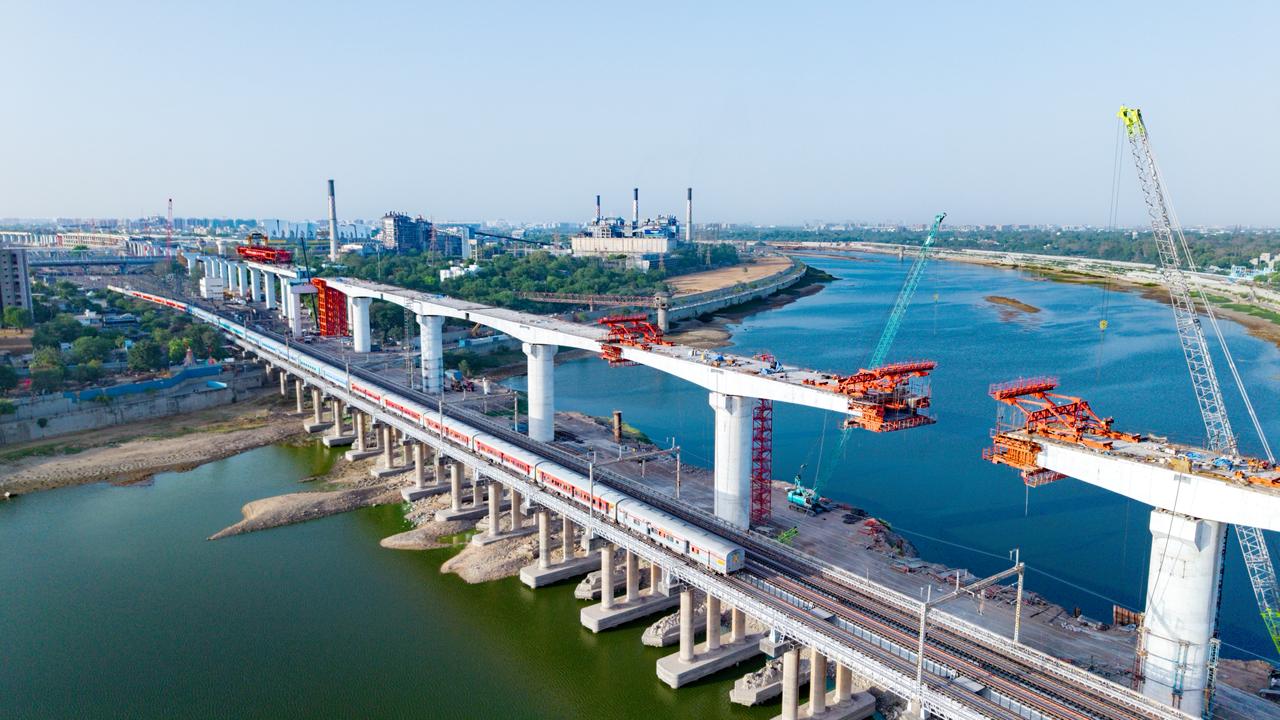
AHMEDABAD, APR 27: The ambitious Mumbai-Ahmedabad High-Speed Rail (MAHSR) corridor marked a significant engineering milestone as construction on the 36-meter-high Sabarmati River bridge advances steadily, showcasing India’s leap into world-class infrastructure.
Spanning 480 meters and strategically positioned between the Sabarmati and Ahmedabad bullet train stations, the bridge exemplifies precision engineering. All key piers now stand complete, while the superstructure takes shape using the advanced balanced cantilever method—a technique that allows seamless construction over active waterways without disrupting river flow.
This critical link ensures uninterrupted connectivity in the 508-km bullet train network, capable of 320 km/h speeds, slashing travel time between Mumbai and Ahmedabad from 7 hours to under 2.5.
Engineers highlight the project’s dual focus on innovation and sustainability. The balanced cantilever approach builds the bridge deck outward from piers, minimizing temporary supports in the Sabarmati River and preserving its ecological flow. Special vibration-dampening designs and corrosion-resistant materials further guarantee longevity amid Gujarat’s seismic and climatic challenges.
National High-Speed Rail Corporation Limited (NHSRCL) officials note that over 40% of the corridor’s 12 river bridges are in advanced stages, with Japanese Shinkansen technology transfer accelerating progress.
The MAHSR, India’s first bullet train venture, spans 12 districts across Maharashtra and Gujarat, with 80% elevated viaducts and 20 tunnels. Land acquisition is nearly complete at 95%, and trial runs are eyed for 2028, full operations by 2030.
Recent inspections by PM Narendra Modi’s infrastructure task force praised the Sabarmati site’s pace, aligning with Atmanirbhar Bharat’s push for indigenous high-speed capabilities.
This bridge not only symbolizes technical prowess but promises economic ripple effects—boosting tourism, trade, and real estate along the corridor.
