

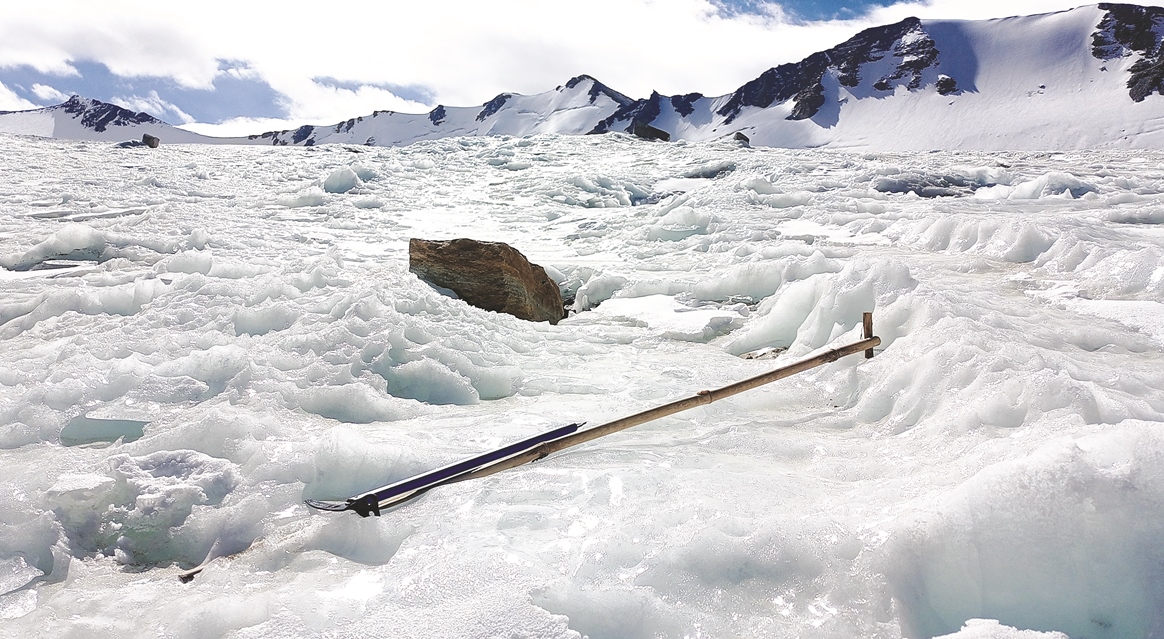
LADAKH’S FRAGILE ICE MASSES DWINDLING

Leh, Jul 23: A comprehensive scientific study conducted by the Ladakh Regional Centre of G.B. Pant National Institute of Himalayan Environment (NIHE) has revealed alarming evidence of glacial retreat in the Rulung and Gyama massifs of Ladakh. Spanning nearly two decades—from 2000 to 2018—the research, grounded in satellite remote sensing analysis, brings fresh attention to the environmental challenges silently unfolding in India’s cold desert region.
The study meticulously examined 152 glaciers—52 in the Rulung massif and 100 in Gyama—by assessing inter-annual surface velocity changes. Utilizing high-resolution satellite data from NASA’s National Snow and Ice Data Centre under the ‘Inter-mission Time Series of Land Ice Velocity and Elevation (ITS_LIVE)’ initiative, the research delivers a sobering overview of the glaciers’ declining health.
Despite their relatively modest sizes, averaging around 0.39 km² in Rulung and 0.45 km² in Gyama, both groups of glaciers are experiencing a steady slowdown in surface velocity. In Rulung, glacier speeds ranged from 0.37 ±0.2 meters per year to 8.2 ±2.8 meters per year, with an average of 2.33 ±1.6 meters annually. Gyama glaciers recorded slightly lower averages, from 0.4 ±0.1 meters to 6.53 ±3.3 meters annually, averaging 1.73 ±0.7 meters.
Over the course of the study, glacier velocity in the Rulung massif declined by 31%, while Gyama glaciers registered an 8% drop. Researchers attribute this reduction to ongoing warming and irregular precipitation patterns—both powerful agents of glacial mass loss. The study further revealed a negative mass balance, with Rulung glaciers losing ice at a rate of -0.17 ±0.03 meters water equivalent per year, and Gyama at -0.07 ±0.01 meters.
Beyond raw figures, the study underscores the complexities of glacial behavior shaped by topographic conditions. Spatial variability in flow patterns, observed both within and between the two massifs, suggests the need for more granular, localized climate monitoring. Yet, the broader narrative remains consistent—Ladakh’s glaciers are shrinking, and their diminished vitality poses a mounting risk to the region’s ecology and water availability.
These glaciers serve as crucial water sources for downstream communities and ecosystems. As their flow slows and mass continues to erode, the implications stretch far beyond ice—threatening agriculture, freshwater supply, and biodiversity in the high-altitude Himalayan terrain.
Funded by the National Mission on Himalayan Studies (NMHS) under India’s Ministry of Environment, Forest and Climate Change, the research findings were recently presented at the European Geosciences Union (EGU) General Assembly in Vienna, April 2025.
With Himalayan glaciers acting as both climate indicators and water towers, this study presents a timely call to action. As Ladakh navigates the challenges of a warming world, the silent retreat of its glaciers could soon become an urgent environmental crisis—unless decisive steps are taken to monitor, mitigate, and adapt.
