


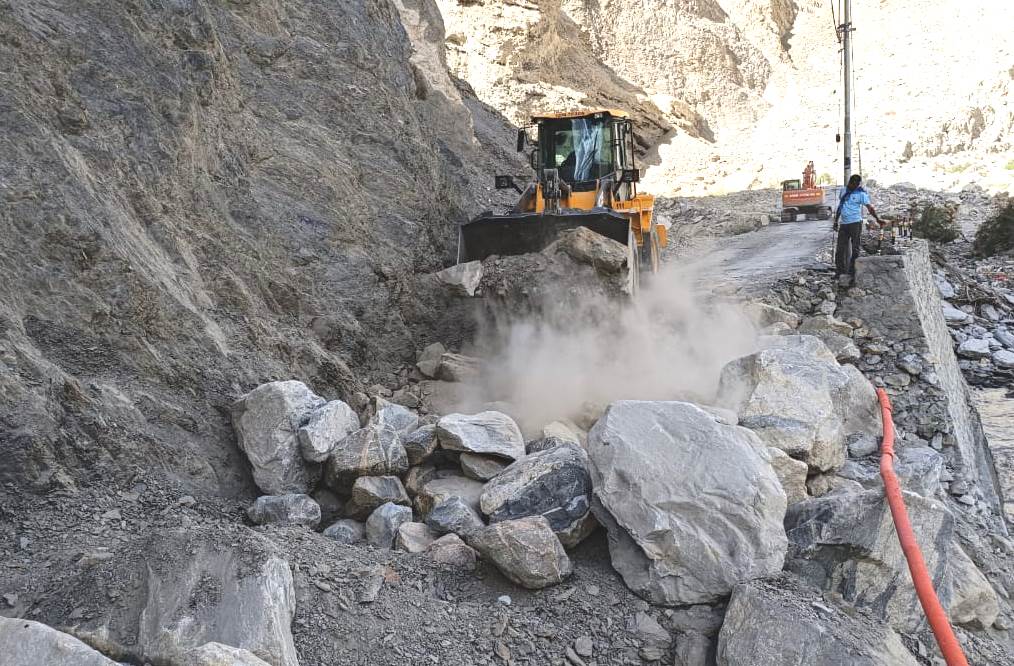
When monsoon descended upon Ladakh this year, it came not as gentle rain but as a relentless assault on its fragile mountains. The Khalsar–Agham–Shyok road — a narrow, winding artery carved through the Shyok Valley — bore the brunt of the onslaught. What began as steady rain in June soon turned into torrents that triggered flash floods, mudslides, and road washouts across the region.
By mid-season, the damage along this vital link was staggering. Over 1,100 metres of the road lay submerged under floodwater, another 3,150 metres were blocked by debris and landslides, and nearly 335 metres of the road formation had been washed away entirely. For days, the Shyok Valley stood cut off from the rest of Ladakh, its residents isolated as water and earth swallowed the only lifeline that connected them to the outside world.
For most people, such conditions would have spelled defeat. But for the engineers and workers of the 111 Road Construction Company (RCC) under Project HIMANK of the Border Roads Organisation (BRO), it became a call to arms. The team, seasoned by years of working in Ladakh’s unpredictable terrain, launched an all-out effort to reclaim the road from the mountains’ fury.
Heavy machinery — dozers, excavators, and tippers — was rushed to the site, and work began under conditions that would test even the toughest crews. The air was thick with rain and silt; the ground gave way underfoot. With slopes crumbling and streams surging across the alignment, every hour of work demanded not only technical skill but physical courage.
“There were stretches where the road simply didn’t exist anymore,” recalls a BRO engineer who was part of the restoration team. “We had to cut new temporary alignments through loose terrain, sometimes working with headlights in the dead of night.”
The disaster had left several civilians and local travellers stranded along blocked sections. Even as they focused on road clearance, BRO teams found themselves carrying out rescue operations, helping residents reach safer ground and ensuring essential supplies reached the isolated settlements of the valley. Local officials described the coordination between the district administration and BRO as seamless, with teams working “like one unit” despite the harsh conditions.
The situation brought into sharp focus what BRO’s work truly represents — not just road construction, but lifeline maintenance. In Ladakh’s high-altitude deserts, every route that BRO maintains is a channel for food, medicine, and hope.
The Khalsar–Agham–Shyok road holds more than local importance. It is a strategic corridor linking the Shyok Valley with routes leading toward the Daulat Beg Oldi (DBO) axis — one of the world’s highest and most remote operational sectors. The repeated blockages this monsoon season not only disrupted local life but also posed serious logistical challenges.
For the BRO, reopening this route was therefore both a humanitarian and strategic imperative. Step by painstaking step, they cleared debris, rebuilt embankments, and filled craters with compacted material. In places where floods had erased the alignment altogether, emergency bypasses were constructed to restore movement until the main formation could be rebuilt.
By late season, full connectivity had been restored, marking yet another triumph of perseverance in the face of Ladakh’s brutal elements.
Project HIMANK, often referred to as the “lifeline of Ladakh,” has a long record of achieving the impossible — whether it is carving roads across glaciated passes or reopening routes buried under snow and rock. The 111 RCC’s effort this monsoon has become part of that living legacy.
Their work reflects the BRO’s enduring ethos captured in its motto: “Shramena Sarvam Sadhyam” — Everything is achievable through hard work.
For the villagers of Shyok and Agham, that motto is not just a phrase — it is reality. “We thought we were cut off for the season,” said a shopkeeper from Agham. “Then the BRO came with their machines and men. They didn’t stop, even when it rained all night. They gave us back our road.”
As the season draws to a close and Ladakh prepares for the long winter ahead, the scars of this year’s rains are still visible along the mountain slopes. Yet so too are the signs of resilience — newly graded roads, repaired culverts, and the tire tracks of men who refused to yield.
