

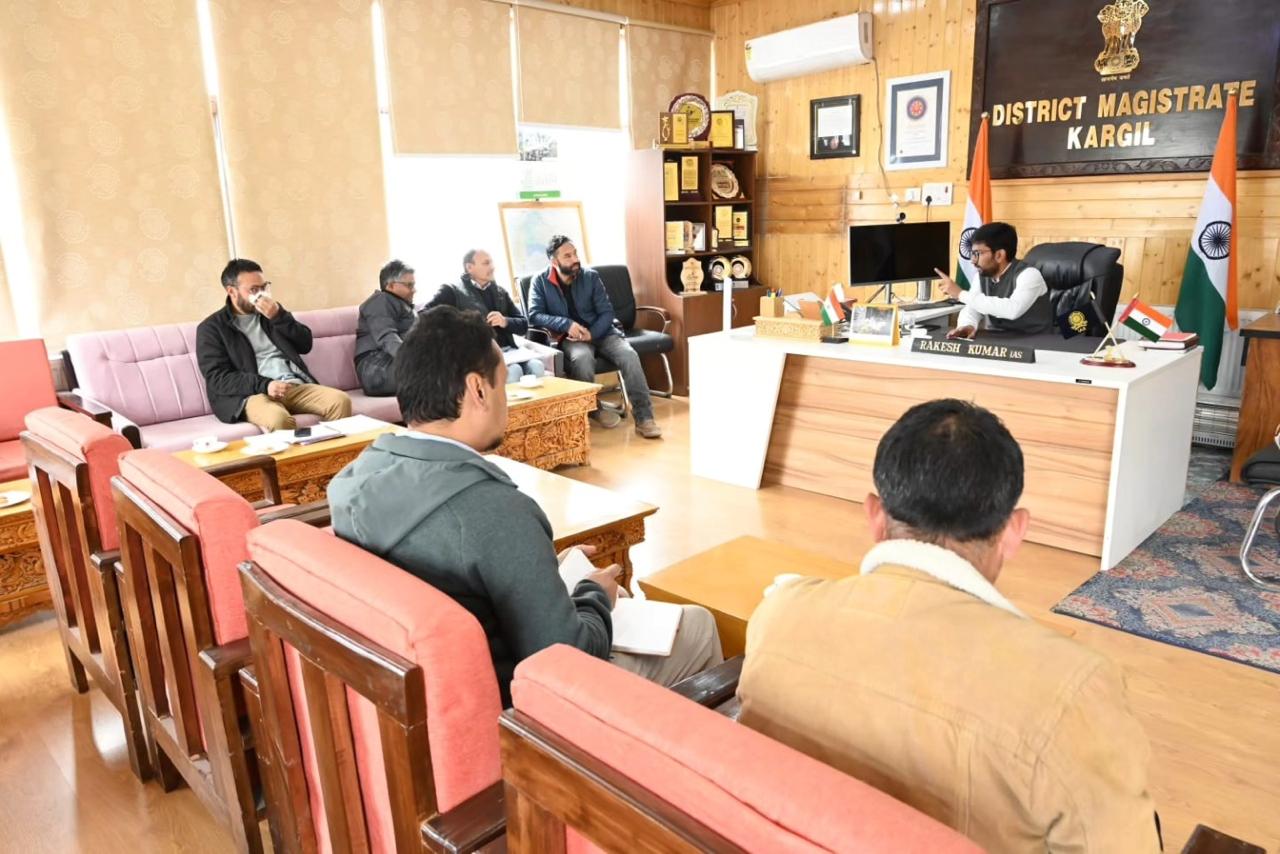
Kargil, Apr 18: Acting on directions from Ladakh’s Lieutenant Governor Vinai Kumar Saxena, the district administration has initiated a coordinated development plan for the Drass region, combining water management with eco-tourism and environmental protection.
“Our focus is on building sustainable infrastructure while preserving the ecological character of Drass,” said Deputy Commissioner Rakesh Kumar on Friday, outlining the broader strategy during a high-level meeting convened to review development priorities.
Chairing the meeting, the Deputy Commissioner emphasised the need to align water management, tourism potential and environmental safeguards in one of Ladakh’s most sensitive landscapes.
A major proposal under consideration is the construction of a check dam along a two-kilometre stretch of the Drass River towards Minimarg. Officials have been directed to undertake a drone survey to identify feasible starting and end points for the structure. Conceived during the Lieutenant Governor’s recent visit, the project is expected to regulate water flow and improve its utilisation for lift irrigation and allied purposes, offering relief to farmers in the region.
Attention has also turned to the largely unexplored Mushkoh Valley, which the administration believes holds promise for eco-tourism centred on wildlife and seasonal wild tulip blooms. The Deputy Commissioner directed the Tourism Department to prepare a structured plan that enables visitors to experience the valley’s natural setting without disturbing its ecological balance.
At Droupadi Kund, officials have been instructed to ensure strict protection measures while examining its development as a scenic viewpoint. The approach reflects a cautious attempt to improve accessibility while retaining the site’s natural character.
To ensure coordinated implementation, a multi-departmental committee has been constituted, bringing together representatives from the Irrigation and Flood Control, Tourism, Forest, Wildlife and Agriculture departments, along with the district administration. The panel has been tasked with preparing a detailed report and submitting its recommendations at the earliest.
The meeting also discussed the development of tulip gardens in Kargil alongside the conservation of naturally occurring wild tulips. Authorities are expected to identify suitable land for cultivation, which may also be utilised for agricultural purposes where appropriate.
Emphasising long-term planning, the Deputy Commissioner stressed the need for infrastructure that encourages visitors to stay longer and explore the region, while ensuring responsible use of natural resources. For Drass, often defined by its extreme climate, the initiative signals a shift towards carefully managed tourism supported by practical water management measures.
