

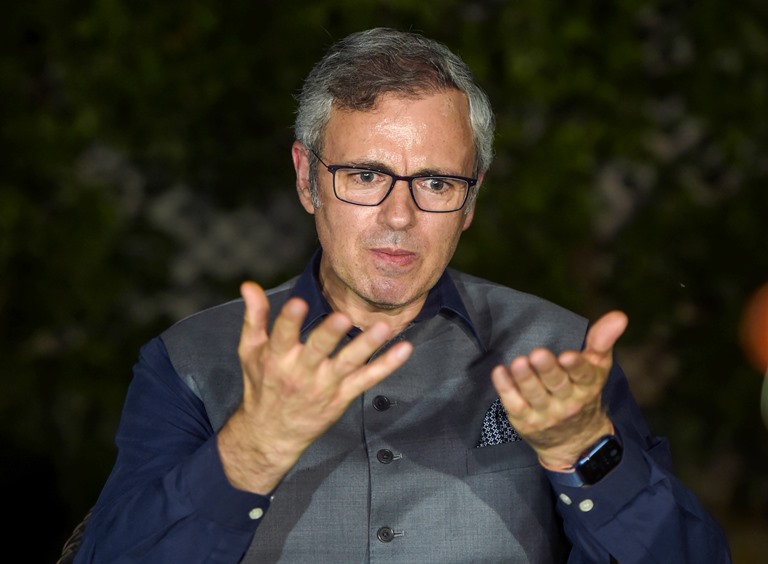
Srinagar: Jammu and Kashmir Chief Minister Omar Abdullah on Sunday dismissed allegations by the Bharatiya Janata Party (BJP) that he had approached the ruling party at the Centre in 2024 seeking an alliance in return for the restoration of statehood.
“I swear on the Holy Quran that I didn’t seek an alliance with the BJP in 2024 for statehood or for any other reason. Unlike Sunil Sharma, I don’t tell lies for a living,” Abdullah said in a post on X, rejecting the charge levelled by Leader of the Opposition Sunil Sharma.
Sharma had claimed that Abdullah visited Delhi earlier this year to offer support to the BJP in exchange for restoring Jammu and Kashmir’s statehood. Addressing an election rally in Budgam, the BJP leader alleged that Abdullah had made a similar attempt in 2014 when the assembly polls produced a hung verdict.
“In 2024, he again went to Delhi and offered to form the government with the BJP if statehood was restored. His offer was rejected, and he was told that we had a mandate to sit in the opposition,” Sharma told reporters. “He should swear on the Quran that he did not go to Delhi for government formation. We are ready to do the same wherever he wants,” he added.
Abdullah’s rebuttal comes amid escalating political sparring between the National Conference (NC) and the BJP during the ongoing campaign season. The NC leader has intensified his criticism of the Centre, asserting that his party remains the only political force “truly confronting the BJP” in Jammu and Kashmir.
Earlier in the day, Sharma, while campaigning for BJP candidate Syed Mohsin in Budgam, accused the NC of “double standards” and “hypocrisy.” He alleged that the party was attempting to block what he called a “wave of change” in the Union Territory.
“The NC is leaving no stone unturned to obstruct the BJP’s growth in Kashmir, but people have seen through their politics of deceit,” Sharma said.
Political observers say the exchange underscores deepening hostilities between the two parties ahead of the upcoming assembly elections, with both sides seeking to shape the narrative around statehood and regional representation.
