

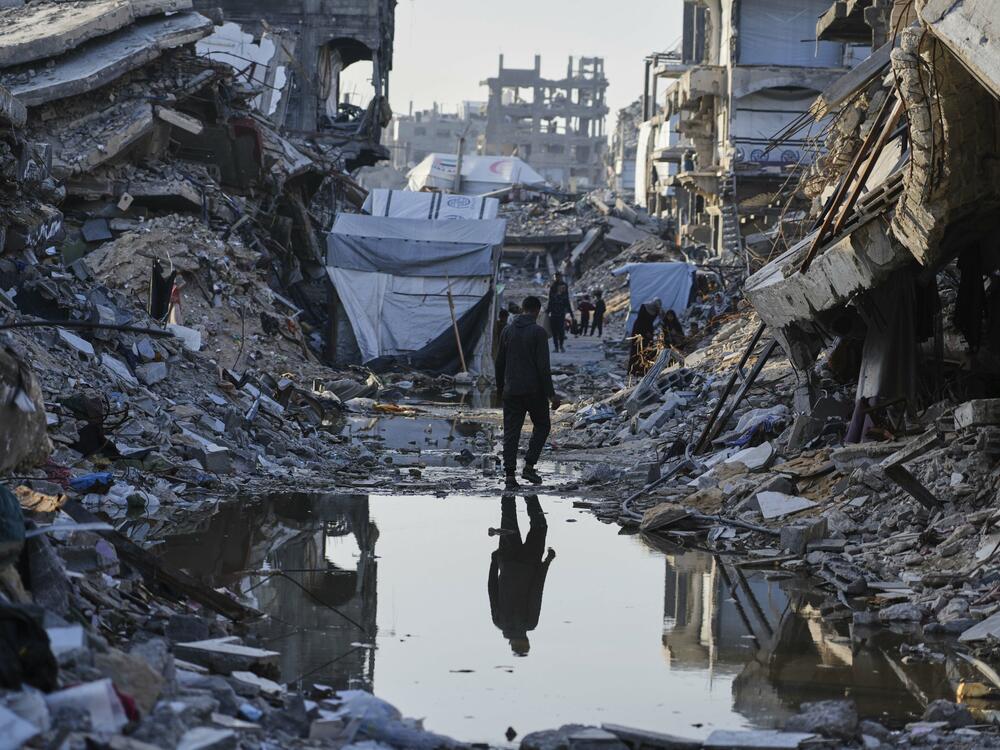
Dier al Balah, Jan 16 : Israeli Prime Minister Benjamin Netanyahu has cast doubt on the significance of the United States’ announcement that the fragile Gaza ceasefire would move into its second phase, calling key elements of the plan largely symbolic and raising fresh questions about its implementation.
In a late Wednesday meeting with the parents of Israeli police officer Ran Gvili—the last Israeli hostage whose remains are still held in Gaza—Netanyahu said the proposed Palestinian governing committee announced under phase two was merely a “declarative move,” rather than the substantive progress described by US envoy Steve Witkoff.
Gvili’s parents had urged Netanyahu not to proceed with the ceasefire until their son’s remains were returned, according to Israel’s Hostage and Missing Families Forum. Netanyahu assured them that securing his return remained a top priority.
While the announcement of the second phase marked a diplomatic step forward, it left several critical issues unresolved. These include the composition of an apolitical Palestinian governing committee of experts, the role of an international “Board of Peace,” the deployment of international forces, and the reopening of Gaza’s southern Rafah border crossing. An Israeli official, speaking on condition of anonymity, said the committee’s makeup was coordinated with Israel. Key questions also remain about disarming Hamas and rebuilding the war-ravaged territory.
Palestinians in Gaza expressed skepticism over what phase two would mean on the ground, pointing to ongoing violence and persistent shortages of basic necessities.
Gaza’s Health Ministry said more than 450 people have been killed since Israel and Hamas agreed to halt fighting in October. Those deaths, including more than 100 children according to UNICEF, are part of the 71,441 Palestinians reported killed since the start of Israel’s offensive. While Israel disputes the figures, the UN and independent experts consider the ministry’s data the most reliable available.
“We see on the ground that the war has not stopped, the bloodshed has not stopped, and our suffering in the tents has not ended,” said Samed Abu Rawagh, who was displaced from Jabaliya to southern Gaza. “Every day there is suffering—from rain to sun, from sun to death.”
Hamza Abu Shahab, from eastern Khan Younis, said people were waiting for tangible improvements, such as better access to food, fuel and medical care. “We were happy with this news, but we ask God that it is not just empty words,” he said. “We need this to be real.”
With a population exceeding 2 million, Gaza continues to face harsh winter conditions, shortages of humanitarian aid and an acute lack of adequate temporary housing. This marks the third winter since the war began on October 7, 2023, when Hamas-led militants attacked southern Israel, killing around 1,200 people and abducting 251 others.
The second phase of the ceasefire is expected to address far more complex issues than the first, including Hamas’ disarmament and the transition to a new governance structure after nearly two decades of the group’s rule in Gaza.
The United Nations estimates reconstruction costs will exceed USD 50 billion, a process likely to take years, with limited funding pledged so far.
Hamas has said it will dissolve its current government to allow the new committee to take charge but has not clarified the future of its military wing, civil servants or civilian police force. Bassem Naim, a member of Hamas’ political bureau, welcomed the committee’s announcement as a step toward an independent Palestinian state, saying on X that responsibility now lies with the United States and international mediators.
Israel, however, has maintained that Hamas must lay down its weapons—a demand the group’s leaders continue to reject, insisting Palestinians have what they describe as a “right to resist.”
