

LEH: A sweeping call for an actionable Himalayan sustainability agenda—spanning climate resilience, disaster preparedness, biodiversity restoration, and clean energy—emerged as the central highlight of the three-day national conclave that concluded at the G.B. Pant National Institute of Himalayan Environment (GBPNIHE). Experts from across the country warned that the Himalaya is approaching an ecological tipping point and urged policymakers to translate scientific evidence into immediate, region-wide interventions.
The conclave’s sessions outlined sharp concerns: from aerosol-driven warming and rising cryosphere instability to unchecked tourism, shrinking wetlands, and declining agro-biodiversity. Scientists pressed for long-term atmospheric observatories, strict emission norms, improved waste segregation, and innovations such as polythene-to-graphene recycling.
Biodiversity researchers cautioned that highland ecosystems are slipping from hotspot status amid habitat pressure and biological invasion. They recommended updated species databases, bryophyte inclusion in environmental assessments, peatland protection, and AI-enabled mapping of ecological disturbances.
Traditional knowledge advocates stressed that Indigenous Knowledge Systems remain vital for climate resilience, especially with women and pastoralists as core custodians. The panel flagged fading agro-biodiversity and weakening knowledge transfer, calling for community-based learning platforms and policy integration of traditional food, water, and land-use practices.
Disaster experts highlighted accelerating cryosphere instability and sediment-driven GLOF risks. They urged catchment-specific early warning systems, integrated modelling of extreme runout events, and restrictions on development in hazard-prone valleys, alongside the creation of a Himalayan Multi-Hazard Operations Cell.
Wetland and peatland specialists pointed to pollution, encroachment, and poor management of Ramsar sites. With machine learning–based peatland mapping and new carbon-sink data emerging, they sought integrated management plans, hydrological studies, and tourism carrying-capacity assessments.
Regional cooperation sessions pushed for cross-border hydrological dialogue, data-sharing frameworks, and the establishment of a Himalayan Academy of Sciences. Experts argued that ecological change is outpacing current interventions, demanding a broader Himalayan mandate and dedicated regional funding.
In discussions on ecosystem services, speakers urged recognition of the Himalaya as natural capital and encouraged green bonds, climate insurance, ecological fiscal transfers, and payments for ecosystem services to counter shrinking forest budgets and eroding dependence on natural resources.
Green energy deliberations promoted region-specific solutions—from passive solar buildings to micro-hydro, geothermal, and wind systems—anchored in affordability and integration of traditional architecture with modern technologies.
Tourism experts recommended diversifying destinations, forming a Himalayan Tourism Consortium, and adopting Bhutan’s high-value–low-impact approach. A proposed “Himalayan wallet” for environmental services and carrying-capacity evaluations featured prominently.
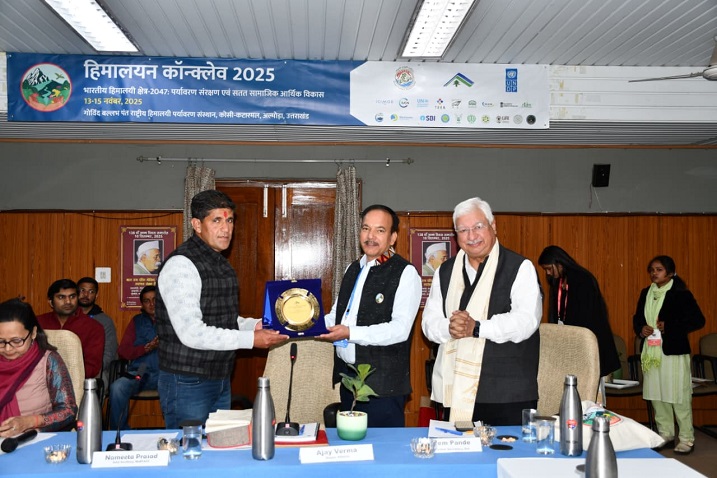
In the closing plenary, GBPNIHE Director Dr. I.D. Bhatt urged institutionalizing data-sharing, building accessible Himalayan databases, and publishing research through dedicated platforms. Senior dignitaries including Dr. Laxmikant, former Union Secretary Hem Pandey, Joint Secretary Nameeta Prasad, and Almora Mayor Ajay Verma demanded stronger collaboration, environmentally sensitive infrastructure, mentoring networks for young researchers, and heightened public awareness.
The conclave ended with a vote of thanks by Dr. K. Chandrasekar, concluding three days of sharp, solution-driven deliberations aimed at securing the future of the Himalayas.
National conclave flags urgent action plan for fragile Himalayas at GBPNIHE
Biodiversity Conservation climate policy India Climate Resilience cryosphere instability disaster risk reduction ecosystem services environmental governance GBPNIHE conclave green energy solutions Himalayan ecology Himalayan sustainability Indigenous Knowledge Systems Kargil Ladakh Ladakh News Leh peatland conservation sustainable tourism Himalayas The Earth News
