

Leh, Mar 25: Setting the tone for the Union Territory’s rural and economic planning for the coming financial year, the National Bank for Agriculture and Rural Development (NABARD) on Tuesday projected a Priority Sector credit potential of ₹1427.84 crore for Ladakh for FY 2026–27, with a clear thrust on agriculture, allied activities, MSMEs and rural tourism.
The projection, unveiled through the Focus Paper at a Credit Seminar in Leh, outlines a structured credit roadmap intended to expand institutional lending and support livelihood generation across Ladakh’s diverse and geographically challenging regions.
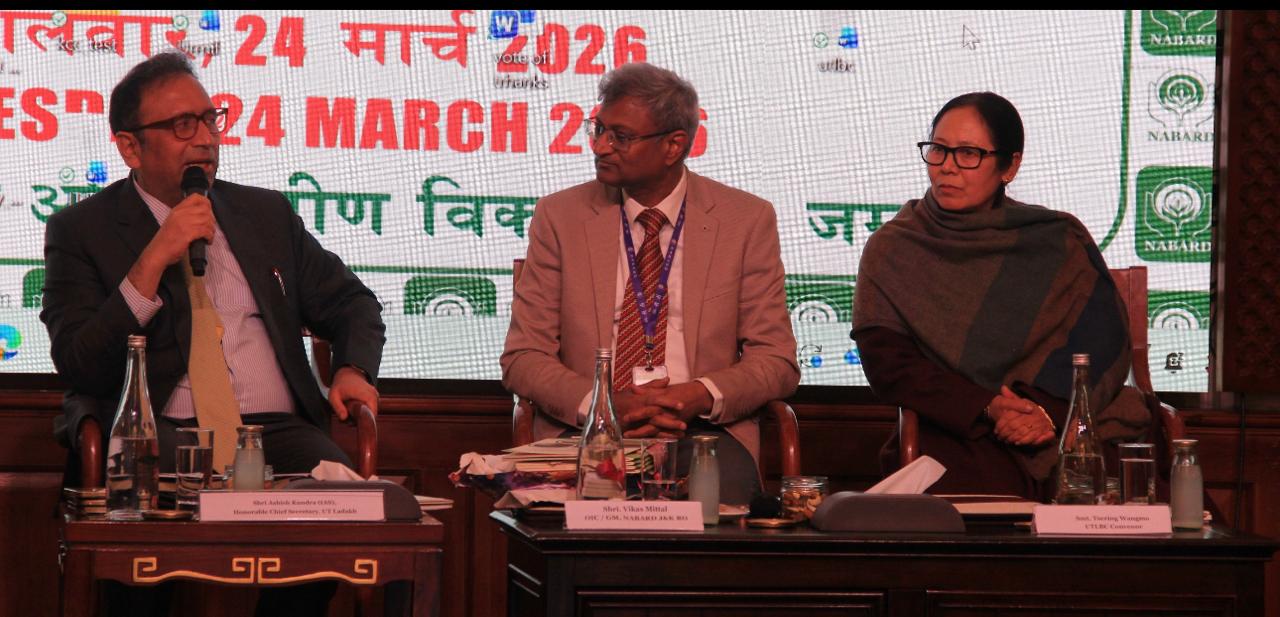
The document was released by Chief Secretary Ashish Kundra in the presence of senior administrative officials, banking representatives and development stakeholders, marking a coordinated push towards strengthening credit delivery systems in the Union Territory.
In his keynote address, the Chief Secretary emphasised the need for enhanced institutional support mechanisms, particularly for cooperative societies, through focused training, capacity building and sustained assistance in securing credit linkages with banks.
He proposed the establishment of a dedicated Project Management Unit to support the administration in designing and implementing programmes in agriculture and rural development. Kundra also called for the formation of a consultative framework involving government departments and NABARD to improve coordination and convergence in development initiatives.
Highlighting the importance of targeted planning, he stressed the need to promote income-generating activities in Vibrant Villages, with a view to strengthening local economies in remote areas. He also acknowledged NABARD’s ongoing interventions and urged for deeper collaboration to implement integrated development projects.
NABARD’s General Manager and Officer-in-Charge, Vikas Mittal, underlined the institution’s continued engagement in strengthening rural credit flow in Ladakh. He pointed to the importance of collaborative planning and focused interventions in unlocking economic opportunities across sectors.
The Focus Paper, presented by Tsewang Dorjey, Assistant General Manager at NABARD’s Ladakh Sub Office, provides detailed sector-wise projections. It places emphasis on agriculture and allied sectors, along with rural tourism, MSMEs, and non-farm activities.
Priority areas identified include expanding access to agricultural credit, strengthening Farmer Producer Organisations, and increasing productivity in horticulture. Crops such as seabuckthorn and apricot have been identified for area expansion and value enhancement.
The document also outlines strategies to promote handloom and handicrafts through value addition, structured marketing systems, and efforts towards Geographic Indication registration, aimed at improving market access and returns for local producers.
Discussions during the seminar also highlighted NABARD’s ongoing interventions tailored to Ladakh’s ecological and socio-economic context. These include natural resource management initiatives, particularly water conservation efforts through artificial glaciers and automated ice reservoirs.
A presentation on automated ice reservoirs, supported by NABARD, was delivered during the session, demonstrating measures being adopted to address water scarcity in high-altitude areas.
Officials also noted NABARD’s work in strengthening value chains in sectors such as pashmina, along with support for handicrafts and GI-linked products. These interventions are aimed at enhancing income opportunities, building community institutions and promoting sustainable livelihoods.
The seminar witnessed participation from senior officials of the Union Territory administration, representatives of the banking sector and other stakeholders. Among those present were Bhanu Prabha, Secretary, Cooperatives; Urmil Lata, Deputy General Manager, NABARD; and Tsering Wangmo, Assistant General Manager, UTLBC Ladakh.
The proceedings concluded with a vote of thanks, wrapping up deliberations focused on aligning credit planning with Ladakh’s development priorities for the upcoming financial year.
