

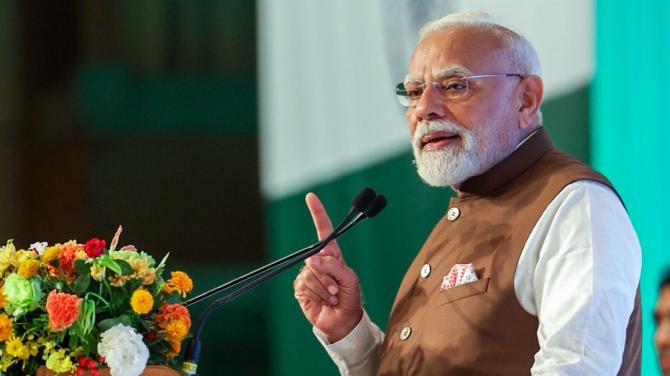
PM stresses Indo-Sino collaboration for global economic stability
Beijing, Aug 29: Prime Minister Narendra Modi and Chinese President Xi Jinping are set to hold two key bilateral meetings during the SCO summit in Tianjin on Sunday, aiming to bolster India-China relations against the backdrop of global trade uncertainties triggered by US President Donald Trump’s policies.
Arriving from Japan on Saturday evening, Modi is scheduled to meet Xi around noon on Sunday, with a potential second meeting before the SCO summit’s official banquet.
On Monday, Modi will attend the summit and likely hold talks with Russian President Vladimir Putin before returning to India.
As India navigates strained ties with the US due to Trump’s 50% tariffs on Indian exports, this summit Modi’s first visit to China in seven years holds critical significance.
Though Modi is expected to have bilateral meetings with several leaders, his meeting with Xi will be the most watched one, not simply in India and China but all around the world.
The outcome of the meeting was expected to set the tone for the future course of bilateral relations, which, experts say, looks bright as the two countries faced the brunt of Trump’s tariffs.
Meanwhile PM Modi on Friday said it is important for India and China to work together to bring stability to the world economic order as he asserted that New Delhi is ready to advance bilateral ties from a strategic and long-term perspective based on mutual respect, mutual interest and mutual sensitivity.
Xi and Modi met last year at Kazan on the sidelines of the BRICS summit, which ended over a four-year deadlock or freeze in the bilateral ties over the military tensions in Eastern Ladakh.
Modi and Xi know each other well. Before the Ladakh tensions, they met numerous times in bilateral and multilateral summits, including informal summits, spending quality time to understand each other. Since the Kazan meeting, the two sides have stepped up wide-ranging interactions.
Special Representatives for the boundary issue, NSA Ajit Doval and his counterpart Wang Yi, have held two rounds of talks in the last nine months to set the tone for the normalisation process of the bilateral relations.
This month’s Doval-Wang meeting, which took place in the backdrop of Trump’s tariff tirade against India, has breathed new momentum into the Sino-Indian relations, which had a chequered history in the last seven decades.
The two officials even spoke of an early harvest of the boundary issue, which is rarely heard in the fraught India-China relations.
In this background, the Modi-Xi meeting acquires significance and raises expectations that they may provide a broader roadmap for enhanced ties.
Also, Trump warmed up to Pakistan after Operation Sindoor, hosting an unprecedented luncheon meeting for Pakistan Army Chief Asim Munir, opening a new strategic window to Islamabad despite India’s grave concerns related to cross-border terrorism promoted by Pakistan.
Pakistan, a member of the SCO, will also be present at Tianjin as Prime Minister Shehbaz Sharif will be attending the summit.
Modi’s meeting with Putin was expected to draw global attention as Trump singled out India for a tariff hike for buying Russian oil and gas.
For its part, China is trying to make the Tianjin SCO summit the largest by inviting 20 foreign leaders.
On the Modi-Xi meeting, Chinese strategic analysts say the Indian Prime Minister’s attendance at the SCO meeting is important for their bilateral relations and for the summit itself.
Welcoming Modi ahead of his visit to the country for the SCO Summit, China believes that the atmosphere of the summit between PM Modi and President Xi will be quite harmonious, since both of them are friends and know each other well, Zhou Rong, Professor of strategic studies at China’s Renmin University, said.
“They used to have very friendly and sincere meetings for the last 10 years. China hopes that Modi’s coming will encourage the concerted effort of all parties to make the summit of the SCO successful and fruitful,” he said.
Although China and India have started making joint efforts to repair their ties, it makes sense that China would be pragmatic and prudent in handling the relations with India, he said, adding that “we need a good neighbourly relation with India and we need to revitalise the two great civilisations”.
Rong Ying, a senior research fellow at China Institute of International Studies (CIIS), said India’s participation and support for the SCO is crucial, and all the other SCO members welcome PM Modi’s participation.
“China, as a host, is anticipating India to make more contributions and play a constructive role in the SCO. China-India close cooperation and collaboration in regional and global groupings like the SCO has been a major area with great potential,” Rong, also Professor at Sichuan University, told PTI.
The success of the SCO Tianjin summit should be defined by peace, security, and development challenges commonly facing the SCO members, which is going to showcase the significance of the bloc as a new regional grouping different from the traditional ones, Rong said.
Modi, in an interview with The Yomiuri Shimbun published during his ongoing visit to Japan, Modi also asserted that stable, predictable, and amicable bilateral relations between India and China, as two neighbours and the two largest nations on earth, can have a positive impact on regional and global peace and prosperity.
Asked about the importance of improving relations with China at this time, Modi said, “At the invitation of President Xi Jinping, I would be travelling to Tianjin from here to take part in the SCO Summit. Since my meeting with President Xi in Kazan last year, steady and positive progress has been made in our bilateral ties.”
Stable, predictable, and amicable bilateral relations between India and China, as two neighbours and the two largest nations on earth, can have a positive impact on regional and global peace and prosperity, he said.
This is also crucial for a multi-polar Asia and a multi-polar world, he added.
“Given the current volatility in world economy, it is also important for India and China, as two major economies, to work together to bring stability to the world economic order,” Modi said.
India is ready to advance bilateral relations from a strategic and long-term perspective on the basis of mutual respect, mutual interest and mutual sensitivity, and to enhance strategic communication to address our developmental challenges, he said.
On his views on the Japanese government’s concept of a free and open Indo-Pacific, Modi said there is a strong convergence between Japan’s vision of a free and open Indo-Pacific and India’s own approach encapsulated in our Indo-Pacific vision, in the ‘Vision MAHASAGAR’ and the Indo-Pacific Oceans’ Initiative.
India and Japan are committed to an Indo-Pacific that is peaceful, prosperous, stable and where the territorial integrity and sovereignty of nations are respected, the prime minister said.
“Both our countries have strong and extensive linkages with countries in the Indo-Pacific region, and we both engage with some of them in plurilateral formats to give expression to our shared objectives,” he said.
Talking about his recent conversations with the leaders of Russia and Ukraine, Modi said India has maintained a principled and humanitarian stance on the conflict, which is equally appreciated by both President Vladimir Putin and President Volodymyr Zelenskyy.
“In line with this, both the leaders spoke to me to share their perspectives on the developments related to the conflict. I reiterated India’s principled and consistent stand and encouraged dialogue and diplomacy to resolve the conflict. I have already indicated India’s willingness to support meaningful efforts aimed at achieving peaceful resolution of the conflict,” he told the Japanese newspaper.
“I believe, by virtue of our good relations with both sides, including key stakeholders, we can strengthen efforts dedicated to the restoration of an early and lasting peace in Ukraine,” Modi said.
Stressing the importance of the Global South, Modi said the global community has made a commitment to create a more equitable world through achieving Sustainable Development Goals by 2030.
“If we have to live up to this commitment, then the Global South must be given priority. In a highly interconnected world, we have seen the debilitating impact of the pandemic, conflicts and supply chain disruptions on the Global South,” the prime minister said.
They continue to face myriad challenges involving global governance, climate change, food and energy security, debt and financial stress, all having a significant impact on their development priorities, he said.
“As members of the Global South, we clearly understand these concerns and their effects on people’s lives. We have made strenuous efforts to bring these to the forefront of the global agenda,” he said.
“All our global initiatives, like Mission LiFE, Coalition for Disaster Resilient Infrastructure, International Solar Alliance, Global Biofuels Alliance, focus on promoting the interests of the Global South. Our G20 Presidency saw the inclusion of the African Union and gave voice to the aspirations of the Global South,” Modi pointed out.
Similarly, in BRICS, India is actively engaged in working toward the benefit of the Global South, he added.
India attaches importance to its engagement with BRICS, which has emerged as a valuable forum for consultation, and cooperation and has helped promote mutual understanding, on a specific set of issues of common interest to emerging economies, he said.
Under the rubric of the Quad, he said they have worked for the development and progress of the countries in the Indo-Pacific.
“India has also consistently called for urgent and comprehensive reforms of the global multilateral institutions to make them more effective and reflective of the current geopolitical and economic realities,” he said.
He pointed out that in the last 20 years, since its inception in 2004, the Quad has emerged as a force of global good, delivering positive outcomes for the people of the Indo-Pacific region.
