

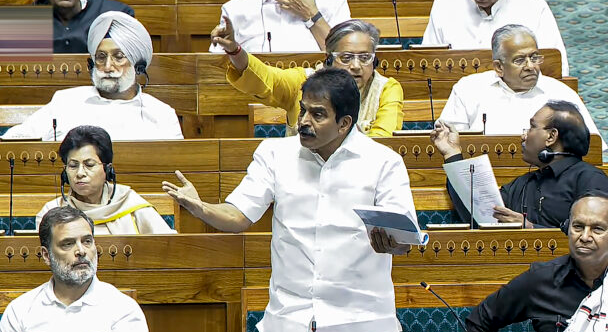
New Delhi, Apr 16 : The Constitution (131st Amendment) Bill, which seeks to tweak the women’s quota law to enable 33% reservation for women in the Lok Sabha and state assemblies, was introduced in the Lok Sabha today after a heated 40-minute debate and a division of votes.
The bill passed its introduction with 251 members in favor and 185 against. Alongside it, two ordinary bills—the Delimitation Bill and the Union Territories Laws (Amendment) Bill—were also introduced to implement the amended quota law in Delhi, Puducherry, and Jammu & Kashmir.
Congress leader K C Venugopal questioned why these changes weren’t included when the women’s quota law was first passed in 2023, calling the bills “anti-constitutional.” Samajwadi Party chief Akhilesh Yadav asked why the government is rushing without conducting a fresh census, even though he supports women’s reservation.
Home Minister Amit Shah responded that the Census 2027 is already underway and includes caste enumeration, but warned that reservation based on religion is “unconstitutional.” Speaker Om Birla allowed the Constitution amendment bill to be discussed alongside ordinary bills, citing past precedents since they relate to the same subject.
DMK MPs wore black as a protest, with T R Baalu saying his party supports the 2023 women’s quota law but not the current bill’s delimitation focus. RSP’s N K Premchandran also opposed the amendment, stressing it’s about delimitation, not reservation.
Under the proposed 131st Amendment, Lok Sabha seats will increase from the current 543 to a maximum of 850 (815 from states and up to 35 from Union Territories) to operationalise women’s reservation before the 2029 parliamentary polls. The increase is based on delimitation using the 2011 Census.
State and UT assemblies will also expand to accommodate 33% reservation for women. Reserved seats will be rotated among different constituencies in each state or UT.
Several opposition parties had earlier decided to unite in voting against the delimitation provisions while clarifying they are not against women’s reservation itself.
