

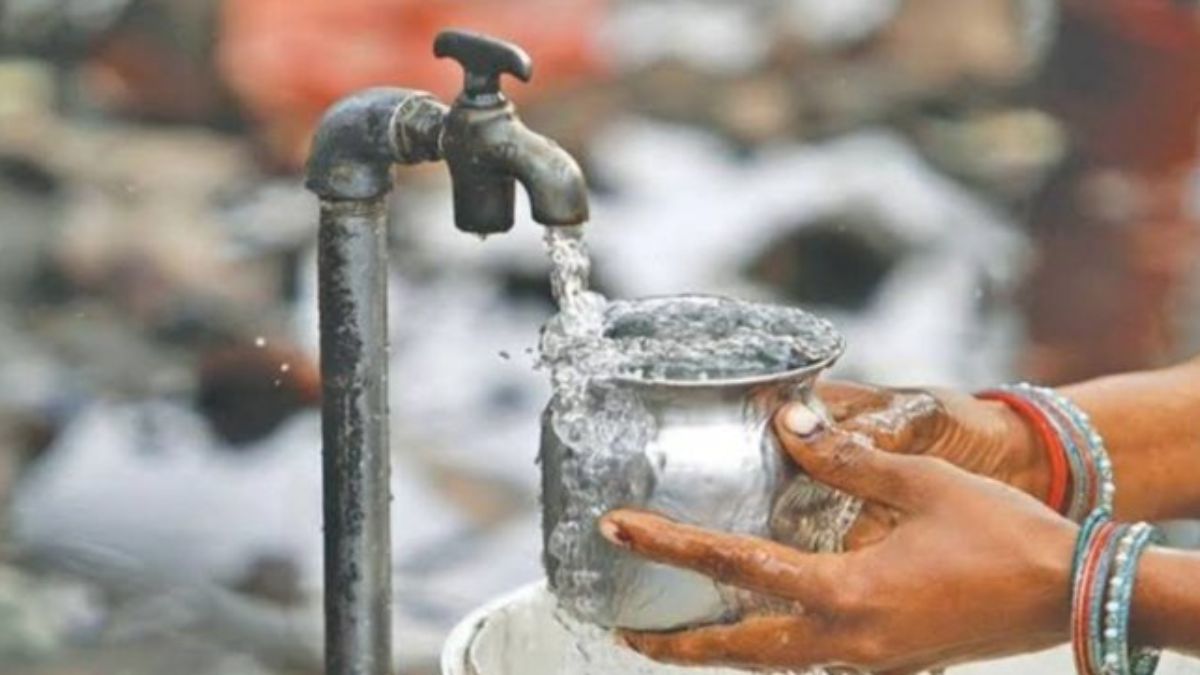
Jammu, Feb 19: The Jammu and Kashmir Government revealed Thursday that the Centre’s flagship Jal Jeevan Mission (JJM) has delivered functional tap water connections to about 15.6 lakh households across the Union Territory—over 81% of the total 19.25 lakh rural homes—but more than 3.61 lakh families remain without this basic necessity.
Answering CPI(M) MLA Mohammad Yousuf Tarigami’s starred question in the Legislative Assembly, Jal Shakti Minister Javed Ahmad Rana shared district-wise data highlighting stark disparities. Srinagar and Ganderbal lead with 100% coverage (10,407 and 41,551 households respectively), while Jammu lags badly with 1.26 lakh connected out of 1.89 lakh, leaving 62,950 high and dry—the highest shortfall statewide.
Rajouri (44,759 uncovered) and Kathua (35,064) follow Jammu’s gap, with Kupwara (27,159), Doda (26,757), Samba (23,648), Poonch (22,077), and Udhampur (20,589) also trailing. Lower shortfalls persist in Baramulla (16,706), Kishtwar (13,893), Budgam (13,764), and others down to Shopian’s 3,472.
Launched nationally to ensure 100% Functional Household Tap Connections (FHTC) by 2024—providing at least 55 liters per capita daily of BIS-standard water—the JJM faced extensions amid challenges like terrain, funding, and maintenance in J&K’s hilly and border regions. Rana assured ongoing works prioritize the uncovered, with manpower optimally deployed across PHE divisions despite no supervisory shortages.
In south Kashmir’s Kulgam and Yaripora municipalities, all homes already have connections, but AMRUT 2.0 schemes worth ₹5.75 crore and ₹3.74 crore will boost supply for 6,421 and 1,142 households by FY 2026-27. A new Operation & Maintenance policy is in works, covering manpower for sustainable rural infrastructure.
The update reflects J&K’s push toward water security, building on earlier milestones like 70% coverage in 2025, but underscores urgency to bridge urban-rural divides, ensure quality, and prevent contamination in vulnerable districts amid climate stresses and population growth. Full saturation remains a key electoral and welfare priority.
