

‘Process have been initiated to fill gazetted, non-gazetted posts’
Leh, Aug 11: The Chief Secretary of Ladakh, Dr Pawan Kotwal Monday said that Government of India (GoI) had taken several landmark decisions for ensuring the holistic development of Ladakh UT keeping in mind the unique geographical conditions of the region and cultural identity of its native; and the UT administration was busy in fast tracking the implementation process to pass on the benefits to the people of Ladakh, especially youth.
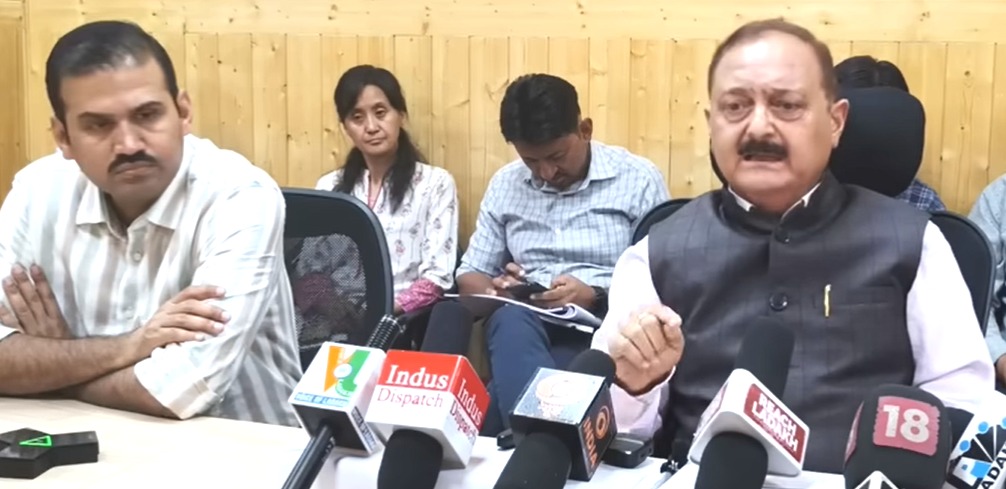
Addressing a press conference flanked by Secretary Information & PR and PDD, Vikram Malik, Dr Kotwal highlighted the achievements and progress in UT Ladakh and said “In a landmark move aimed at safeguarding employment opportunities for locals, the Union Territory of Ladakh has framed new domicile rules ensuring that no outsider can obtain a domicile certificate until October 31, 2034, thereby reserving all government vacancies exclusively for the youth of Ladakh.”
“The J&K Reservation Act, 2004 has been amended through Presidential Regulation to raise reservation in government jobs to 85per cent. Additionally, 10per cent of EWS seats will be de-reserved from the same merit list, effectively ensuring that 95per cent of jobs are meant for Ladakhi youth — an arrangement “nowhere else in the country,” he added.
The district recruitment boards have already advertised 534 posts in Leh and 474 in Kargil, while the Ladakh Subordinate Service Selection Board has begun recruitment for 377 posts. To fill gazetted posts — including 125 Medical Officers, 67 lecturers, and 32 Accounts Officers — a special request was made to UPSC, which agreed to include Ladakh in its current recruitment calendar despite having finalized it earlier.
Since no recruitment has taken place in the past six years, a five-year across-the-board age relaxation has been granted to overage candidates. Revenue officers have been directed to prioritize issuing ST, ALC, and Ladakh Resident Certificates to eligible applicants to ensure no one misses out due to documentation delays.
The Government of India has approved 33per cent reservation for women in the Ladakh Autonomous Hill Development Councils (LAHDCs), strengthening women’s participation in decision-making. Additionally, Bhoti and Purgi have been declared official languages alongside English, Hindi, and Urdu, with special focus on promoting Purgi and other local languages through the Ladakh Academy of Art, Culture and Languages.
The new Ladakh Sports Policy introduces cash incentives to promote a sports culture. An Ice Hockey Federation has been constituted, and a dedicated policy for mountaineering will benefit locals engaged in adventure activities. Thirteen different adventure sports will now follow regulated safety standards to raise their quality.
Efforts are underway to make the Ladakh Medical College functional next year, with 350 sanctioned posts and SNM Hospital being upgraded from 200 to 350 beds. District Hospital Kargil will be expanded from 100 to 200 beds. Plans are also in place to set up an engineering institute on the lines of NIT in Kargil, while work on Sindhu Central University has begun, featuring green energy projects like a wind turbine and solar power installations.
Pashmina production in Ladakh currently stands at 45 metric tonnes, with a state-of-the-art dehairing machine now operational. Cooperatives will be engaged to boost the sector, while sophisticated goat kid pens are reducing livestock mortality. The administration aims to increase Pashmina sheep and Karakul goat populations to further raise output.
A massive 11 GW Solar Power Plant will be set up at Kharnak on 48,000 acres. Addressing grazing concerns, the design will raise panel height to 5 feet, allowing livestock to graze underneath. A demonstration project at Pang, finishing in September, will showcase its benefits before full-scale implementation. The ₹22,000 crore Green Corridor Project will transmit this clean energy.
The 4G saturation project is progressing rapidly to ensure e-services reach even the remotest villages. While Ladakh’s budget allocation has dropped from Rs 6,000 crore to Rs 4,700 crore this year, the administration will seek a revised budget, aiming for 80per cent Capex expenditure to justify additional funding.
Urban Development Authorities are planned for Leh and Kargil to manage rapid urbanization, while a committee will address Nautor land rights. Registration of hotels and guest houses has been eased, with the Sewage Treatment Plant condition removed and an online system under development.
Dr. Kotwal stressed that Ladakh’s unique geography demands that distance, not population, be the key criterion for central schemes, ensuring equitable development of this vast and remote region.
