


Panel Interacts with Students & Faculty on Academic Aspirations
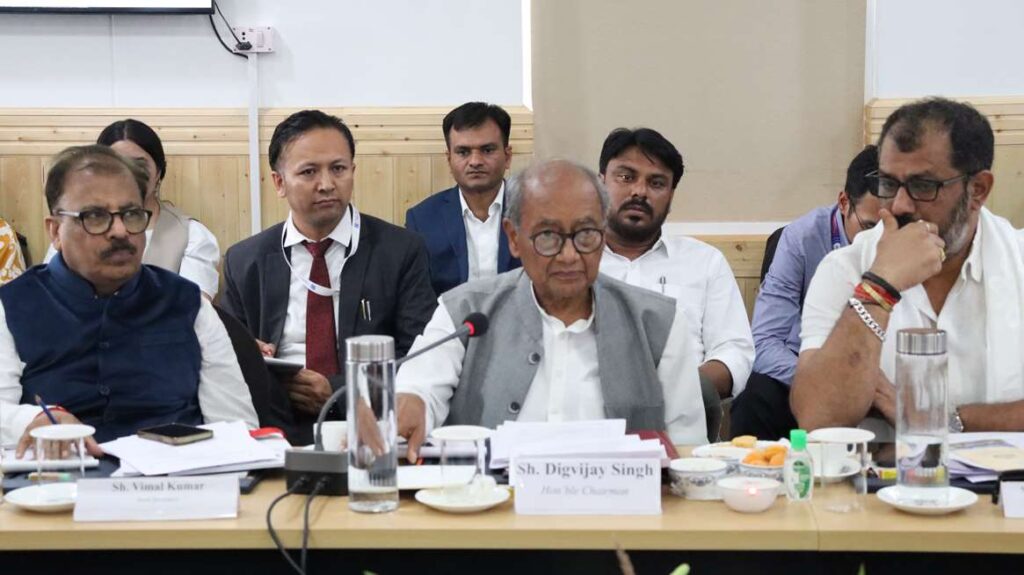
Leh, July 18: Against the majestic backdrop of Ladakh’s snow-covered peaks, the University of Ladakh welcomed the Department-related Parliamentary Standing Committee on Education, Women, Children, Youth and Sports. The visit, held at the Leh Campus, brought national attention to the university’s progress and its growing role in strengthening education in India’s border region.
The delegation, led by Digvijay Singh, Chairperson of the Committee, included Members of Parliament from both houses, as well as senior officials from the Ministries of Culture, Education, and Defence Research. The Vice-Chancellor of the University, Professor Saket Kushwaha, along with faculty, staff, and students, received the delegates with warmth and enthusiasm.
During the interactions, the committee held discussions with various institutions from Ladakh and New Delhi. These included the Department of Higher Education (UT Ladakh), Central Institute of Buddhist Studies, Sindhu Central University, Defence Institute of High Altitude Research, and others. Topics ranged from staffing gaps in educational institutions to ways of improving coordination among universities and colleges across the region. Barriers that students face while accessing education in remote Himalayan areas also formed a core part of the conversation.
A major highlight of the visit was the inauguration of a new computer laboratory developed under the PM-USHA scheme. Equipped with modern technology, the lab is expected to support digital learning and skill-building among students from Ladakh. The delegation also released the university’s publications Radiance and the LAMA Newsletter, celebrating local academic voices and ongoing research efforts.
The tour of the university’s facilities offered the delegation a closer look at advanced research labs and student-led projects. The committee expressed appreciation for the range of studies underway and the university’s commitment to science and technology.
An exhibition followed, featuring contributions from the Leh and Kargil campuses of the University of Ladakh, government colleges, the School of Agriculture Science and Technology, the Department of Science and Technology, and the Central Institute of Buddhist Studies. A local women’s collective, SAMZANG Group from Taru village, also displayed their work, drawing attention to the mix of traditional culture and emerging skills within Ladakh’s educational framework.
The visit concluded with a cultural program where students from the university and its affiliated colleges performed folk dances and songs, reflecting the deep-rooted heritage of the region. Supported by local Army units, the performances added a vibrant and personal touch to the delegation’s experience.
As the sun set over the mountains, the day marked not just a formal visit, but a shared vision for nurturing education, innovation, and opportunity in one of India’s most remote but promising regions.
