

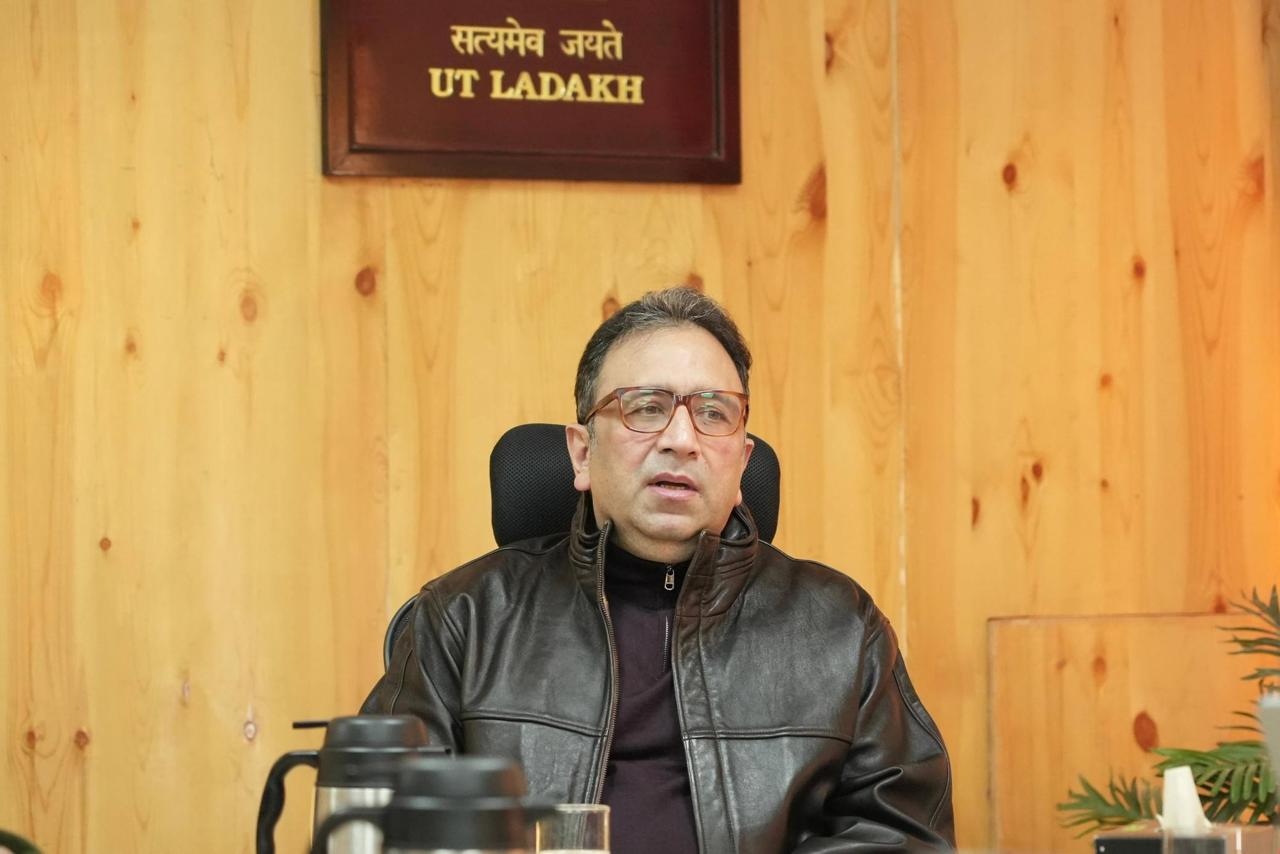
Leh, Jan 9: Calling the shift to digital land governance an urgent administrative priority, Chief Secretary Ashish Kundra on Thursday chaired a detailed review meeting on the newly rolled out Ladakh Land Records Portal, which is intended to overhaul land revenue administration across the Union Territory.
Opening the discussion, Kundra said the online system must quickly transition from pilot testing into everyday usage. He noted that the portal should become the primary channel for all land transactions in Leh district within the current month and added that the administration would monitor progress closely to ensure deadlines do not slip.
Assistant Commissioner Revenue Shabir Hussain presented the status of the project and explained that the platform has been designed as a secure web-based application built around paperless workflows and supported by modern digital mapping technology. He informed the meeting that village-level surveys have been completed in forty villages of the Leh district, while the remaining villages and all areas of Kargil district are still in progress. Drone-assisted mapping, he said, is being used to speed up survey work in areas where terrain and weather make conventional data collection difficult.
Hussain further explained that the portal already hosts critical revenue documents such as Jamabandi, Girdawari, Records of Rights and mutation details, allowing citizens and departmental users to access and analyse information online. Once expanded, the platform will serve as a single digital entry point for maps, survey and settlement records, land partitions and immovable property registration, supporting both residents and institutional agencies including courts, banks and planning authorities.
Chief Secretary Kundra examined the architecture of the portal in detail with a particular focus on the accuracy of base maps and the methods being used to validate records. He stressed that digital entries must be authenticated before the system is thrown open to public search. While routine extracts could eventually be made available for instant download, he said transactions involving sale, inheritance, division and mortgage must remain subject to scrutiny and proper verification. Kundra also asked officials to confirm how many users had accessed the platform so far and directed that adoption rates be tracked.
The meeting reviewed login safeguards, staff access rights and the training of field officials. Kundra called for competency tests for Patwaris and other staff handling land revenue work and urged departments to remove basic operational bottlenecks by ensuring laptops and technical support reach field offices without delay.
Emphasising outreach and user education, the Chief Secretary instructed that the portal be fully activated in Leh district by January 26 and said it should become compulsory for filing and updating land records once notified. He described the transition as central to building a transparent and reliable land administration system, where records are preserved digitally and made easily accessible.
The meeting was attended by senior officers from the Revenue Department, NIC Ladakh, Finance Department and representatives of the vendor agencies involved in the project implementation.
Earlier, the Chief Secretary Ladakh, Ashish Kundra chaired a departmental review meeting of the Public Works Department (PWD) and the Mechanical Engineering Department (MED) at Leh to assess progress, challenges, and future plans related to infrastructure development in the region.
During the meeting, Michael M. D’Souza, Secretary (GAD/PWD–R&B), made a detailed presentation on the functioning and performance of the PWD, highlighting ongoing and proposed works under various centrally sponsored and UT-level schemes. The presentation covered initiatives under the Central Road and Infrastructure Fund (CRIF), Status of major strategic tunnel projects, Pradhan Mantri Gram Sadak Yojana (PMGSY), Special Development Package (SDP), and State Capex Budget.
It was informed that road and bridge projects worth approximately ₹2,896 crore are being executed under CRIF, along with additional bridge works approved by the Ministry of Road Transport and Highways. The presentation also underscored the unique geographical and climatic challenges of Ladakh, including high-altitude terrain, extreme winters, a short working season, and ecological sensitivity, which significantly affect project execution.
The meeting reviewed the physical and financial progress under the State Capex Budget, reporting about 91 percent expenditure as of December 31, 2025. A total of 72 projects covering buildings, roads, and bridges, with an estimated cost of ₹288.32 crore, are under execution, with several works already completed. Progress under PMGSY was also assessed, noting that of the 196 schemes sanctioned under PMGSY-I to III, 137 have been completed, while PMGSY-IV is focused on providing connectivity to unconnected habitations under the Vibrant Villages Programme.
The discussion also covered works under the Special Development Package, financial expenditure of other departments under SDP, requirements of maintenance grants, the pending release of PMGSY-I funds from the Ministry of Rural Development, and the key achievements of the PWD (R&B) Department over the last five years.
The Mechanical Engineering Department presented an overview of its organizational structure, divisional setup in Leh and Kargil, availability of machinery division-wise, key achievements during 2025, and its vision, roles, and responsibilities in supporting infrastructure development across the UT.
The Chief Secretary emphasized the need for optimal utilization of the working season and explored possibilities of extending work during winter through better planning, technology adoption, and addressing labour-related issues. He reviewed the status and criteria of Class-A contractors, ongoing tenders, and under-construction projects, and directed the department to prepare a comprehensive digital road network map indicating covered and uncovered areas to improve connectivity planning.
He further instructed the department to move towards end-to-end digital processes, including contractor registration, tendering, payments, work codes, and geo-tagged photo monitoring, in coordination with the IT Department. The use of camera-based monitoring systems on major projects and the role of the technical section in overseeing ongoing works were also reviewed.
The Chief Secretary directed identification of unused government buildings for alternative purposes and sought an explanation regarding vacant posts in the department and delays in their advertisement.
The meeting was attended by Michael M. D’Souza, Secretary (GAD/PWD–R&B), Er. Abdul Mutalib, Chief Engineer, PWD (R&B) PMGSY, Dr. Dorjey Gyatso, Superintending Engineer, PWD (R&B) Circle Leh, along with other senior engineers and departmental officials.
