

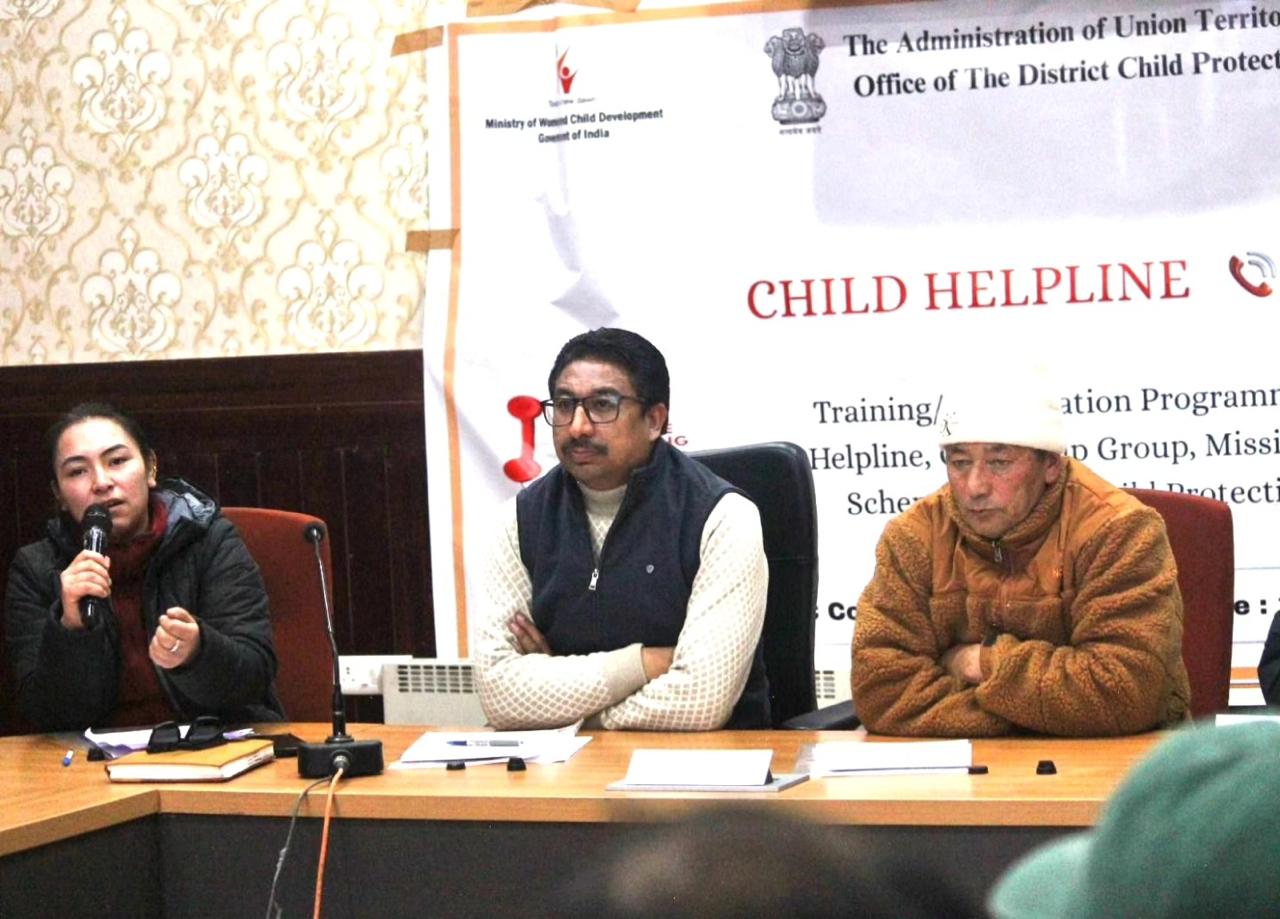
Leh, Feb 14: In an effort to strengthen community-level child protection mechanisms, the Child Helpline Unit (CHL) Leh on Saturday organised a sensitisation programme for nearly 60 village headmen from different parts of the district. The session focused on the functioning of the Child Helpline, formation of Child Help Groups, the Mission Vatsalya scheme, and major child protection laws including the Protection of Children from Sexual Offences Act, 2012, the Prohibition of Child Marriage Act, 2006, and the Child and Adolescent Labour (Prohibition and Regulation) Act, 1986.
The programme commenced with a welcome address by Farhana Nazir, Project Coordinator at CHL Leh, who greeted the participants and set the tone for the day’s deliberations. Abdul Rahim, Programme Manager at the State Child Protection Society, outlined the objectives of the initiative and underlined the need for active involvement of village leadership in safeguarding children.
Farhana Nazir elaborated on the functioning of the Child Helpline, explaining how it handles both emergency and non-emergency cases concerning children. She encouraged the headmen to spread awareness about the helpline in their respective villages to ensure timely reporting of cases.
Providing insight into grassroots engagement, Stanzin Palkit, Supervisor at CHL Leh, explained the formation and functioning of village-level Child Help Groups. She informed the gathering that one nominated member from each village would act as a link between the community and CHL Leh, ensuring coordination in matters concerning child safety and welfare.
Fariya Rafiq, Protection Officer for Non-Institutional Care at the District Child Protection Unit (DCPU) Leh, presented an overview of Mission Vatsalya. She highlighted the roles of the Child Welfare Committee, Juvenile Justice Board, and both institutional and non-institutional care systems in addressing the needs of children requiring support.
The legal framework was explained in detail by Stanzin Dolker, Legal-cum-Probation Officer at DCPU Leh. She spoke about the provisions of the Protection of Children from Sexual Offences Act, the Prohibition of Child Marriage Act, and the Child and Adolescent Labour Act. Stressing accountability, she urged participants to report offences promptly and to refrain from disclosing the identity or personal details of children involved in such cases.
Adding to the discussion, Tashi Dolma, Member of the Child Welfare Committee, outlined the committee’s role in assisting Children in Need of Care and Protection, including orphans, abandoned, and surrendered children.
The session concluded with an interactive question-and-answer segment, during which village headmen sought clarification on child sponsorship schemes, safety concerns, and the well-being of children residing in hostels. Officials addressed these queries, reiterating the importance of community vigilance and coordinated action.
The programme reflected a growing emphasis on strengthening child protection systems in Leh through active participation of local leadership and structured outreach initiatives.
