

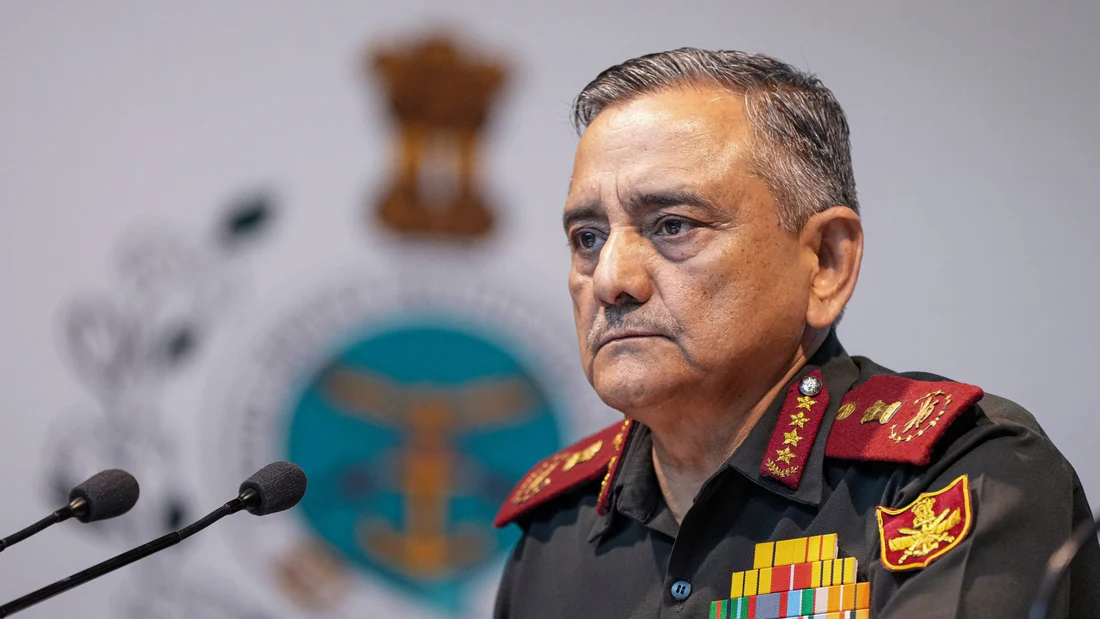
New Delhi, April 10, 2026: In a visionary address, Chief of Defence Staff General Anil Chauhan outlined a bold roadmap for India’s armed forces, urging them to evolve rapidly into a unified, agile, and technologically superior warfighting machine capable of dominating multi-domain operations (MDO). Speaking at the conclusion of the ‘Ran Samvad’ seminar, he firmly positioned MDO not as a fleeting conceptual trend or “buzzword,” but as an inescapable operational reality shaped by breakthroughs in artificial intelligence, data analytics, and the fundamentally altered nature of global conflicts. “MDOs were chosen for this year’s theme not because it’s a buzzword, but I think it’s a kind of new reality,” the CDS asserted, underscoring how modern battlefields defy traditional constraints of time, space, and domain silos.
General Chauhan painted a vivid picture of warfare’s transformation, explaining that conflicts have burst free from physical confines into synthetic, cognitive realms encompassing cyber, electromagnetic spectrum, time compression, and human perception. He introduced the era of “multi-dimensional warfare,” where land, sea, air domains merge with emerging ones, blending kinetic strikes with non-kinetic disruptions, manned platforms with unmanned swarms. The objective? Not outright destruction, but systemic paralysis of adversaries through cumulative, multi-level incapacitation. Drawing on John Boyd’s classic OODA loop (Observe, Orient, Decide, Act), Chauhan revealed a paradigm shift: predictive AI now allows forces to “orient yourself first before you can even observe,” compressing decision cycles for decisive superiority. He candidly addressed intelligence, surveillance, and reconnaissance (ISR) pain points, noting, “The bottleneck is not information, but the speed and quality of its interpretation,” positioning AI and analytics as game-changers for real-time operational edges.
The CDS also reframed victory beyond battlefields, advocating a political lens where outcomes hinge on influence operations and information manipulation—achieving objectives “without actually firing” a shot. He stressed foundational reforms in force design, organizational hierarchies, networks, standard operating procedures (SOPs), and shared doctrinal understanding to foster true jointness across the Army, Navy, and Air Force. The seminar, he lauded, flipped conventions by centering serving mid- and junior officers in strategic discourse—”Normally, it’s veterans or think tanks who would express their views. So I reversed that particular trend”—yielding fresh insights into jointness gaps and the pace of warfighting evolution that only frontline personnel fully grasp.
Looking outward, Chauhan highlighted borderless security threats, calling for deeper dialogue among like-minded nations. He announced the 2027 ‘Ran Samvad,’ to be hosted by the Indian Navy, zeroing in on “high-intensity operations in a transparent and expanded battle space,” with expanded roles for younger officers.
This address reinforces India’s push toward theater commands and self-reliance in defense tech, signaling a proactive stance amid rising geopolitical tensions.
