

By Shivang Satya Gupta
Ladakh, long defined by its breath-taking stillness and unshakable patriotism, is now being targeted by a campaign that thrives on distortion. It masquerades as news, cloaked in the deceptive polish of Artificial Intelligence (AI), but its purpose is unmistakable: to shatter the delicate equilibrium of trust between the people and their protectors.
The austere grandeur of this high-altitude frontier has long served as a sentinel of India’s sovereignty, a place where loyalty is lived rather than declared, and where the presence of the Armed Forces is synonymous with survival and dignity. Yet amid this terrain of resilience and sacrifice, an invisible conflict has begun to unfold—one that seeks not to breach territorial lines, but to infiltrate the public conscience.
Pakistan, having repeatedly failed to destabilise India’s borderlands through conventional provocations, has now adopted a far more insidious strategy. It has turned to AI as a weapon of subversion, replacing bullets with algorithms and penetration attempts with psychological manipulation. Deepfakes have become the new instruments of warfare, designed not to inform but to confuse, distort and fracture.
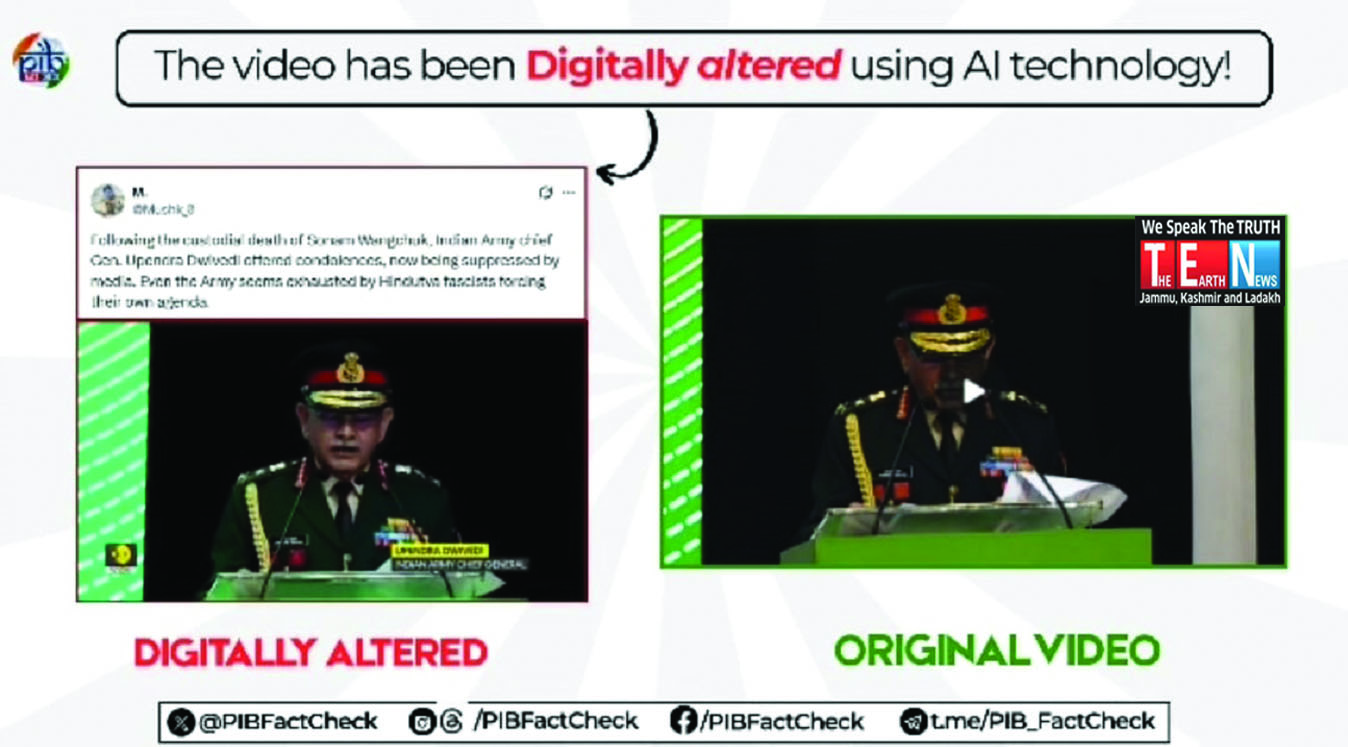
The circulation of a digitally fabricated video that falsely depicted the Chief of the Army Staff, General Upendra Dwivedi, criticising the Government of India over the alleged “custodial death” of activist Sonam Wangchuk represents a dangerous escalation. The Press Information Bureau of India swiftly exposed the video as a manipulation of a completely unrelated speech on India’s military modernisation. Yet the intent behind such deception was not merely to spread a lie, but to corrode confidence in national institutions and to turn patriotism into doubt.
This operation was no whimsical mischief. Its timing, emerging at a moment of tension and emotional vulnerability in Ladakh, revealed a calculated attempt to exploit public sentiments. The region continues to grapple with the turmoil that erupted on 24 September 2025, when Leh witnessed its most violent internal unrest in decades. What began as a call for statehood and constitutional safeguards under the Sixth Schedule—rooted in genuine concerns over unemployment, cultural preservation and land rights—spiralled into chaos. Buildings were set ablaze, police vehicles torched, security forces compelled to open fire, and four lives tragically lost. Curfew descended. Communications went dark. Trust fractured.
In such a climate, where grief and anxiety converge, Pakistan’s digital intrusion sought to amplify discord. By portraying the Army Chief as opposing the elected government, the deepfake aimed to insinuate a dangerous institutional schism and to capitalise on the anguish of mourning families and anxious youth. As history has shown, a single lie presented with authority can spread faster than truth, especially when the populace is already standing at a precipice of fear and frustration.
This represents psychological warfare at its most malignant. The adversary no longer seeks merely to peddle propaganda but to destroy the legitimacy of facts themselves. Once doubt becomes pervasive, every official communication is viewed with suspicion. Confusion becomes the default, and confusion is the most potent fuel for chaos. In a region as strategically vital and emotionally charged as Ladakh, such manipulation poses not just a public order problem, but a national security threat.
The stakes extend far beyond regional unrest. Ladakh is a geopolitical fulcrum, a frontier where India must remain unwaveringly united, because its adversaries closely observe every sign of internal discord. Any erosion of public trust here reverberates across the nation’s strategic posture.
India must therefore respond with both strength and foresight. Restoring peace requires not merely enforcing order but rebuilding confidence. Investigations into the September violence must be transparent and decisive, with accountability delivered through action rather than promises. Clarity is the antidote to suspicion.
Simultaneously, India must fortify its information space. Digital forensics and rapid rebuttal mechanisms must be strengthened so that falsehoods are not permitted even a moment to flourish. Public awareness campaigns that equip citizens to detect manipulation are now as essential as border security infrastructure. The capacity to discern truth has become a national defence requirement.
Pakistan’s malicious objective is clear. It seeks to convert local grievances into anti-national narratives. It wants democratic protest to mutate into separatist sentiment. It wants Ladakh’s magnificent mountains to echo not with pride, but with doubt.
India must ensure that this design fails. The youth of Ladakh deserve dignity, economic opportunity and a voice in shaping their future but they must also be shielded from those who would weaponise their frustrations. Their aspirations must be met with empathy, and their loyalty reinforced with truth.
External enemies succeed only when internal trust collapses. Ladakh has already paid a painful price for this moment of vulnerability. Whether it emerges stronger or weakened depends on how quickly India adapts to this new theatre of conflict—one fought not merely with soldiers and surveillance, but with truth and unity.
Ladakh’s patriotism has never faltered in the fiercest winters or under the shadow of hostile powers. It will not falter now—so long as lies do not succeed in replacing the truth. In this war for perception, certainty is armour and national solidarity is victory. India must defend Ladakh not only with fortifications on the mountains, but with integrity in the minds of its people.
