

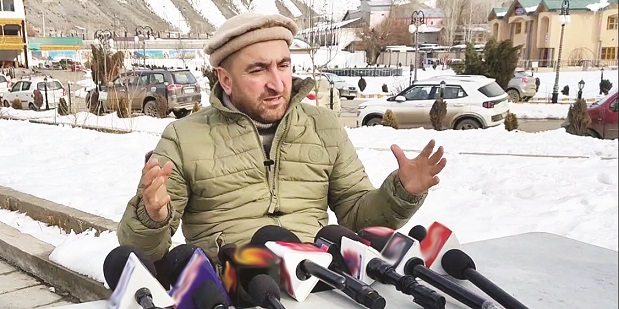
‘Statehood, Sixth Schedule Only Way to Restore Trust in Ladakh’
Kargil/New Delhi, Sept 29: The demand for statehood and constitutional safeguards for Ladakh has emerged as the central rallying point for the region’s political and social leadership, cutting across long-standing religious and regional divides. In an interview to a national News Outlet, Sajjad Kargili, Prominent Political Activist and founding member of the Kargil Democratic Alliance (KDA), said Ladakhis feel “voiceless” under bureaucratic rule and warned that the Centre’s reluctance to devolve power risks deepening alienation in the strategically sensitive Union Territory.
Following the abrogation of Article 370 and the bifurcation of Jammu and Kashmir in August 2019, Ladakh was carved out as a Union Territory without a legislature. According to Kargili, the move stripped the people of their representation and left key decisions in the hands of a handful of unelected officials. “Today, Ladakh has become totally voiceless. Bureaucratic rule has created a trust deficit, insecurity and frustration among the youth,” he said.
The KDA, alongside the Leh Apex Body, has consistently pressed for four non-negotiable demands: restoration of statehood, inclusion under the Sixth Schedule of the Constitution, the establishment of a Public Service Commission, and an additional parliamentary seat to ensure both Leh and Kargil are represented in the Lok Sabha.
Kargili stressed that statehood and Sixth Schedule protections are “complementary” and cannot be separated. “Without statehood, the Sixth Schedule remains incomplete. We do not want a Union Territory where one Lieutenant Governor decides everything,” he said, underscoring that democratic rights and safeguards for tribal land, jobs, and livelihoods are at the core of the movement.
While Ladakh has historically witnessed friction along communal lines, the present agitation appears to have consolidated diverse groups. “There were differences, but for the larger interest of Ladakh’s existence as a community and ethnic identity, we are the same. Our culture, history and language bind us together,” Kargili noted. He pointed out that both Buddhists and Muslims have joined protests, and recent instances of violence, including the deaths of four protesters in Leh, have only strengthened unity.
The detention of climate activist Sonam Wangchuk, a prominent voice in the movement, has further inflamed sentiment. Kargili said his arrest on charges of making provocative speeches has “given more strength” to the agitation. “These accusations are baseless. Instead of weakening us, they have united our leaders, youths and religious bodies more firmly,” he argued.
Talks between the High Powered Committee and the Ministry of Home Affairs have so far yielded little progress. While some issues, such as reservations, have been addressed through executive orders, the KDA insists these are not substitutes for constitutional guarantees. “We often receive verbal assurances, but there is no clear roadmap. The Centre lacks vision on Ladakh,” Kargili said, calling for a “meaningful and productive” dialogue.
Rejecting suggestions that local demands may compromise national security, he countered that empowering Ladakhis would reinforce India’s interests. “Federal structures always serve to strengthen national interests. The Ladakhis are the natural defence of this country—an army without uniform,” he asserted.
Kargili also dismissed international intervention, saying the movement is an “internal issue” of Indian democracy. “We believe in our constitution and civil society. The solidarity we receive from across India is enough,” he said.
With tempers running high after the firing on protesters and the arrest of key leaders, the KDA has renewed its call for an impartial judicial probe and immediate release of detainees. As the standoff continues, Ladakh’s leaders warn that ignoring their demands could intensify unrest. “The government should understand the sensitivity of the region and its strategic importance. They should not push people towards the wall,” Kargili cautioned.
