

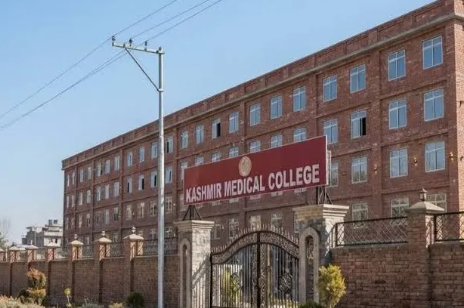
SRINAGAR : A fresh regulatory rejection has dealt another blow to the proposed Kashmir Medical College at Sempora, with the National Medical Commission (NMC) refusing to clear the institution despite High Court intervention, a physical inspection and directions for reconsideration. The decision has put the proposed admission of 150 MBBS students for the 2026-27 academic session beyond reach, at least for now.
The setback came during proceedings before the Jammu and Kashmir and Ladakh High Court, where the NMC and its Medical Assessment and Rating Board (MARB) informed Justice Moksha Khajuria Kazmi that a fresh assessment had once again found the college ineligible for permission to commence admissions during the current academic session.
The development has brought the Milli Trust’s legal battle to a critical juncture. Taking note of the regulator’s latest decision, the court directed the petitioner’s counsel, Advocate Showkat Naqshbandi, to obtain instructions from the trust on whether it wished to pursue the challenge further. The matter has been listed for November 20, 2026.
Appearing for the NMC and MARB, Senior Advocate Gaurav Sharma placed before the court a fresh committee report dated November 5, 2026, and submitted that the application had been reconsidered in compliance with the court’s earlier directions issued on October 5, October 13 and October 28.
Despite the reconsideration, the regulatory authorities maintained that the institution could not be granted permission to begin admissions for the 2026-27 session. They consequently argued that the petition had become infructuous in view of the rejection.
The latest decision comes after a series of judicial interventions in the college’s regulatory approval process.
The MARB had initially rejected the institution’s application on June 9, 2026, citing infrastructure deficiencies. The trust, which had submitted its proposal to the NMC in January, sought permission to establish the college at the Industrial Estate in Sempora with an annual intake of 150 MBBS students.
According to the petitioner, the application was backed by essentiality certificates, consent of affiliation, documents concerning a functional 650-bedded teaching hospital and details of registered faculty.
Challenging the initial rejection, the trust argued that the application had been turned down without a physical inspection of the proposed institution or an opportunity to rectify the deficiencies identified by the regulator.
The trust subsequently approached the Ministry of Health and Family Welfare, the second appellate authority. On August 24, 2026, the Ministry remanded the matter to the NMC for reconsideration of the application and accompanying documents.
Alleging that the appellate authority’s directions had not been properly implemented, the trust moved the High Court through a writ petition, seeking directions for issuance of a Letter of Permission to make the institution operational.
During proceedings in October, the High Court directed the NMC to conduct a physical inspection of the proposed college premises. The inspection took place on October 14, but the MARB issued another order on October 27, disapproving the application.
The trust challenged the fresh rejection, arguing that the regulatory authority had failed to follow statutory procedure and the principles of natural justice. Its counsel contended that the deficiencies identified during inspection should have been communicated to the institution and an opportunity provided to rectify them.
On October 31, the High Court kept the October 27 rejection order in abeyance and directed the NMC and MARB to reconsider their decision. It also asked the regulatory authorities to explore the possibility of granting conditional permission, subject to reasonable conditions, to enable the college to admit students during the 2026-27 academic session.
However, the fresh committee assessment has again gone against the institution, with the NMC reiterating its inability to grant permission for the current academic year.
With the regulatory position once again turning adverse, the November 20 hearing assumes significance. The trust’s response will determine whether the legal challenge continues, even as the proposed medical college remains unable to secure approval for its first batch of MBBS students.
