

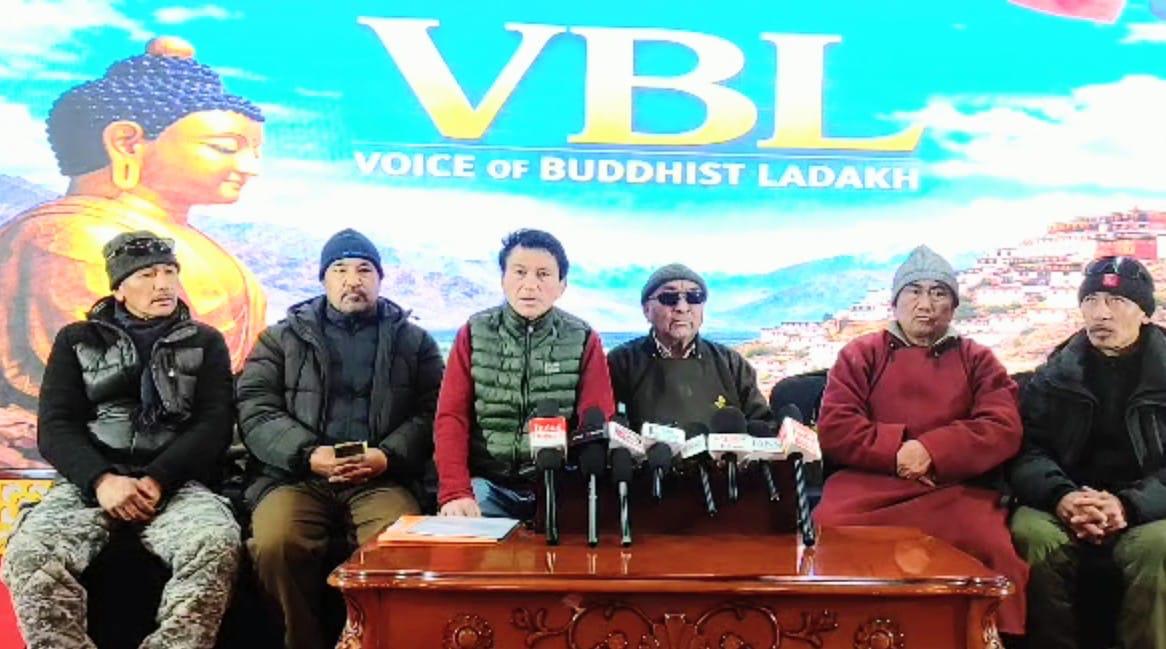
Leh, Jan 08: Voice of Buddhist Ladakh (VBL) on Thursday voiced grave concern over what it described as a deepening existential crisis confronting the Buddhist community in Ladakh, warning that unchecked land alienation, demographic decline, economic marginalisation and shrinking political representation could fundamentally alter the region’s civilisational character.
Addressing his maiden press conference, VBL Convenor Skarma Namtak, flanked by other members, said the Buddhist population, particularly in Changthang, Nubra, Zanskar, Sham and Drass, was facing a combination of internal land ownership changes, declining fertility trends, youth displacement and weakening institutional protection. He said these developments were taking place in the absence of strong constitutional and legal safeguards, leaving the community increasingly vulnerable.
“These are not hypothetical fears. Land is already changing hands within Ladakh. Our youth are migrating, our numbers are declining and our political voice is shrinking,” Namtak said, adding that the consequences of inaction could be irreversible.
Namtak informed that VBL has placed a comprehensive memorandum before Union Home Minister Amit Shah, seeking urgent and phased reforms to secure Ladakh’s demography, land, livelihood and democratic rights. He said the organisation is demanding a legally enforceable domicile framework that goes beyond government employment and extends to land ownership, electoral rights and economic protections, while also seeking intra-Ladakh demographic safeguards to ensure that newly created districts and vulnerable sub-regions are not politically or economically overwhelmed.
Calling land the first line of survival for Ladakh’s indigenous people, he stressed the need for comprehensive land safeguards by vesting all land-related powers in elected Ladakhi bodies and empowering each district to reserve land ownership for its own residents. He added that sensitive industries must be regulated through a negative list approved by elected bodies and that any leasing of land should be permitted only with district-level consent.
On governance reforms, Namtak clarified that VBL does not favour full-fledged statehood at this stage due to concerns over financial sustainability and security sensitivities. Instead, the organisation is proposing a special elected state-level body for Ladakh that would deliver democratic accountability, equitable district representation and administrative responsiveness without placing an unsustainable fiscal burden on the region. He further emphasised that power-sharing and allocation of resources must be guided by geography, remoteness and vulnerability rather than population size alone.
Highlighting minority concerns, Namtak reiterated the long-standing demand for separate district status for Zanskar, pointing out that Buddhists form a vulnerable minority within Kargil district and deserve an independent political voice comparable to other regions of Ladakh.
He also raised serious concerns regarding employment and economic marginalisation, stating that VBL is seeking district-cadre recruitment to prevent internal displacement, minority-based reservation for Buddhists at divisional and UT levels, and strong protection for local contractors in government tenders, alongside district-wise regulation of commercial vehicle operations to safeguard local livelihoods.
Referring to long-term demographic decline, Namtak called for legal safeguards against strategically driven religious conversions linked to marriage and inheritance, warning that without such measures the Buddhist community could face accelerated marginalisation in the coming decades. He said inheritance and property rights of Buddhists must be protected through clear legal provisions.
He further underlined the civilisational and strategic value of Tibetan Buddhism, urging special recognition and dedicated budgetary and legal protection for all five schools of Tibetan Buddhism and traditional institutions such as Amchis, Onpos, Churpons and Gobas, which he described as pillars of Ladakh’s cultural and social life.
Namtak also flagged the application of wildlife protection laws in Ladakh, cautioning that more than 87 per cent of Leh and over 90 per cent of Nubra, Changthang and Sham risk falling under severe restrictions, virtually choking economic activity in Buddhist-majority regions. He demanded a comprehensive re-examination of protected area boundaries to restore balance between conservation and livelihoods.
Concluding, he urged the Centre to adopt a pragmatic and phased approach to governance reforms, prioritising immediate protections relating to domicile, land and democratic representation before taking up more complex and contentious demands. “Ladakh is at a decisive moment. What is at stake is not just governance, but the survival of our culture, identity and security,” he said.
