

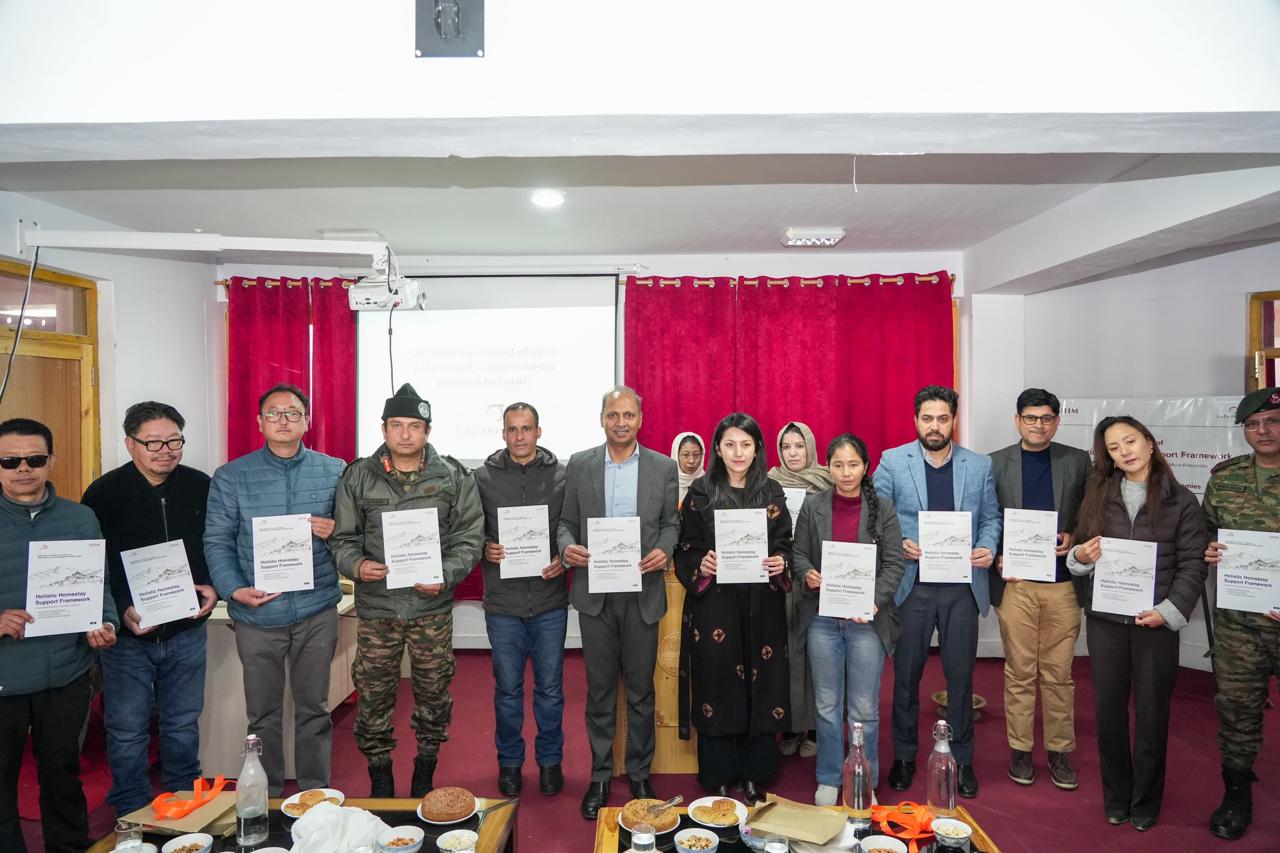
Leh, Mar 06: In an effort to reshape Ladakh’s community tourism model, the Union Territory administration on Thursday launched the Holistic Homestay Support Framework, introducing a structured development system along with a dedicated 21-day training programme for homestay operators aimed at improving service standards while safeguarding the region’s cultural and ecological heritage.
The initiative was formally unveiled by Administrative Secretary Sanjit Rodrigues, IAS, during a programme held at the State Institute of Hotel Management (SIHM) Ladakh.
Designed to strengthen village-based tourism enterprises, the framework seeks to establish a unified mechanism for capacity building, quality assurance and sustainability across Ladakh’s expanding homestay network, which has increasingly become a cornerstone of the region’s tourism economy.
The programme has been developed through a collaborative effort between the Department of Tourism, UT Ladakh, the State Institute of Hotel Management Ladakh, and the Firgun Social Initiative Foundation. Officials said the system will function as a continuous development cycle, providing training, mentoring and monitoring support to ensure that homestay establishments maintain consistent service standards while operating in an environmentally responsible manner.
A central component of the initiative is the introduction of a comprehensive 21-day training curriculum designed to equip homestay operators with professional hospitality skills. The programme aims to nurture hosts who not only deliver quality guest experiences but also serve as custodians of Ladakh’s cultural traditions and fragile mountain ecosystem.
By strengthening capacities, improving service quality and enhancing guest experiences, the framework seeks to position Ladakh’s homestay network as a model of responsible and community-driven tourism.
Addressing the gathering, Rodrigues underscored the importance of reinforcing Ladakh’s homestay ecosystem as a pillar of community-based tourism. He observed that the initiative represents a shift in focus within the tourism sector—from expanding accommodation capacity to enhancing the quality and sustainability of tourism services.
He emphasised that homestays should be viewed not merely as accommodation facilities but as structured rural enterprises embedded within village economies. Such enterprises, he noted, can generate sustainable livelihoods while preserving Ladakh’s cultural identity and ecological balance.
Rodrigues further stated that the framework aims to develop economically resilient, culturally rooted and environmentally responsible homestays through improved service standards, systematic capacity building, sustainability compliance and continuous monitoring and mentoring support. He reiterated the administration’s commitment to ensuring that tourism growth in Ladakh remains inclusive, community-driven and environmentally sustainable.
The launch event brought together a wide spectrum of tourism stakeholders, reflecting growing collaboration across the sector. Representatives from the All Ladakh Tour Operators Association, including Rigzin Wangmo Lachic, and the All Ladakh Hotel and Guest House Association, represented by Tsewang Namgyal, were present.
Representatives of the Ladakh Scouts, including Lt. Col. Sudheer Sharma and Vikram Chawla, also attended the programme, reflecting the longstanding connection between Ladakh’s institutions and local communities.
The event also witnessed participation from development and corporate partners such as the State Bank of India, World Wide Fund for Nature (WWF), HDFC Bank, Jammu & Kashmir Bank, and the Ladakh Ecological Heritage Organisation, highlighting growing institutional support for initiatives that integrate tourism development with environmental stewardship and community empowerment.
Among other officials present were Principal, SIHM Ladakh, Ghulam Mohammad; Director Tourism UT Ladakh, Tsering Paldan; and Assistant Director Tourism Leh, Padma Angmo, reflecting strong administrative commitment towards strengthening Ladakh’s homestay ecosystem.
