

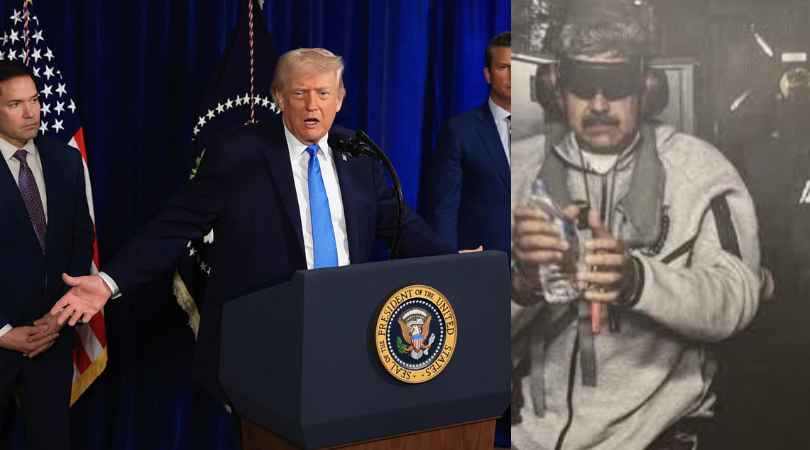
CARACAS (VENEZUELA), Jan 4:Venezuelan President Nicolas Maduro was captured by United States forces and removed from the country in a dramatic predawn military operation Saturday that saw a sitting head of state forcibly extracted from office.
President Donald Trump announced that the US government would assume temporary control of Venezuela and exploit the nation’s substantial oil reserves to generate revenue through international sales.
The operation represents the peak of mounting pressure from the Trump administration against the South American nation, following months of military strikes targeting vessels allegedly smuggling narcotics into the United States.
US intelligence meticulously monitored Maduro’s daily routines, including his dietary habits and sleeping locations, while planning what became one of the most dramatic regime changes in contemporary history.
Maduro and his wife Cilia Flores were seized overnight from their residence at a military installation and transported aboard a US warship bound for New York, where they face criminal prosecution under a Justice Department indictment alleging narco-terrorism conspiracy.
Trump stated America would govern Venezuela during a transitional period, though no immediate evidence of US administrative control emerged. Venezuelan state television continued broadcasting pro-Maduro content, showing live footage of supporters rallying in Caracas streets.
“We’re going to run the country until such time as we can do a safe, proper and judicious transition,” Trump declared at a Mar-a-Lago press conference, describing the operation as “extremely successful” and warning against threats to American sovereignty.
The legal basis for the military action—reminiscent of the 1990 US invasion of Panama that resulted in Manuel Antonio Noriega’s capture—remains unclear. Washington does not recognize Maduro’s legitimacy, who last appeared publicly Friday meeting Chinese officials in Caracas.
While Maduro and other Venezuelan officials were initially indicted in 2020 on narco-terrorism charges, the Justice Department issued fresh charges Saturday against both Maduro and Flores, characterizing their administration as a “corrupt, illegitimate government” sustained by cocaine trafficking operations targeting the US.
Trump shared an image on Truth Social purportedly showing a blindfolded Maduro in custody wearing a sweatsuit.
Multiple explosions echoed through the Venezuelan capital early Saturday as low-flying aircraft swept overhead. Maduro’s government condemned what it termed an “imperialist attack” on civilian and military facilities, calling citizens to street demonstrations.
The assault, lasting under 30 minutes, produced at least seven explosions that sent residents fleeing into streets while others documented events on social media.
Vice President Delcy Rodríguez confirmed casualties among Venezuelan civilians and military personnel without providing specific numbers. Trump acknowledged US forces sustained injuries but reported no American fatalities.
“We think, we develop, we train, we rehearse, we debrief, we rehearse again, and again. Not to get it right, but to ensure we cannot get it wrong,” stated Dan Caine, Chairman of the Joint Chiefs of Staff.
Videos verified by The Associated Press captured tracers and smoke enveloping the landscape as repeated explosions illuminated Caracas’ nighttime sky. Additional footage showed vehicles traversing highways as blasts lit up surrounding hillsides.
Smoke rose from a Caracas military hangar while another installation lost electrical power.
Nahum Fernandez, a ruling party leader, told AP that Maduro and Flores were at their Fort Tiuna residence during the raid. “That’s where they bombed,” he said. “And there, they carried out what we could call a kidnapping of the president and the first lady.”
Venezuelan law designates Rodríguez as Maduro’s successor, though no confirmation of power transfer emerged. She issued a statement demanding proof of life for both detainees.
The strike followed months of intensifying Trump administration pressure, including substantial US military deployment in South American waters and attacks on suspected drug-smuggling vessels in the eastern Pacific and Caribbean.
Last week marked the first known CIA operation on Venezuelan territory—a drone strike targeting a docking facility allegedly used by drug cartels.
As of Friday, 35 boat strikes had killed at least 115 people, according to administration figures. Trump characterized US actions as “armed conflict” with drug cartels necessary to combat narcotics flowing into America.
Maduro had denounced the military operations as disguised efforts to remove him from power.
Venezuela’s ruling party has governed since 1999 when Hugo Chavez assumed office promising to elevate impoverished citizens through socialist revolution. Maduro succeeded Chavez following his 2013 death.
Maduro’s 2018 reelection was widely dismissed as fraudulent due to major opposition parties being barred from participation. During 2024’s election, ruling party-controlled electoral authorities declared his victory hours after polls closed, despite opposition evidence showing he lost by over a 2-to-1 margin.
Venezuelan reactions split sharply, with some citizens protesting the capture while others celebrated.
At a Caracas demonstration, Mayor Carmen Melendez joined crowds demanding Maduro’s release. “Maduro, hold on, the people are rising up!” protesters chanted. “We are here Nicolas Maduro. If you can hear us, we are here!”
Armed civilians and uniformed militia members appeared in streets of traditionally pro-government neighborhoods.
Other city areas remained quiet hours after the operation as residents absorbed developments. Some zones continued experiencing power outages, though vehicular traffic resumed normally.
