

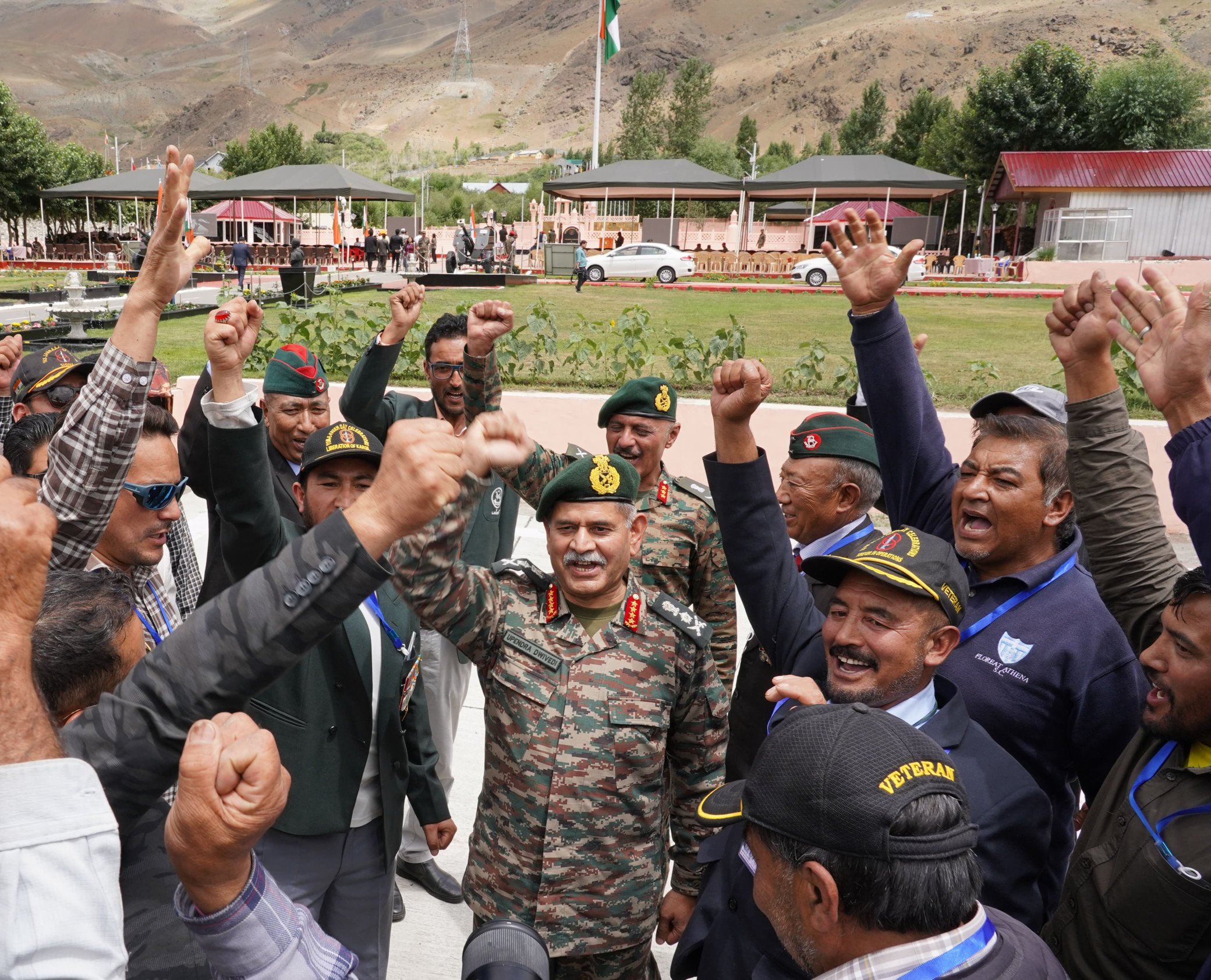
Drass, Jul 26: Chief of the Army Staff General Upendra Dwivedi laid a wreath at the Kargil War Memorial and paid homage to the fallen heroes, as he described Kargil Vijay Diwas as a symbol of the indomitable courage and determination of the Indian Army.
In the central event organized at Drass, the Army Chief highlighted the Army’s “unique victory” on the Kargil peaks 26 years ago, and said the military achieved a “decisive victory” during Operation Sindoor as well continuing that tradition.
Reiterating the Indian Army’s commitment to protecting the nation’s sovereignty and self-respect, General Dwivedi also launched three projects, including a portal where people can pay ‘e-shradhanjali’ to martyrs, as part of the 26th Kargil Vijay Diwas.
Speaking on the occasion, the army chief said that the surgical strikes carried out during Operation Sindoor were a clear message to Pakistan that supporters of terrorism will not be spared.
“Operation Sindoor was a message to Pakistan as well as a response to the Pahalgam terror attack, which was a deep wound for the entire nation. This time India did not only mourn but showed that the response will be decisive,” Gen Dwivedi said at the Kargil War Memorial here.
The chief of army staff said a stern response to the adversary was the new normal established by India.
“The faith shown by the countrymen and the free hand given by the government, the Indian Army gave a befitting surgical response. Any power that tries to challenge the unity, integrity, and sovereignty of India or harm the people will be given a befitting reply. This is the new normal of India,” he said.
Gen Dwivedi said that during Operation Sindoor, the army eliminated nine high-value terrorist targets in Pakistan with zero collateral damage.
“India attained a decisive victory by effective targeting of terror infrastructure in Pakistan during Operation Sindoor. The army targeted the terrorist infrastructure and foiled the other aggressive moves of Pakistan to attain a decisive victory,” he said.
Dwivedi said Indian gave peace a chance, but Pakistan resorted to cowardice.
“The Pakistani action on May 8 and 9 was responded to effectively. Our army air defence stood like an impregnable wall which could not be breached by any missile or drones,” he said.
He said the Indian Army is on its way to becoming a force to reckon with in the world.
“Rudra, all of brigade, is being established for which I gave an approval yesterday. Under this, we will have infantry, mechanised infantry, armoured units, artillery, special forces and unmanned aerial units at one place to provide logistics and combat support,” he said.
The army has formed a special strike force Bhairav Light Commando Unit, which is “always ready to surprise the enemy at the border.”
Dwivedi said, “Every infantry battalion now has a drone platoon. In the artillery, the Shaktiban regiment has been set up, which will be equipped with a drone, counter-drone, and loiter munition. Every regiment will have a composite battery equipped with these things.”
The army chief said our capability will increase manifold in coming days as we are equipping the army air defence systems with indigenous missiles.
Recalling the presence of Prime Minister Narendra Modi at the silver jubilee celebrations last year, the military chief said the presence of top leaders shows that it is not only an army day but a festival for the entire nation.
“The nation is safe due to the sacrifices made by the heroes at the icy heights. We remember their dedication and determination, and we bow to the brave heroes who laid down their lives so that we can live a peaceful life with dignity,” he added.
Earlier, General Dwivedi launched three projects, including a portal where people can pay ‘e-shradhanjali’ to martyrs, as part of the 26th Kargil Vijay Diwas.
The others were a QR code-based audio gateway, on which people can listen to the stories of the 1999 Kargil war battles fought, and the Indus Viewpoint, which offers people a chance to go up to the Line of Control (LoC) in the Batalik sector.
“The citizens can now pay e-shradhanjali to the heroes who made the supreme sacrifice for the country without visiting the memorial,” an army officer said.
The project is aimed at sensitising people about the sacrifices made by the armed forces and the hardships they faced while discharging their duties, he said.
The other project launched was a QR code application, where people can listen to stories about the various battles that were waged to fight off Pakistani intruders in 1999.
“The concept is similar to museums, where the visitors can listen to the details of the exhibits using earphones. Here, people will get to listen to the saga of courage, valour, bravery and sacrifice by the soldiers,” the officer said.
Indus Viewpoint, another project launched, will allow visitors to go up to the LoC in the Batalik sector.
“This will give an idea to the visitors about the conditions in which soldiers serve, the difficulties and constant dangers they face on a day-to-day basis to ensure that the nation remains safe,” the officer said.
Batalik was one of the main battlegrounds during the Kargil war.
Located at an altitude of over 10,000 feet, Batalik was the focal point of the Kargil war due to its strategic location between Kargil, Leh, and Baltistan.
The small village in the Indus River valley has now become a major tourist attraction.
