

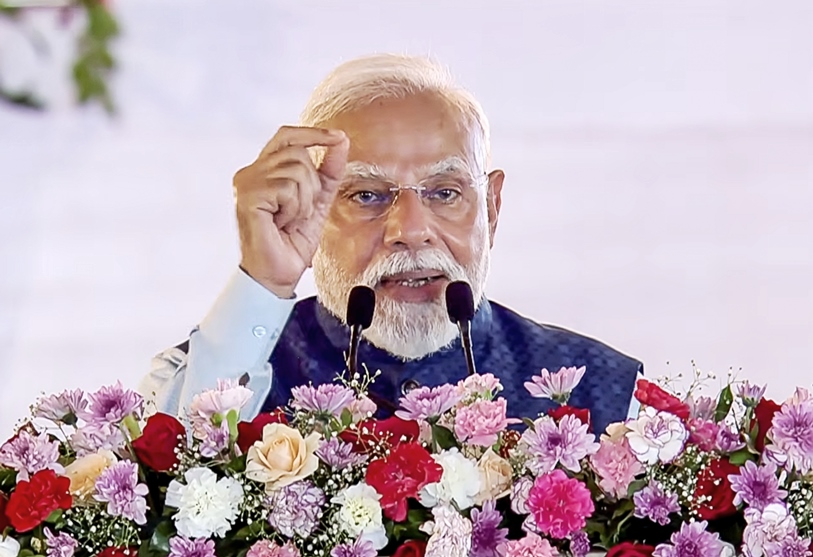
New Delhi, Sept 04: Prime Minister Narendra Modi on Thursday said gaming is not bad but gambling is and that future of the youth must be safeguarded. The PM also said India can dominate the global online gaming market.
In an interaction with national awardee teachers, the prime minister said there are huge job opportunities in online gaming market.
“India can dominate global online gaming market, if done in a right manner; there are huge job opportunities too. Gaming is not bad but gambling is, future of our youth must be safeguarded,” he said.
The Promotion and Regulation of Online Gaming Act, 2025, bars all forms of online money games while promoting e-sports and other online games.
The recently enacted law seeks to prohibit advertisements related to online money games and bars banks and financial institutions from transferring funds for any of such games.
Later in the day the PM, along with Singapore Prime Minister Lawrence Wong virtually inaugurated the second phase of the PSA-operated Bharat Mumbai Container Terminal (BMCT) at the Jawaharlal Nehru Port here.
Following this, the terminal’s total container handling capacity would stand at 4.8 million TEUs from 2.4 million TEUs earlier.
JNPA Chairman Unmesh Sharad Wagh said that the country’s premier container port, Jawaharlal Nehru Port, is looking at allowing Ro-Ro (Roll on/Roll off) service from its facility for efficient vehicle transportation.
The country’s premier container port handles five major dedicated container terminals operated by global market leaders with a deep draft of 15+ metres, with the capability of handling 18,000 TEU vessels.
At the port, the event was attended by Minister of State for Ports, Shipping and Waterways Shantanu Thakur, Maharashtra Chief Minister Devendra Fadnavis, Managing Director PSA India Gobu Selliaya and Wagh, among others.
“We are also thinking of starting a Ro-Ro service. The exporters (car makers) have sought permission, which are pending due to certain issues. We are discussing those issues with them,” Wagh said on the sidelines of the event.
He said that the Port is “very keen” to give them permission for these services, as there is a lot of demand, adding that currently these export vehicles come to Mumbai from Pune, and have to travel an additional distance besides congesting the city’s roads.
On the expansion, he said, “We require capacity as our trade and economy are growing, which requires a lot of ports. The expansion of this terminal is an important milestone for us in achieving the Prime Minister’s vision of port-led development.
The 100 per cent renewable energy terminal, PSA Mumbai Terminal is the first container terminal port with DFC (dedicated freight corridor)- compliant with six rails and 8 RMGs (rail mounted gantry) and efficiency in handling 18000 TEUs, according to JNPA.
The terminal has also received USD 1.3 billion FDI, the largest, under a PP model, providing connectivity to over 63 ICDs – via road and rail, as per the port operator.
Over almost three decades, PSA has invested a total of USD 2.3 billion in India, of which more than half is in BMCT, Singapore Deputy Prime Minister had said during a visit to the JNPA last month.
JNPA handles 54 per cent of the containerised cargo across all major ports of India.
Wagh also said that JNPA has already crossed 10.1-million TEUs capacity, and expressed hope that the facility will be handling this much capacity in the next two years.
“We think that our capacity should be ahead of our requirement. Last year we handled 7.3 million TEUs, while this financial year it will be 8 million TEUs. Even after having this much capacity, we are sure that we will handle over 10 million TEUs in the next two years in JNPA itself. That is the growth India is witnessing,” he said.
Wagh also sounded confident that the JNPA will just be a 100 per cent green and shore-power-compliant facility in the next two years but also be able to reduce its turnaround time by at least 20 per cent during this period.
Earlier in the day the PM said, GST 2.0 is a double dose of support and growth for the nation and the next-generation reforms have been done to support India’s progress in the 21st century.
His comments came a day after the GST Council approved a complete overhaul of the tangled Goods and Services Tax (GST) regime.
In an interaction with National Teacher awardees, Modi noted that five new gems (panch ratna) have been added to India’s vibrant economy through the GST reforms.
He said GST has become even simpler and new rates of 5 per cent and 18 per cent will become effective from first day of Navratri.
“GST 2.0 is a double dose of support and growth for the nation. Next generation reforms in GST has been done to support India’s progress in 21st century. Five new gems (panch ratna) have been added to India’s vibrant economy through GST reforms,” he said.
“Without timely changes, we cannot give our country its rightful place in today’s global situation. I had said from the Red Fort on 15 August this time that it is crucial to undertake next-generation reforms to make India self-reliant. I had also promised the countrymen that there would be a double blast of happiness before this Diwali and Chhath Puja,” he added.
The prime minister said that during Congress regime basic household items used to be “heavily taxed” and the BJP government has tried to address those issues for ease of common man.
In another related development, India and European Union pledged to seal their much-awaited free trade deal by December with Prime Minister Narendra Modi and 27-nation bloc’s top leaders Antonio Costa and Ursula von der Leyen pledging to promoting a rules-based global order, amid Washington’s disruptive trade policies.
In a joint phone call with European Council president Costa and European Commission chief von der Leyen, Modi reiterated India’s consistent support for peaceful resolution of the Ukraine conflict and early restoration of peace and stability.
The leaders underlined the role of the India-EU strategic partnership in jointly addressing global issues, fostering stability, and promoting a rules-based order for mutual prosperity, an Indian readout said.
The phone talks among the three leaders came as India looks to blunt the impact of the Trump administration’s 50 per cent tariff on Indian goods.
The three leaders also discussed holding the next India-EU summit in India at an early date of mutual convenience and PM Modi invited Costa and von der Leyen for the same.
In a social media post, Modi described the conversation as “very good”.
“Reaffirmed our shared commitment for an early conclusion of the India-EU FTA and implementation of the IMEEC corridor. Exchanged views on issues of mutual interest and efforts for bringing an early end to the conflict in Ukraine. We agreed that our Strategic Partnership has a key role to play in fostering stability and promoting a rules-based order,” he said.
On the Ukraine conflict, von der Leyen said India has an important role to play in bringing Russia to end “its war of aggression and helping create a path towards peace”. The European Commission president welcomed India’s continued engagement with President Volodymyr Zelenskyy.
“This war carries global security consequences and undermines economic stability. So it is a risk to the entire world,” she said on ‘X’.
The phone call, largely focusing on India-EU free trade deal and the summit, came days before EU trade commissioner Maros Sefcovic’s planned trip to New Delhi amid reports of both sides making significant headway towards finalising the trade pact.
India and the EU relaunched the negotiations for the free trade agreement (FTA) in June 2022 after a gap of over eight years.
“As the world’s largest democratic forces, India and EU share a strong and close relationship built on trust, shared values, and a common vision for the future,” the Indian readout said.
It said Modi, Costa and von der Leyen also welcomed progress in bilateral relations in key sectors such as trade, technology, investment, innovation, sustainability, defence, security and supply chain resilience, and reaffirmed the shared commitment for an early conclusion of the India-EU FTA negotiations and implementation of the IMEEC (India-Middle East-Europe Economic Corridor).
“Looking ahead, we plan to agree on a joint strategic agenda at the next EU-India summit, as early as possible in 2026. We also remain fully committed to concluding the Free Trade Agreement negotiations by the end of the year. To achieve this, progress is needed now,” von der Leyen said.
The Indian readout said the leaders also exchanged views on regional and global issues of mutual interest, including the efforts to bring an end to the conflict in Ukraine.
“PM Modi reiterated India’s consistent support for peaceful resolution of the conflict and early restoration of peace and stability. The leaders agreed to remain in touch,” it said.
The IMEEC initiative was firmed up on the sidelines of the G20 Summit in Delhi in 2023.
Billed as a pathbreaking initiative, it envisages a vast road, railroad and shipping networks among Saudi Arabia, India, the United States and Europe with an aim to ensure integration among Asia, Middle East and West.
