

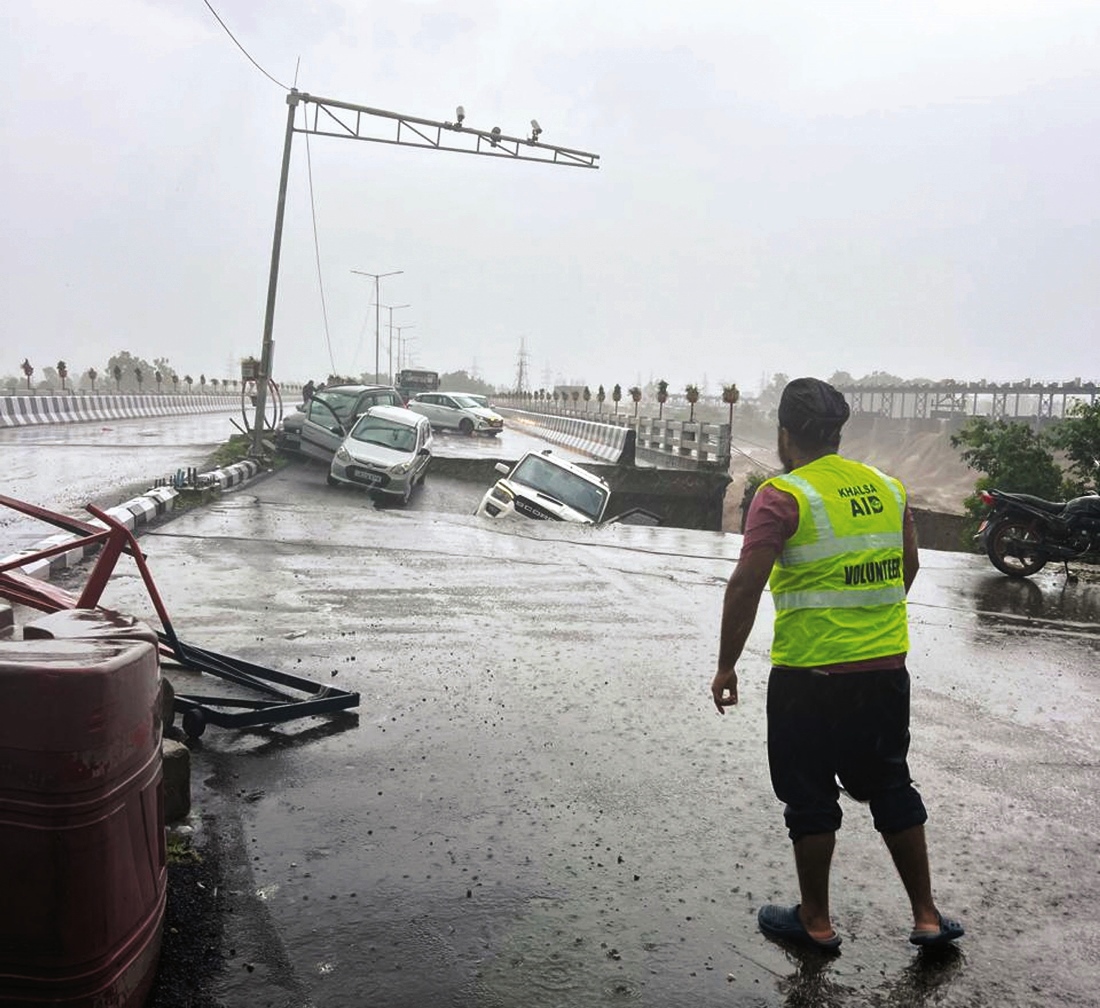
Jammu, Aug 26: Torrential rains unleashed havoc across Jammu on Tuesday, sweeping away bridges, inundating neighbourhoods, and paralyzing life as the swollen Tawi River surged past danger levels. The city was thrown into disarray after the Bhagwati Nagar Bridge, also known as the Fourth Tawi Bridge, collapsed into the raging river, while other crucial crossings were sealed amid fears of further structural failures.
Eyewitnesses described the terrifying moment when the Bhagwati Nagar Bridge crumbled under the force of churning waters, its girders snapping before vanishing into the muddy torrent. Shattered concrete drifting downstream soon flooded social media, a chilling emblem of the unfolding disaster. Rescue teams of the State Disaster Response Force rushed to the site, warning residents in low-lying belts to evacuate.
The main Tawi Bridge, vital for both commuters and cargo movement, was closed indefinitely after water levels touched nearly 25 feet against the danger mark of 20. The shutdown plunged Jammu into gridlock as traffic was diverted through narrow alternative roads, while floodwaters submerged New Plot, Sanjay Nagar, and adjoining colonies. Vehicles were abandoned on waterlogged roads, some swept away by flash floods. “This is unavoidable to prevent further loss,” a senior traffic officer said as stranded commuters endured hours-long snarls.
The calamity was not confined to Jammu. In Doda district, a sudden cloudburst claimed at least three lives. Days earlier, another bridge had collapsed on the Jammu-Pathankot highway, cutting off villages and stalling relief operations. With the Chenab and Ravi rivers also swelling dangerously, the administration sounded high alert across multiple districts. In Akhnoor, the Chenab rose 1.5 feet above danger level, while Kathua reported the Ravi crossing the one lakh cusec mark, flooding low-lying areas.

Heavy rains also forced suspension of the Mata Vaishno Devi pilgrimage, with the Shrine Board halting the yatra after the Himkoti route became unsafe. “Devotee safety is paramount. The yatra will resume only when conditions stabilize,” a Shrine Board spokesperson said. Landslides meanwhile blocked the Katra-Jammu road near Kadmal, as well as stretches of the Jammu-Srinagar National Highway, stranding commuters and disrupting essential supplies.
The India Meteorological Department attributed the extreme weather to an active monsoon trough, reporting over 250 millimeters of rainfall in Jammu within 20 hours—drawing comparisons to the 2014 floods. A red alert was issued for Jammu, Samba, Kathua, Reasi, Udhampur, and parts of Doda, warning of flash floods, landslides, and cloudbursts until August 27.
Chief Minister Omar Abdullah reviewed the situation in Srinagar before announcing his immediate departure to Jammu to oversee relief measures. “The situation in many parts of Jammu province is serious. Instructions have been issued to release emergency funds to Deputy Commissioners for urgent restoration work,” Abdullah wrote in a post on X.

In an emergency response, the administration pressed the National Disaster Response Force into service alongside local agencies, conducting mass evacuations and moving families into makeshift shelters. Schools and colleges will remain closed until August 27 as officials brace for worsening conditions. District-wise helpline numbers were also released, with police and civil officers using loudspeakers to urge residents to shift to safer areas.
Reports from high-altitude districts of Kishtwar, Reasi, Rajouri, Ramban, and Poonch confirmed widespread damage to homes, roads, and public infrastructure, with officials cautioning that the full scale of destruction will emerge only after assessments. Environmentalists, meanwhile, warned that unchecked urban sprawl and fragile infrastructure had amplified the flood threat, with the crisis highlighting the growing impact of climate-driven extreme weather in the Himalayas.
As swollen rivers roar through the region and forecasts remain grim, Jammu faces a prolonged ordeal. For residents watching bridges collapse and homes drown, the disaster has reopened scars of past floods and underscored the city’s vulnerability to nature’s fury.
