

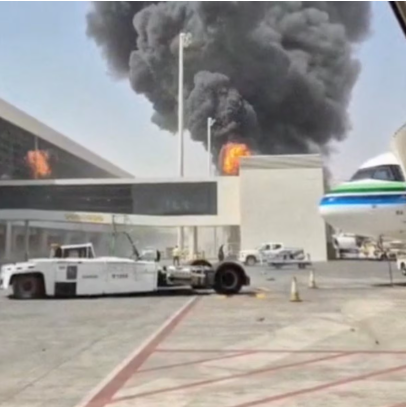
CAIRO, Oct 11: At least 12 people were killed and more than 300 injured in a missile attack on King Khalid International Airport in Saudi Arabia’s capital, Riyadh, civil aviation authorities said early Sunday. Several of the injured were reported to be in critical condition.
The Saudi-led coalition fighting Houthi rebels in neighbouring Yemen blamed the Iran-backed group for the attack, describing it as a “fully-fledged war crime” and vowing a firm response. The rebels had not issued an immediate statement on the latest strike.
The attack, which reportedly targeted an airport complex housing terminals 3 and 4 for domestic flights, was described as the deadliest in any Gulf Arab country since the start of the Iran war. It comes amid a wider escalation of hostilities involving the Houthis and Saudi-backed Yemeni government forces.
According to Saudi authorities, the deceased included four Saudi nationals and citizens of Bangladesh, Palestine, the United States, Egypt, Jordan, Syria and Sudan. The injured were being treated at several hospitals.
Footage shared on social media and analysed by The Associated Press showed emergency vehicles outside the airport following the attack.
The strike is the latest in a series of attacks targeting the airport and other Saudi infrastructure over the past week. The escalation is expected to intensify pressure on Saudi Arabia’s allies, including the United States, to provide additional military support to the kingdom.
US President Donald Trump said on Saturday that Washington was considering whether to join Saudi strikes against the Houthis.
“We may. We’re going to look at it,” Trump said, adding that a decision would be made after assessing the latest developments.
Later, Trump said he planned to speak with Saudi Crown Prince Mohammed bin Salman and described the attack as unacceptable. Asked whether the United States might become directly involved, he responded, “We’ll find out.”
US Secretary of State Marco Rubio confirmed that an American citizen had been killed in the attack and condemned the strikes.
“These reprehensible attacks demonstrate a blatant disregard for innocent civilian life. They must stop now,” Rubio said in a social media post.
Saudi civil aviation authorities announced the suspension of airport operations following the attack. Security was tightened, entrances were blocked and flights were diverted to other airports, according to flight-tracking service Flightradar24. Several countries, including the United States, Britain, Germany, Australia and Canada, advised their citizens to avoid the airport.
The Houthis had earlier claimed attacks on Saudi targets, including King Khalid International Airport, and warned international airlines against operating in Saudi airspace, which they described as a potential theatre of military operations.
The latest escalation follows a major Saudi-led military offensive against the Houthis, with coalition air support backing Yemeni government forces seeking to reverse recent rebel gains along the Red Sea.
The conflict between Saudi Arabia and the Houthis dates back to 2015, when Riyadh intervened in Yemen’s civil war in support of the internationally recognised government. A period of relative calm following a 2022 ceasefire ended in July, when hostilities resumed amid renewed accusations and attacks involving both sides.
The Houthis have also threatened shipping and aviation infrastructure as tensions have widened across the region. Their earlier attacks on commercial vessels in the Red Sea following the outbreak of the Gaza war had disrupted international shipping, while the ongoing Iran conflict has raised concerns about further threats to vital maritime routes.
Saudi Arabia, the world’s largest oil exporter, has faced growing security concerns as missile and drone attacks have targeted airports, military installations and energy infrastructure. The attacks have also unsettled regional markets and raised fears of broader disruption to oil supplies and international trade.
Regional officials previously told The Associated Press that Saudi Arabia was facing shortages of missile interceptors and had sought air-defence assistance from France, Britain, Pakistan and Egypt. The United States has also reportedly provided intelligence sharing, target identification and planning support for the latest offensive against the Houthis.
Meanwhile, Saudi Arabia’s foreign minister and his Omani counterpart discussed the need to support diplomatic efforts to ease regional tensions. Oman has periodically played a mediating role in regional disputes.
The European Union Aviation Safety Agency has expanded its guidance on Saudi airspace, citing the Houthis’ capacity to strike targets deeper inside the kingdom and the growing threat to aviation infrastructure. It warned that missile and drone attacks, along with interception efforts, could increase the risk of civilian aircraft being misidentified.
Several international airlines, including Air India, FlyDubai, Lufthansa Group and Pakistan International Airlines, had already suspended or adjusted flights to and from Riyadh and other Saudi airports for varying periods.
Saudi authorities have also warned the public against filming, publishing or sharing information about missile and drone interceptions and their impact sites, cautioning that violations could lead to legal consequences.
The latest attack has heightened concerns that the conflict could expand further, drawing additional regional and international powers into an increasingly volatile confrontation.
