

Land Disputes, Flight Delays & Tribal Rights dominate NCST Meet
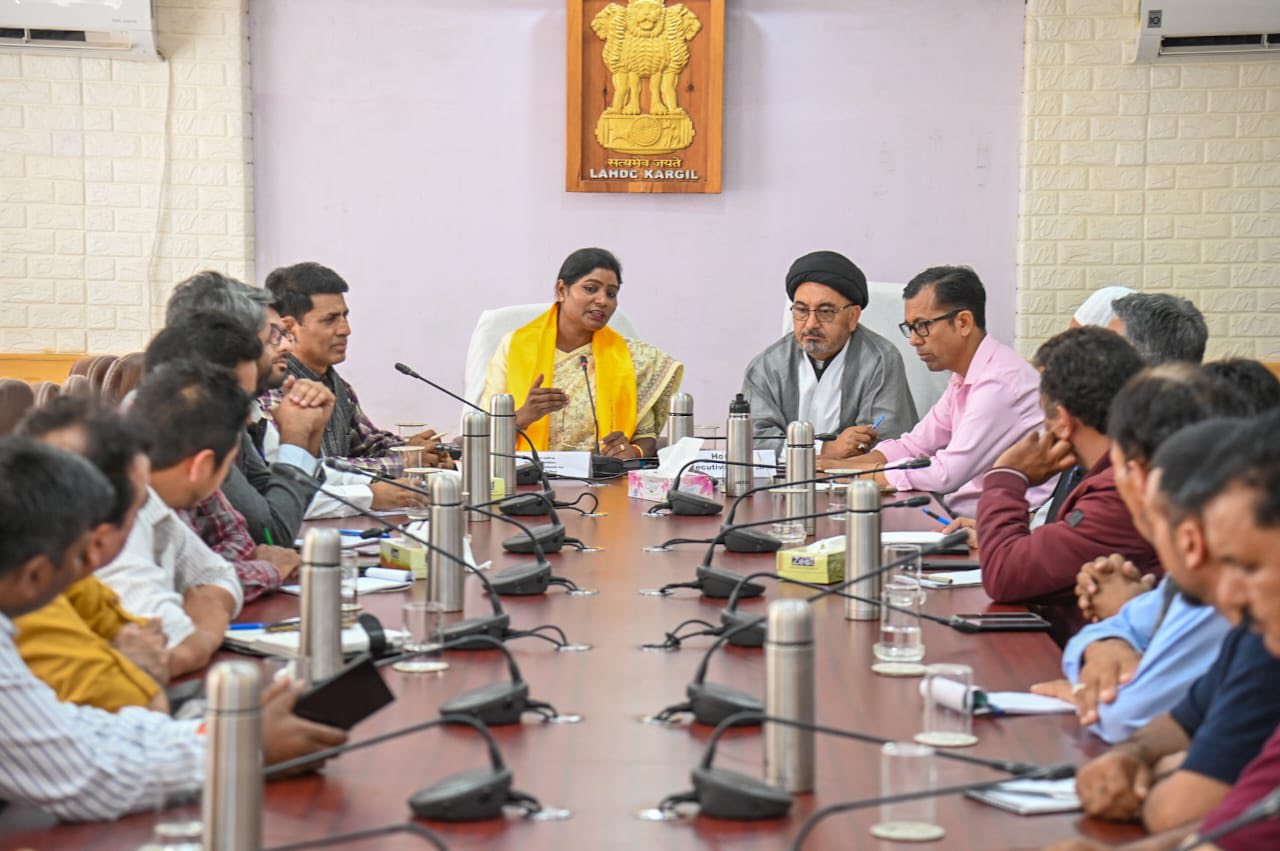
Kargil, Jun 28: A high-level meeting was convened on Friday between the Member of the National Commission for Scheduled Tribes (NCST), Dr Asha Lakra, and the Executive Councillors and Councillors of the Ladakh Autonomous Hill Development Council (LAHDC), Kargil.
During the interaction, LAHDC Kargil strongly reiterated the long-standing demand for the inclusion of Ladakh under the Sixth Schedule of the Indian Constitution, which would ensure greater constitutional and administrative safeguards for the region’s tribal communities.
The Council also urged the restoration of full autonomy to the LAHDCs in both Kargil and Leh, as envisaged in the original Hill Council Act.
The meeting, focused on critical issues concerning the tribal population and the broader aspirations of the people of Ladakh.
Among other key issues raised were the immediate implementation of the proposal to create five districts in Ladakh, which had been approved in principle, and a renewed demand for granting district status to the regions of Chiktan and Sankoo to improve administrative efficiency and local governance.
A significant portion of the meeting also focused on land disputes between civilians and the Indian Army, which continue to create tensions and require urgent resolution. The Council expressed concern over non operations of civilian flights in Kargil and urged to recommend it to the union government.
Executive Councillor for Rural Development and Zanskar Affairs, Shri Phunsok Tashi, and former EC Shri Aga Syed Mujtaba, were present at the meeting, along with several Councilors of LAHDC Kargil. They highlighted the pressing need for the effective implementation of welfare schemes across various departments, pointing out existing bottlenecks and lapses in execution and further raised issue of lapsable funds.
The Councilors also raised various grievances related to their areas regarding the implementation of schemes.
In response, the visiting NCST Member acknowledged the concerns raised and assured the Council that the Commission would take up the matter of Sixth Schedule inclusion and restoration of LAHDC autonomy with the Union Government. She also assured that all grievances and developmental demands presented by the Councilors would be documented and forwarded to the concerned ministries for redressal.
The meeting marked an important step in bringing tribal and regional concerns of Kargil to the national forefront, and the Member assured continued engagement with the stakeholders in Ladakh.
The other day Dr Asha Lakra, Member of the National Commission for Scheduled Tribes (NCST), chaired a key meeting at the Conference Hall, Baroo, to review the implementation of welfare programmes and centrally sponsored schemes for Scheduled Tribes in the Kargil district.
The meeting was attended by Deputy Commissioner and CEO, LAHDC Kargil, Rakesh Kumar (IAS); Senior Superintendent of Police, Shri Ram R.; Additional Deputy Commissioner Imteeaz Kacho; Joint Director Planning/Chief Planning Officer; SEs of I&FC, R&B, and Hydraulics; and sectoral heads and district officers from various departments.
Opening the meeting, Dr Lakra extended greetings to the people of Kargil on the occasion of Vijay Diwas. The Deputy Commissioner welcomed the dignitaries and provided a brief overview of Kargil’s demography, geography, and the facilities extended to its predominantly Scheduled Tribe population.
Sectoral heads delivered presentations on the status and progress of various welfare initiatives, including the Integrated Child Development Scheme, Mission Shakti, One Stop Centre, Beti Bachao Beti Padhao, Pradhan Mantri Awas Yojana, Swachh Bharat Mission, MGNREGA, Self Help Groups (SHGs), and the functioning of departments such as Agriculture, Horticulture, and Cooperatives.
Dr Lakra appreciated the efforts made in implementing these schemes and urged all departments to ensure better interdepartmental coordination to enhance delivery and impact. She emphasised the importance of active women participation across institutions such as the Police Women’s Cell, One Stop Centre, and Mission Shakti programmes.
Highlighting the role of SHGs in women’s empowerment and household economic improvement, Dr Lakra advised the development of a Sabzi Mandi in the district to provide market linkage for SHG produce. She also advised the setting up of a food processing unit to help SHGs add value to their goods and increase income generation.
In addition, Dr Lakra urged the district administration to ensure Scheduled Tribe students avail benefits under the Savitribai Phule Scholarship scheme.
To support aspirants of UPSC, SSC, and State Services, the Hon’ble Member directed the district administration to organise special coaching classes, enabling local youth to pursue careers in the civil services.
She instructed all departments to submit their concerns and issues in writing, enabling her office to escalate them to the relevant ministries in the Union Government for appropriate action.
