

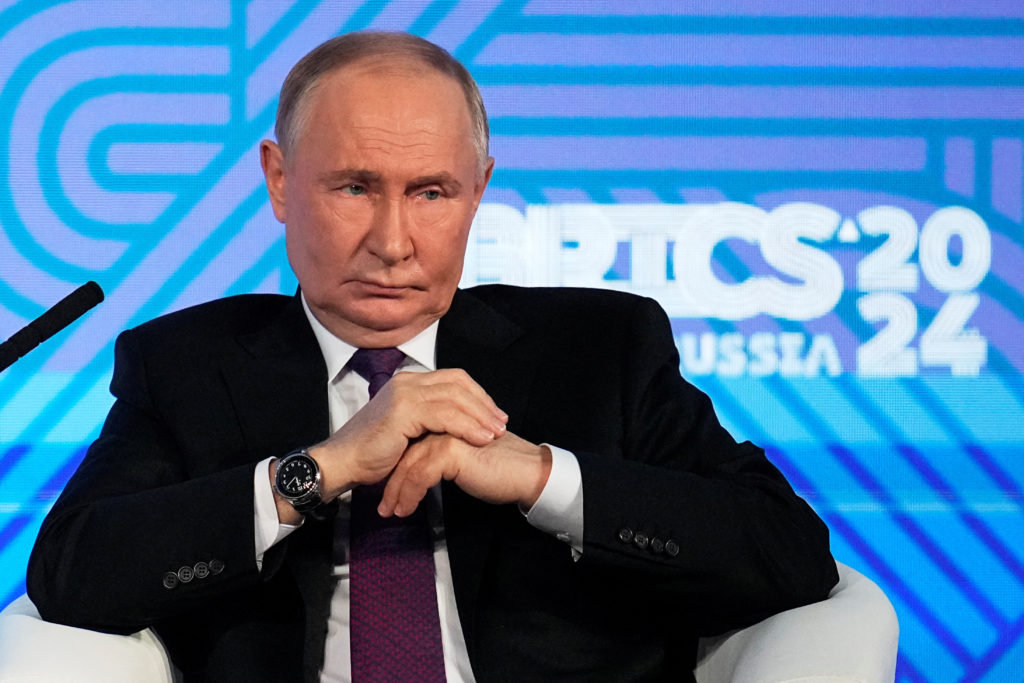
MOSCOW, Oct 2: Russian President Vladimir Putin has warned that the world is entering a prolonged period of instability and geopolitical uncertainty, while calling for the emergence of a more stable multipolar international order.
Addressing the plenary session of the Valdai Discussion Club, Putin described the current period as a “decisive turning point”, saying rapid developments in technology, artificial intelligence, climate, medicine, military science, demographics and the global economy were reshaping international relations.
He said technological advances offered major opportunities to improve living standards but also created new risks, including risks that could have consequences for humanity as a whole.
Putin also linked global developments to growing political tensions within individual countries, arguing that traditional political systems were struggling to adapt to changing social conditions.
He said internal instability could sometimes spill across national borders, further increasing international tensions. Putin predicted that geopolitical conflicts could continue as countries respond to major economic and strategic changes.
Calls For A Multipolar Global System
Putin said he expected the international system to gradually move away from what he described as Western hegemony towards a multipolar order.
He argued that the transition would be complex and could involve significant risks, but said countries should focus on reducing those risks and finding mechanisms for cooperation.
According to Putin, existing international institutions and mechanisms for balancing the interests of states were no longer fully effective in dealing with the changed global environment.
He called for reforms to the United Nations, saying greater roles should be given to countries from Asia, Africa, Latin America and the Middle East to reflect changes in the global balance of power.
Putin said UN reform should involve more than expanding the Security Council and should also address the organisation’s priorities in response to emerging global challenges.
AI And Emerging Technologies
The Russian president devoted considerable attention to artificial intelligence and other technological developments, saying they raised social, cultural and humanitarian questions that were not present when many existing international institutions were created.
He warned against what he described as uncontrolled use of AI in areas affecting human values and cultural development, and also raised concerns about biotechnology and genetic engineering.
Putin called for international cooperation to address what he described as complex and potentially far-reaching questions surrounding emerging technologies.
He also pointed to organisations such as BRICS and other regional groupings as part of the changing international landscape, while acknowledging that building a new global system would be a lengthy process.
Putin Reiterates Russia’s Position On Ukraine
Addressing the Ukraine conflict, Putin repeated Russia’s position that Moscow did not initiate the confrontation and said Russia had been forced to respond militarily.
He accused Ukraine and NATO of pursuing policies that threatened Russia and alleged that Western countries had supported political changes in Kyiv and supplied weapons to Ukraine. These are Russian government claims that are disputed by Ukraine and Western governments.
Putin said Moscow remained interested in peace and cooperation but acknowledged that rebuilding trust between countries would be difficult.
He argued that a new international equilibrium would ultimately require compromises and greater accommodation of the interests of different countries.
Warning Over Uncertain Transition
Putin said the transition towards a new international system could be unpredictable and involve “unexpected twists and turns”, including dangerous developments.
He also criticised what he described as increasing reliance on the principle that power determines international outcomes, arguing that moral standards and commitments remained important for global stability.
Reflecting on the collapse of the Soviet Union, Putin attributed it primarily to internal problems and what he described as mistakes by successive generations of Soviet leadership.
He said the experience demonstrated the importance of considering the long-term consequences of political decisions.
Putin concluded by stressing that responsibility for the future of humanity required practical efforts to prevent current global tensions and technological developments from producing catastrophic outcomes.
