

Winter Session commences on high note with 13 Bills listed
Lauds Radhakrishan’s journey from humble beginnings to public service
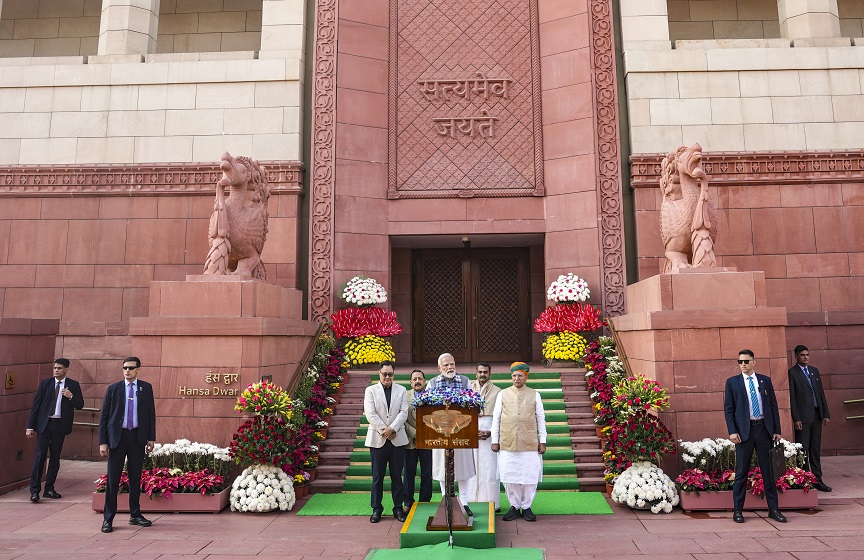
NEW DELHI: Parliament is not a place for drama but for delivery, Prime Minister Narendra Modi said on Monday in a hard-hitting attack on the Opposition as he accused it of turning the House into a “warm-up arena” for elections and an outlet to vent out frustration after defeat.
Speaking to reporters outside Parliament ahead of the start of the Winter session, he said the House must not become a stage for political theatrics but a platform for constructive and result-driven debate, and offered to give the opposition tips to bring positivity in politics.
“There is plenty of room for drama; those who want to do it, keep doing it. Parliament is not a place for drama; it is a place for delivery,” the prime minister said, targeting the Opposition for stalling parliamentary proceedings during the previous sessions.
“Even for raising slogans, you can do so across the country. You have spoken where you have been defeated. You can also speak where you are yet to face defeat. But in Parliament, the focus should be on policy, not slogans,” Modi, buoyed by the landslide victory of the NDA in recent Bihar polls, said in a swipe at opposition parties, while urging lawmakers to work with a sense of responsibility.
The Monsoon session of Parliament was virtually washed out over the Opposition’s protests on Special Intensive Revision (SIR) of electoral rolls in Bihar.
The Winter Session of Parliament began in the Lok Sabha with the government placing 13 Bills on its legislative agenda, including several that have not been reviewed by any Standing Committee.
Officials said the Business Advisory Committee has already allocated time for major Bills and scheduled discussions.
Key proposals lined up for the session include the Atomic Energy Bill, 2025, the Higher Education Commission of India Bill, amendments to National Highways and Corporate Laws, and the Securities Markets Code Bill, 2025.
Two Bills pending from the previous session are also expected to be taken up. However, the Opposition has demanded that Parliament hold a detailed discussion on the Special Intensive Revision (SIR) of electoral rolls being carried out across 12 states and Union Territories.
Opposition parties have also threatened to stall the Winter session of Parliament over the SIR exercise in nine states and three Union territories if the issue is not discussed in Parliament.
“For some time now, our Parliament is being used either as a warm-up arena for elections or as an outlet for frustration after defeat,” Modi said.
Referring to the drubbing of opposition parties in the Bihar polls, he said they were perturbed by the electoral loss and unable to digest failure.
“Defeat should not be the ground to create disruption. Victory should not convert into arrogance either,” the prime minister said.
Highlighting the importance of informed debate, Modi urged members to offer constructive and accurate critiques where needed, so that citizens are better informed. “This work is demanding, but it is essential for the nation,” he said.
The prime minister cautioned political parties against allowing frustration over electoral defeats to overshadow parliamentary proceedings.
“The Winter Session must reflect balance, responsibility and the dignity expected from public representatives,” he said.
The record turnout witnessed in the Bihar elections is the biggest strength of democracy, he said, adding the Opposition too should fulfil its responsibility and come out of its “depression” after the loss in elections.
The prime minister said the game the Opposition has been playing for the last 10 years is no longer acceptable to the people. “They should change their strategy – I am ready to give them a few tips,” Modi said.
He urged all parties to recognise the purpose of Parliament and “come out of the frustration of defeat”.
Prime Minister Modi added that he had heard statements of leaders of certain opposition parties that suggest their inability to accept electoral outcomes.
“There are one or two parties that are unable to accept their defeat. From the statements I heard yesterday, it seems that the loss has deeply troubled them,” he said.
The prime minister also stressed that opportunities should be given to the new generation of Members of Parliament. “The House should benefit from their experiences, and through this House, the nation should also gain from their fresh perspective,” Modi said.
The PM praised newly appointed Rajya Sabha Chairman CP Radhakrishnan, highlighting his rise from a modest, farmer-background family to a key constitutional position as a testament to the strength of Indian democracy.
Speaking in the Rajya Sabha, Modi said Radhakrishnan’s life has been marked by unwavering dedication to social service, noting that political office has been only one aspect of his public contribution.
“His journey inspires all who seek to serve society,” he said.
In September, Chandrapuram Ponnusami (CP) Radhakrishnan was elected as India’s 15th Vice President, a post that made him the ex officio chairman of the Rajya Sabha.
Modi was speaking at his felicitation at the start of the winter session of Parliament, the first session that Radhakrishnan is presiding over as the chairman of the Upper House.
The Prime Minister recounted his exemplary tenure across various roles, including Governor of multiple states and Lieutenant Governor of Puducherry, where he worked closely with local communities, often defying protocol to ensure outreach.
He also cited two incidents from his early life – surviving a childhood near-drowning and a bomb blast in Coimbatore – which shaped his commitment to public service.
Modi highlighted Radhakrishnan’s personal values, including his spiritual resolve inspired during a visit to Varanasi, his youth leadership, and his steadfast stand for democracy during the Emergency. “He has always chosen the path of struggle over the easy way, motivating generations of young citizens”.
The Prime Minister expressed confidence that under his leadership, Rajya Sabha members would uphold the dignity and prestige of the House while contributing to the nation’s progress.
He said Radhakrishan’s life has been rooted in social service, with politics being only one facet.
“From his youth to today, he has remained committed to serving society. His journey from an ordinary family to this position inspires all who wish to contribute to public life,” he noted.
Recalling his tenure in various constitutional roles, Modi said, “Whether as Governor in Jharkhand, Maharashtra, Telangana, or Lieutenant Governor of Puducherry, he built close connections with local communities. In Jharkhand, he regularly visited villages and engaged with tribal communities, often ignoring protocol and logistics to ensure outreach”.
The Prime Minister shared two significant incidents from his life that shaped his public service ethos. “As a child, he narrowly survived a near-drowning incident at Avinashi temple pond. Later, he narrowly escaped a bomb blast in Coimbatore targeting LK Advani’s yatra, which killed 60-70 people. He transformed these experiences into a lifelong commitment to serving society.”
He also recounted a personal anecdote from Varanasi: “During his first visit to Kashi, he decided to give up non-vegetarian food after receiving the blessings of Maa Ganga. This reflects his spiritual resolve and capacity for self-transformation, which inspires others”.
Highlighting Radhakrishan’s early leadership qualities, Modi said, “From his student days, he demonstrated leadership and organisational skills. During the Emergency, he did not choose the easy path but stood as a soldier of democracy, participating in programmes for public awareness and mobilisation”.
He also appreciated his approach to protocol and public life.
“Often, people in high office get bound by protocol. But, he has always rose above constraints of protocol. His life shows the power of a public servant unbound by formalities,” he said, adding that though Radhakrishnan was born in “Dollar City”, he chose to focus on the welfare of those who belonged to oppressed, marginalised, or underserved communities.
On his organisational abilities, Modi noted, “Whatever responsibility was entrusted to him, he executed it with excellence. He has always worked to bring people together, welcomed new ideas, and created opportunities for the next generation”.
“His long experience in public life, combined with integrity, service, and patience, will guide this House. I am confident that under his leadership, the Rajya Sabha will uphold its dignity and continue to play a pivotal role in India’s progress,” he said.
