

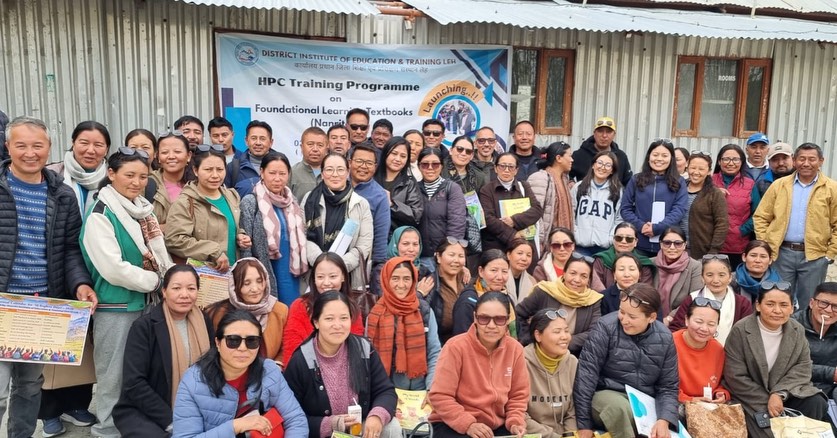
Durbuk, Apr 05: The District Institute of Education & Training (DIET), Leh has concluded a two-day Holistic Progress Card (HPC) training programme across Nyoma, Nubra and Durbuk zones, with over 220 teachers participating in an initiative aimed at strengthening foundational learning in line with the National Education Policy (NEP) 2020.
The programme, held on April 3 and 4, saw the participation of 71 teachers from Nyoma, 87 from Nubra, and 65 from Durbuk. The training primarily focused on educators teaching Balvatika to Grade 2, targeting early childhood education and foundational literacy and numeracy.
Officials said the initiative was organised jointly by DIET Leh and the respective Zonal Education Offices, with support from the Chief Education Office. The sessions were designed to enhance teacher capacity, refine classroom practices, and promote competency-based teaching methods aligned with the goals outlined under NEP 2020.
The Holistic Progress Card framework, introduced as part of the national policy, emphasises continuous and comprehensive assessment of students beyond conventional examination systems. The training programme aimed to familiarise teachers with this approach, enabling them to better track and support student development in foundational stages.
Participants engaged in interactive sessions that addressed practical classroom challenges and explored methods to integrate assessment with everyday teaching. The emphasis remained on improving learning outcomes through activity-based and child-centric approaches.
Education officials noted that the response from teachers across the three zones reflected a growing focus on strengthening early learning systems in Ladakh. The participation levels, particularly from educators handling lower grades, were seen as central to ensuring that policy reforms translate into measurable improvements at the school level.
The completion of the training programme marks a continued push by DIET Leh and local education authorities to align teaching practices with national standards, while addressing the specific needs of schools in remote and high-altitude regions of the Union Territory.
