

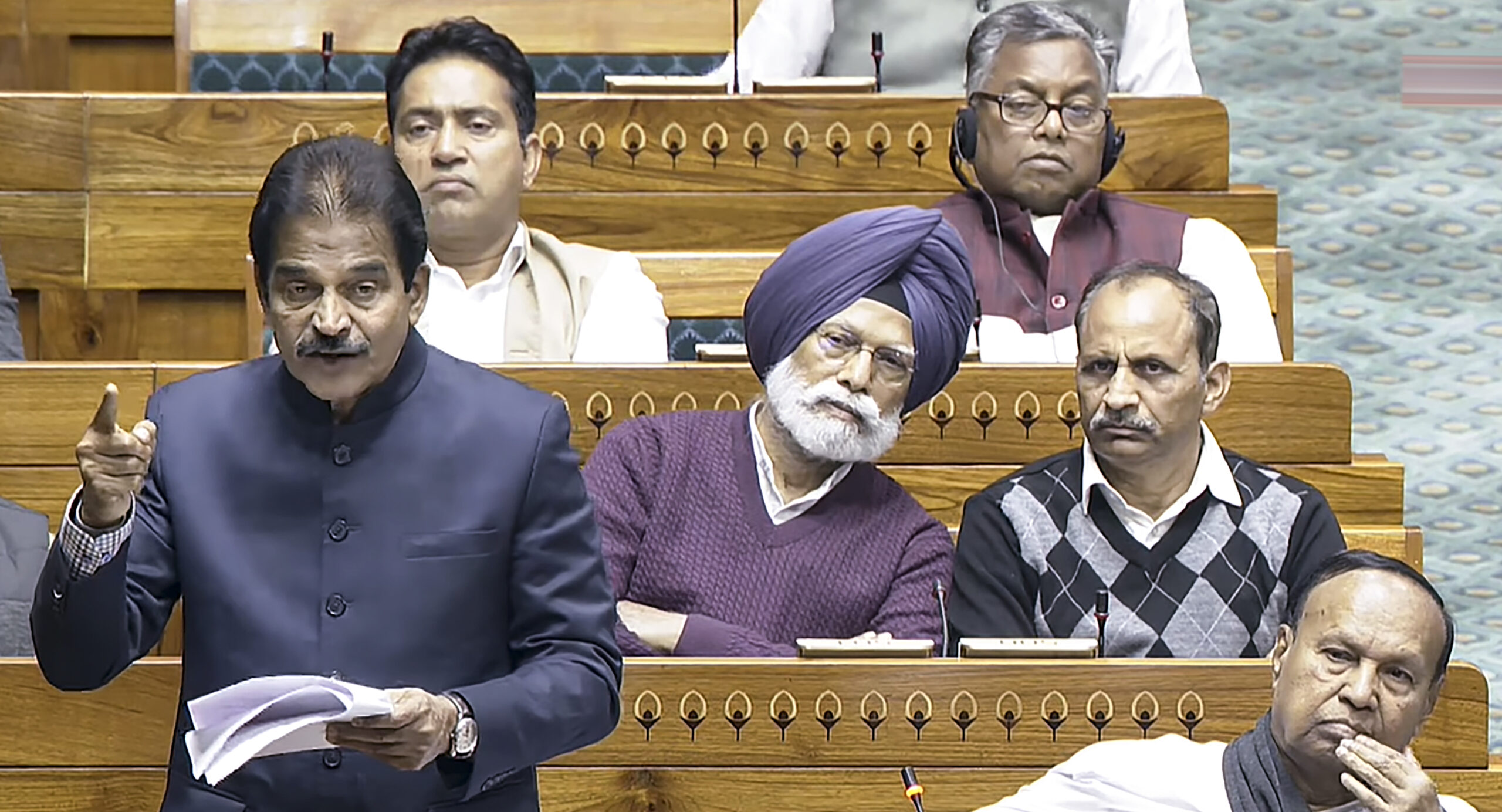
New Delhi, Dec 15: Opposition members in the Rajya Sabha on Monday strongly pitched for comprehensive reforms in the anti-defection law, stressing that frequent defections undermine the people’s mandate and raise serious questions about the sanctity of elections.
Taking part in a discussion on election reforms, BRS member K.R. Suresh Reddy and CPI(M) MP John Brittas said that failing to honour promises made in election manifestos amounts to “cheating the voter,” while large-scale defections dilute democratic values.
“The biggest challenge that Indian democracy continues to face, despite two major constitutional amendments, is defection,” Reddy said, adding that the problem has only worsened over the years.
He underlined that democracy does not end with casting a vote. “We have to respect the voter. What we are seeing today is that once elections are over, the real drama begins,” he remarked, pointing to post-poll defections and political manoeuvring.
Calling defection “the name of the game,” especially in smaller states with fewer legislators, Reddy said his party, the Bharat Rashtra Samithi (BRS), has consistently demanded stronger anti-defection measures. He proposed the formation of a dedicated parliamentary committee to closely monitor defection trends and suggest corrective steps.
“To make the anti-defection law watertight, why not have a committee that constantly examines how defections are evolving and how they can be curbed?” he asked. He also questioned the increasing judicial intervention in such matters, noting that the Supreme Court has often been compelled to step in.
“Why should courts, already overburdened, be drawn into an area that is purely within the parliamentary domain?” Reddy said.
He further criticised legislators who defect after being elected on a party’s manifesto. “Promising the sky in the election manifesto and delivering nothing is literally cheating the voter. In my opinion, that is the real ‘vote chori’,” he said.
Echoing similar concerns, CPI(M) leader John Brittas said the people’s mandate must be respected even after elections conclude. “When horse-trading happens, when mass defections occur, when resorts become sanctum sanctorum, the purity of elections is seriously compromised,” he observed.
Brittas noted that while the anti-defection law earlier curbed individual defections, it has failed to prevent “wholesale defections” in recent times.
Responding to the Opposition’s demands, JD(U) MP Sanjay Kumar Jha recalled the February 2005 Bihar Assembly elections, which resulted in a hung House. He alleged that despite Nitish Kumar having the numbers to form a government, the then UPA government at the Centre imposed President’s rule through a late-night Cabinet meeting.
“No MLA could take oath. Even today, they are not considered former MLAs but are called ‘abhutpurv MLAs’ because they never took oath,” Jha said. He added that despite winning the election, the Congress-led government’s decision deprived elected representatives of assuming office.
The debate highlighted growing concerns across party lines over electoral integrity, defections, and the urgent need to strengthen democratic institutions to uphold the will of the voters.
