

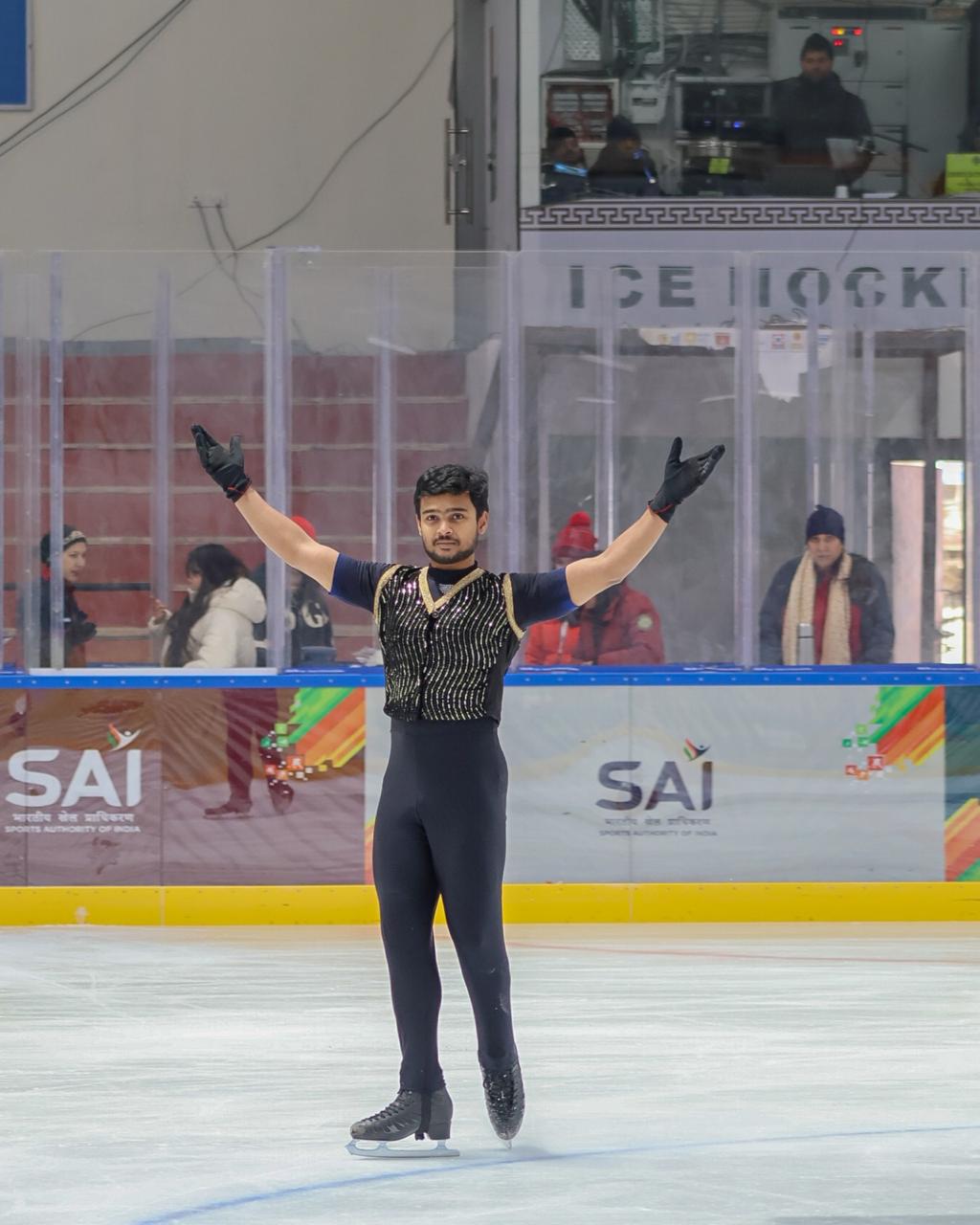
Leh, Jan 24: When figure skating found a place for the first time at the Khelo India Winter Games 2026, the moment carried meaning beyond a new event being added to the schedule. It marked the opening of a long-awaited national window for a sport that has largely lived on the margins in India. At the centre of that moment stood Abhijith Amal Raj of Kerala, who claimed the gold medal in the men’s advanced category and, in the process, completed a rare homecoming to the ice.
For Abhijith, the gold in Leh was not just another addition to an already crowded medal cabinet. It was his return to competitive ice figure skating after nearly a decade, and that too on Indian soil. Known internationally as a world champion in artistic roller skating, Abhijith’s appearance at the Khelo India Winter Games carried a different weight — one of continuity, perseverance and quiet purpose.
The 24-year-old is among India’s most decorated skaters. He won gold at the World Roller Skating Championship in 2019, followed by Asian Roller Skating Championship titles in 2023 and 2025, and the World Skate Oceania and Pacific Cup in 2023. Yet, his journey in skating began much earlier and, unusually for a boy from coastal Kerala, on ice.
Abhijith first stepped onto skates before he could speak properly. Formal training began at the age of three. In a state with no ice rinks and limited exposure to winter sports, figure skating was always an uphill pursuit. Equipment, coaching and access came at a cost few families could sustain. His father chose to invest everything into his son’s training, turning talent into a test of endurance.
By the age of nine, Abhijith was training under Arjuna awardee Anup Kumar Yama. Later came advanced coaching under 11-time artistic roller skating world champion Luca d’Alisera. That phase required frequent travel to Italy, with training costing around 100 euros an hour for four hours a day. Monthly expenses ran into lakhs. To keep the dream alive, the family sold property and moved into rented accommodation. Government support arrived much later; the early years were shaped by personal sacrifice rather than institutional backing.
Before his rise in roller skating, Abhijith had already made his mark on ice. In 2014, he won gold at the Asian Open Figure Skating Trophy in Taiwan, the Dubai Golden Cup and the Malaysian Open National Championship, along with national titles in 2013 and 2014. Another international gold followed in Malaysia in 2016. Soon after, limited opportunities at home pushed him to focus fully on roller skating, where he went on to reach the top of the world podium.
His victory at the Khelo India Winter Games 2026 therefore marked a full circle — a return to ice skating at a time when the sport has finally found a national platform in India.
Abhijith’s story mirrors the wider struggle of niche sports like figure skating in the country. For years, serious progress meant travelling abroad for rinks, coaching and competition exposure — an option out of reach for most families. Determined to change that path for others, Abhijith has taken on the role of mentor and builder alongside his competitive career.
Along with his skating partner Vacasya Lakshmi Narayanan, gold medallist in Artistic Partner event at the Asian Roller Skating Championship 2025, he co-founded Adler Vision, a figure skating academy operating in Kerala and Tamil Nadu. In just two years, the academy has enrolled over 100 students from across the country.
International coaches such as Luca d’Alisera and Italy’s Rachele Campagnol have been brought in to train young skaters in India itself. The focus begins with roller skating, with a structured pathway towards both roller and ice figure skating, keeping national competitions like Khelo India firmly in sight.
“We start with roller skating, and based on a skater’s interest and performance, they can move into ice skating or continue to excel in roller skating,” Abhijith said.
“Our skaters have already competed in several state and national-level events. With platforms like Khelo India, we plan to send select skaters to upcoming ice skating championships.”
Abhijith, who was recruited by the Income Tax Department of Maharashtra under the sports quota in 2024, sees the Khelo India Winter Games as more than a medal stage. He describes it as a “prestigious championship” and says his presence in Ladakh was meant to inspire young skaters back home.
With figure skating introduced for the first time, the sixth edition of the Khelo India Winter Games featured 23 skaters from eight states. Haryana led participation with eight skaters, followed by Andhra Pradesh and Uttarakhand with four each. For a winter sport in a largely tropical country, it is a modest but promising beginning.
As the ice melts in Leh, Abhijith Amal Raj leaves behind more than a gold medal. His return signals the possibility of continuity — that Indian figure skating, once forced to look outward, may finally begin to grow at home.
