

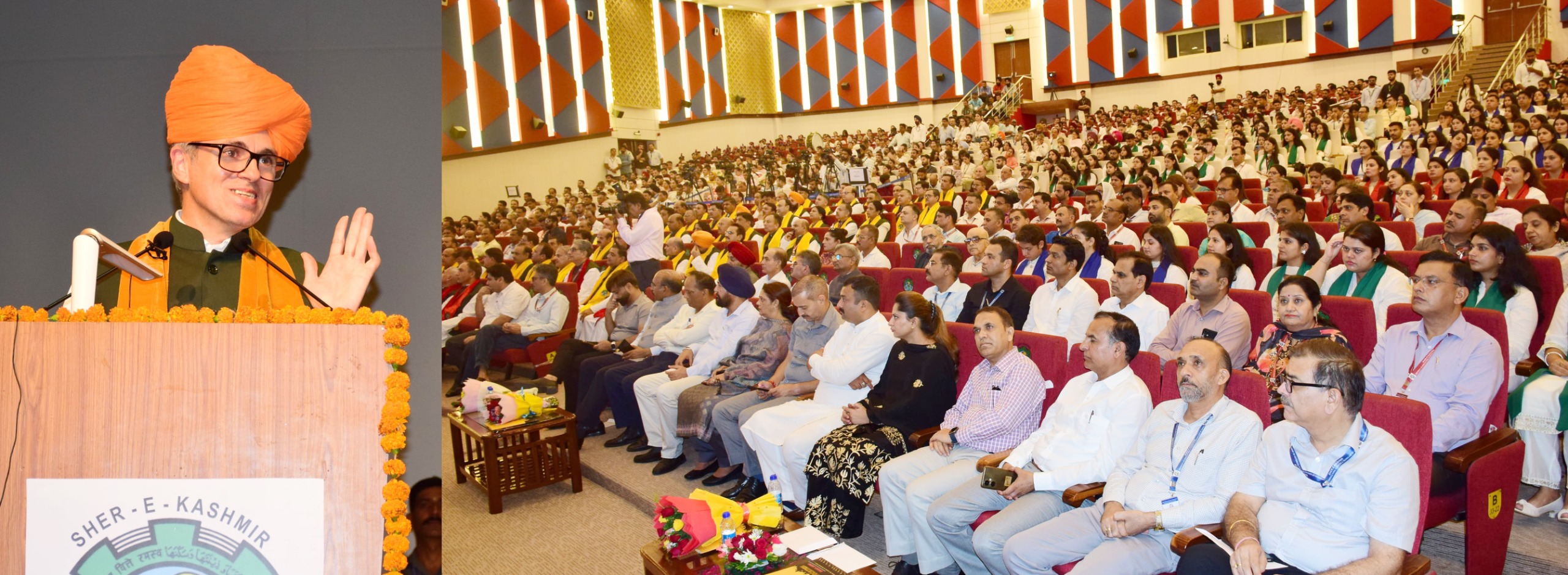
Jammu, Aug 04: Chief Minister Omar Abdullah praised agricultural scientists, faculty, and students for driving innovation, urging farmer-focused research to foster a self-reliant Jammu and Kashmir.
Speaking at SKUAST’s 9th convocation, he celebrated female students’ remarkable achievements, securing 252 of 446 degrees, seven of eight gold medals, and 32 of 35 merit certificates.
“It’s a joy to see girls excelling in agri-education and research,” he said, noting the shift from a time when girls were underrepresented in the field.
Abdullah emphasized that agriculture is no longer a male-dominated domain, with women carving out their place through hard work, earning enthusiastic applause.
Highlighting the importance of agriculture and allied sectors, he said this is an area which has a rich potential and needs a focussed attention from the government and the academia to build self-reliant Jammu and Kashmir with farmer-centric research.
“This sector is the most important part of our economy. In terms of visibility, tourism is seen as more important while industry also gets a lot of attention. But if you look at the GDP of J-K as a state, as a territory, agriculture and allied sectors far exceed anything else that contributes to the economy of the J-K,” Abdullah said.
The chief minister said new technologies, innovations, new ideas and new government policies like the holistic agriculture program of J-K or sending money directly into the bank accounts of farmers by the union government, insurance cover for failed crops provide an opportunity in this sector.
However, he said, this sector is also fraught with risks and dangers. “The land is becoming more and more scarce and climate change is also a reality.”
Abdullah said there was a time in Jammu and Kashmir when the locals would not have thought that they could face water scarcity.
“There was a time when we thought that water will always remain, we will always use it but there will never be a shortage of water or draught like situation. This has changed as we face water shortage and we have to see what we can do to modify the way we grow, to try and conserve our limited resource,” he said.
He also talked about excessive dependence on chemicals and agricultural fertilizers and said the world is moving more towards organic crops, the crops that do not have an adverse effect on the health of the people.
Congratulating the students who have received their degrees and medals, the chief minister said looking at so many young, bright and enthusiastic future agricultural professionals going out into the world would be of great help to the society.
“Some of you will join government service, some private sector and perhaps some will work for themselves. But in all this, I hope that you will hold true to your teachings,” he said.
Later in the day, Abdullah conducted an extensive inspection of the Tawi Riverfront Development Project.
A flagship initiative under the Jammu Smart City Limited (JSCL), the project aims to revitalise the banks of the river by integrating flood protection with recreational and commercial infrastructure to create a dynamic urban space.
The chief minister reviewed the progress of civil works under Phase-I of the project, which spans from Bhagwati Nagar Barrage to Bikram Chowk Bridge.
He was informed that more than 97 per cent of work under Part-A, which includes the construction component of Phase-I, has been completed, while the target for full completion is set for September, they said.
During the inspection, Abdullah reviewed key features of the project, including the development of multi-tiered promenades along both banks of the river and a central island, construction of flood mitigation infrastructure such as diaphragm and retaining walls, pier protection measures on existing bridges, creation of a central business and recreational zone and installation of interceptor drains to divert polluted nullahs away from the river.
The chief minister was briefed that under Part-A, a total embankment length of 2.70 km is being developed, incorporating four promenades of varying widths and reclaiming around 23 hectares of land, the official said.
He said the Part-B of the project will include finishing works such as construction of connecting roads, food courts, viaducts, toilet blocks, horticulture and promenade flooring.
The chief minister expressed satisfaction with the pace of execution and stressed the importance of its timely completion.
“The project is not solely about urban beautification but about shaping a new identity for Jammu centred on the historic Tawi River,” Abdullah said.
He said the initiative will serve both ecological and economic objectives.
He also highlighted the potential of the project to enhance tourism, generate employment and provide sustainable commercial real estate options, including green buildings, parks, sports zones and cultural plazas.
The chief minister reviewed the monetisation strategy being prepared by the CBRE, a commercial real estate and investment services firm, which will support the extension of the riverfront development from Tawi Bridge to Sidhra Bridge in future phases.
Abdullah appreciated the coordinated efforts of the JSCL, the Jammu Municipal Corporation and the Jal Shakti Department and directed the concerned officials to maintain strict adherence to quality and timelines while ensuring sustainability and public convenience throughout the execution of the project.
